Nearly coinciding with the country’s 250th anniversary, this is Query the Past’s 250th blog post. Thank you for reading.
Léon Ducharme said to me, “Madam, you must only take the clothing you need for yourself and your children, give us the keys, and leave; we are here to take possession of this house, it belongs to us.” I answered, “Where should I go, on these roads, perilous as they are; an unaccompanied woman, with four children . . . ?”
The year was 1837 and state authority had disintegrated in Lower Canada.
Led by Ducharme, more than sixty armed men had entered the home and stores of Jean Baptiste Casavant in Saint-Césaire. The master being away, they proposed to expel his wife, Marie Victoire Boucher, and their children. Relenting at last, Ducharme and his accomplices confined Boucher and the children to a bedroom. They sacked the house and stores, which fed the improvised garrison. The occupation likely continued for more than a week, that is, until approaching troops brought a semblance of order to the parish.
Alongside “la Conquête” and the Quiet Revolution, the Rebellions of 1837 and 1838 occupy an enviable place in Quebec’s historical imagination. Their continued relevance is maintained by the Journée nationale des Patriotes (a statutory holiday), the Maison nationale des Patriotes in Saint-Denis, such films as Quand je serai parti… vous vivrez encore and 15 février 1839, frequent mention in the press, and works of popular history. Many Quebeckers can name the main battles of Lower Canada’s insurrections and the leading figures of the conflict. Historical awareness is buttressed by a nationalistic lens focused on diametrically opposed camps: “l’envahisseur anglais” and a protest movement representing the French-Canadian majority.
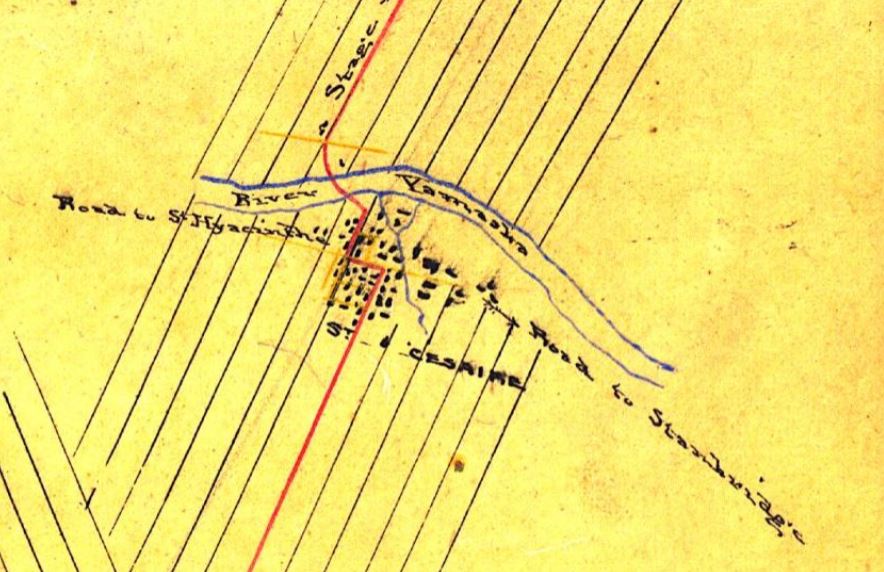
Scholarly research has brought nuance to this narrative and helped transcend a story that has long revolved around high politics, hero worship, and national identity. However, the breakdown of law and order, political escalation, and the exaction of popular justice by ordinary people like Léon Ducharme remains nebulous outside of the main theaters of the Rebellions. In Montreal’s hinterland, the focus on military engagements at Saint-Denis, Saint-Charles, and Saint-Eustache conceals a civil war that played out with various inflections in different communities.
Whatever their deeply-held beliefs, residents of many parishes were caught between two factions and had to bend to the prevailing winds—which could shift rapidly. In the process, they faced the risk of retaliation at the hands of their neighbors, both loyal and Patriote. The course of events in Saint-Césaire makes these threats amply clear.
The Casavant family was not alone in facing the whims and wrath of the mob. Magistrate and merchant William Chaffers was forced to flee; his house and stores were also occupied. Insurgents attacked civilian homes and compelled, under threat of greater violence, local office holders to surrender their commissions. No longer were there justices of the peace, sheriffs, bailiffs, or militia. Neither people nor property were safe.
* * *
Twenty years ago, Louis-Georges Harvey hired me as a summer research assistant to collect Rebellion-era pamphlets and index Montreal Gazette articles with political content. Over the course of three summers, I saw nearly every issue of the Gazette published from 1792 to 1838. The experience helped inform my thinking about the Rebellions. We couldn’t dismiss the Gazette as a pro-British, Tory rag without erasing half of the story of political struggle that exploded in violence in 1837.

That was then. I did not expect to return to the topic nearly two decades later, least of all through genealogy. But, as it happens, my Lacroix ancestors lived in Saint-Césaire before and after the Rebellions, and I wanted to know something of their experiences and allegiances.
I found them in Saint-Césaire when a stepson married in January 1837. Exactly three years later, they were in the overwhelmingly English-speaking and Protestant Township of Brome. A winter move being unlikely, they must have left Saint-Césaire in 1839 or 1838. Whether this was a purely economic move or the product of unwelcome political opinions is still an open question… but, had they been displaced Patriotes, Brome would have been a most unlikely refuge.
In trying to reassemble the genealogical puzzle, I came across a small mountain of affidavits, depositions, letters, and reports about the situation in Saint-Césaire—all documents that provide an on-the-ground view of conflict in the rural Yamaska parish.
Order was lost, reconstituted, and restored. Allegiances shifted quickly. There were meetings, kangaroo courts, disguises, pillaging, knocks in the night, and threats of assassination. As eruptions of violence often are, this was a messy situation. Reprisals for past wrongs occurred as Patriote sympathizers asserted their power in November 1837. As the political and military winds shifted, these insurgents’ targets—French and English—testified against their oppressors. Most of the ringleaders would benefit from Lord Durham’s amnesty. Toussaint Goddu, who had led a column of men to the Richelieu in the wake of Saint-Denis, was sent to Bermuda.
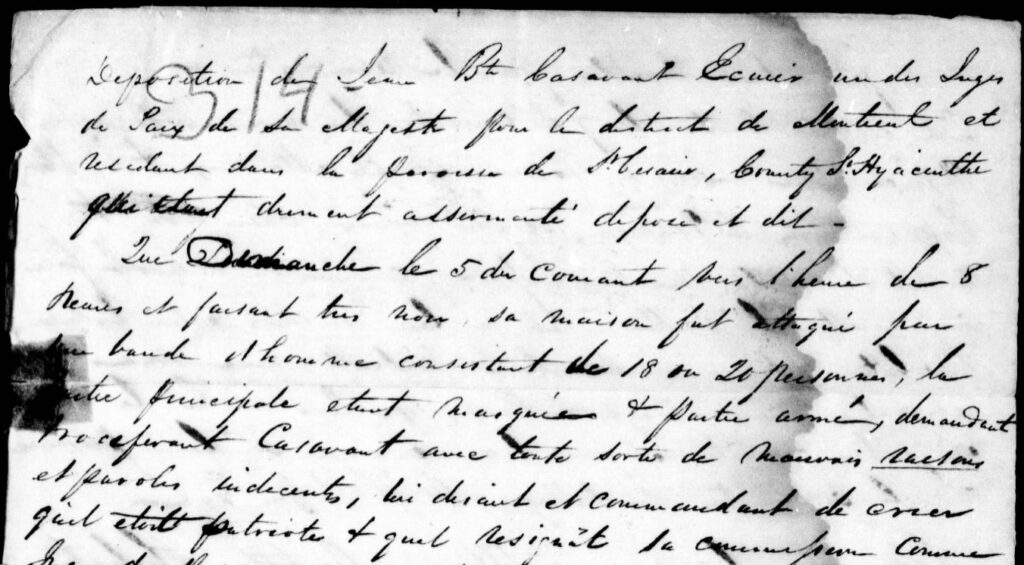
Goddu’s mission was an exception, and a late one: the concerns of the Saint-Césaire Patriotes were intensely local and they acted in their own community. This is not to say that they were unsophisticated or that they held no higher political aspirations. Rather, they confronted power and oppression as they knew them, that is, in the form of office holders, merchants, and notables who had made themselves disagreeable often socially and economically.
As I recently noted on social media, the Patriotes of 1837-1838 have become holy blissful martyrs in Quebec’s collective memory. In the popular imagination, they are as cartoonish as their political counterparts and rivals.
With renewed attention to mob rule and rural violence, my recently published article on the Rebellions may, in a very small way, restore some of their humanity to each side. The article is available online to Histoire sociale/Social History subscribers.
Further Reading
I have previously studied the Rebellion era in two peer-reviewed. A piece in the International History Review provides a new glimpse of the cross-border Patriot War of the late 1830s. In an article in the American Review of Canadian Studies, I place the Rebellions’ political refugees in the larger arc of early migrations from Lower Canada.
On this blog, see a brief overview of the Rebellions’ fall-out and a glimpse of the little-known Ogden Report.
Patrick, je pense que ton article est un sale torchon…
It’s a “White-washing” attempt to wash off the blood on “Red Coats” hands and smear it on my ancestors back…
Writing about Quebec History through “The Gazette” POV is just plain deceitful… That journal was and is still the worst racist Imperialist anglo-colonialist piece of shit paper the world has ever known…
This ain’t no serious historical material… Writing about Quebec through that lens is the same as writing about Jews while getting all your info reading “Der Stürmer”…
You can do better than that.
J’ai hésité à faire paraître ce commentaire et à y répondre. Or, osant croire à la bonne foi de mes lecteurs et lectrices, je saisis l’occasion d’éclaircir mon propos.
Il est bien possible que mes articles soient de sales torchons. Il pourrait même y avoir un consensus à ce sujet. Il est aussi possible que je sois capable d’écrire un meilleur article.
Cependant :
Vous avez lu un billet de blogue qui résume un article de profondeur publié dans une revue savante (évaluée anonymement par des pair.e.s). Voilà souvent ce qui se passe au Québec : on voit The Gazette et on crie au meurtre. L’article paru dans Histoire sociale/Social History ne cite aucunement The Gazette. Or, même si c’était le cas, le journal demeure une source d’époque utile qu’il faut aborder de manière critique, tout comme on aborderait The Vindicator ou La Minerve de manière critique. C’est ce qu’on appelle faire de l’histoire.
Je persiste : The Gazette renferme effectivement une tranche importante de l’histoire des Rébellions. On ne peut comprendre la conflagration politique et militaire des années 1830 sans savoir quelque chose du camp loyal (ou bureaucrate, ou tory, comme vous voudrez). Le but du projet de recherche auquel j’ai participé n’était pas de régurgiter mot pour mot le point de vue de ce camp, mais de comprendre les revendications incompatibles qui ont mené au conflit.
Les Britanniques ne reçoivent pas de « blank check » dans mes travaux. D’ailleurs, les suites immédiates des Rébellions sont bien documentées. La littérature savante a peu touché aux formes de violence déployées par les Patriotes et mon article vise à mieux les comprendre à partir des documents d’époque. Doit-on prétendre que cette violence n’a pas existée parce que les insurgés ont par la suite été incarcérés ou poussés à l’exil, ou ont perdu leurs granges? On peut ne pas aimer le passé; le passé demeure.
Votre réaction me confirme qu’au Québec, les Patriotes demeurent pour bien des gens de saints martyrs. Okay, c’est une opinion. Mais il faut départir la mémoire de l’histoire. Durham n’a pas besoin de défenseurs; Papineau, pas plus. À mon avis, en tant qu’historien, ce dont nous avons besoin, c’est d’abord de s’entendre sur les faits.
Je laisse votre comparaison entre The Gazette et la Shoah sans commentaire. Je vous envoie l’expression de salutations (mais aussi de mes torchons, si vous y croyez vraiment) les plus distingués.
Now I REALLY want to know more about this business. I tried to access your articles online, but there’s a paywall. You don’t happen to have author’s copies that you make accessible, do you?
Yamaska caught my eye. Yikes, but I have a lot of ancestors there in the mid-1800s. Including a Bourgeois branch. Which is on my “what happened to Acadians after Acadia” list. Which leads me to wonder about the ongoing getting caught between rival dominant powers, even if they’ve morphed to a more local group from the imperial level.
And I’m thinking, too, that I’m stepping into a similar hornet’s nest with respect to that Acadian fiction I’m working on. Because the first “bad guys” are the French and Mi’kmaq who burned Beaubassin in the 1750s.
Is there a book you’d recommend in English for the Patriot Rebellion story for someone to get an overview of this?
I have no context for The Gazette, though it seems that the newspaper incites strong feelings.
Keep these coming!
Ann: I will send you an copy of the Hs/SH article. For a (brief) general overview, I might recommend Jean-Paul Bernard’s CHA booklet [https://cha-shc.ca/wp-content/uploads/2022/08/5c38ac882f428.pdf], which depicts the course of events, some of the causes, and the major debates surrounding the Rebellions.