For this series, I am indebted to the staff of Dimond Library at the University of New Hampshire; the Roman Catholic Diocese of Manchester; and Lise Moran of the Whitefield Historical Society. All shared valuable documentary resources on the history of Whitefield.
Every research project begins with a spark and mine came, oh, let’s say, ten years ago. That spark simmered and smoldered for some time before launching me properly in the study of Franco-American immigrants outside of mill cities.
On my occasional travels to Dalton, in northern New Hampshire, I would drive through Whitefield, located nine miles east of Littleton and I-93. Whitefield is the postcard image of rural New England: a town green with a gazebo and benches, the obligatory Dollar General and Dunkin Donuts, a diner favored by locals (Grandma’s Kitchen), a Carnegie library, beautifully maintained homes from a prior era, signs of hard times, and a few wandering teens just trying to stay entertained (and out of trouble).
But there was something else—and it seemed to clash with this near-stereotype. On the Dalton Road, I passed a cemetery. The stones would disappear in an instant—but in that brief flash I would spy distinctly French names. In Whitefield? What the heck were French Canadians doing here? Manchester, sure; Nashua, of course. But Whitefield?
In subsequent years, my research brought me to other locations. My blog, my publications, and my presentations have shed light, in a small way, on communities like Whitefield. Broadly, I have satisfied my curiosity. But the original question remains. What’s the deal with Whitefield?
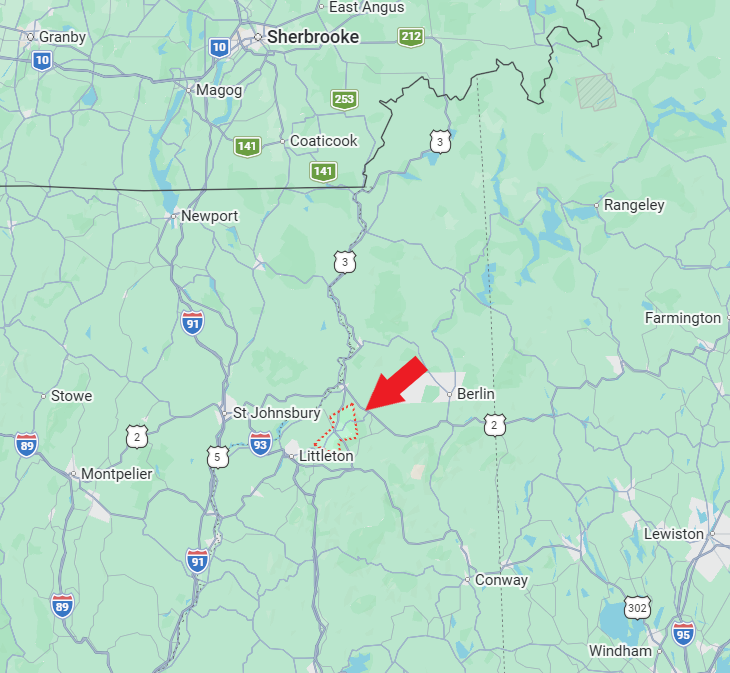
Whitefield is a two-cemetery town. I do not mean that literally, for there are quite a few burial grounds within its limits. Outside of family plots, the bodies of Protestants have found a home indistinctly in one or two cemeteries. This holds equally for nearby towns. But, at the end of the nineteenth century, Whitefield became the site of a veritable novelty: a consecrated Catholic cemetery. Enough Catholics had gathered here and in surrounding communities to warrant the establishment of a mission and then a parish. The arrival of Catholics put to shame the differences between (and among) Baptists, Methodists, and Congregationalists. The ghosts of the Reformation had come to town.
Those ghosts bore such names as Moran, Murphy, and Ryan, even Federico and Puglisi.
Then there were Canadians—immigrants bearing names like Desruisseaux, Fournier, Gendron, Pilotte, and Roberge.
A short article published in Plattsburgh’s Le National in February 1886 captures a big part of the community’s origin story:
Whitefield is a small village located on the Boston & Lowell railroad line. Canadians amount to approximately 50 families and are served by the pastor of Lancaster [N.H.], an Irish priest, who comes to visit them once a month . . . The Canadians of Whitefield are employed in the sawmills of MM. Brown and Libby. One of our compatriots is at the head of a large blacksmith’s workshop and seems to be doing well.
The Catholic population of Lancaster, eight miles north of Whitefield’s village center, appears to have been predominantly Irish. This was not the case for Whitefield and several neighboring communities. Some time in 1886, in light of the rapidly increasing French-Canadian population, the bishop of Manchester called upon Joseph Noël Plante, a young vicar then posted in Nashua, to establish a distinct parish. Plante’s success in Whitefield ultimately worked against the community, for, after six years, the bishop reassigned him to establish a Franco-American national parish, Sacré-Coeur, in Concord. This did not sit well with residents—much less when an Irish priest (“qui, il est vrai, parle un peu français”) was appointed in his place. This person was James H. Riley. (Ironically, for a time, the Irish in Lancaster had a French-Canadian priest.) At the end of the decade, Father Amédée Lessard was appointed to lead the parish. Through its francophone priests, Whitefield may have exerted a special draw on Canadian families in Dalton and Jefferson that would have otherwise sought religious rites in Lancaster.
This, of course, says little of the push and pull of working families. There are two names that we need to recall as agents of this migration—and they are both Brown.
William Wentworth Brown, of Maine, was among a small group of entrepreneurs who purchased the Berlin Mills Company in the 1860s. Located on the Montreal-to-Portland rail line and on the upper reaches of the Androscoggin River, the Berlin Mills facilities quickly expanded. Later known as the Brown Company, the business relied heavily on French-Canadian labor. It propelled Berlin’s economy for more than a century. As far as Quebec was concerned, W. W. Brown and his successors put Coos County on the map.
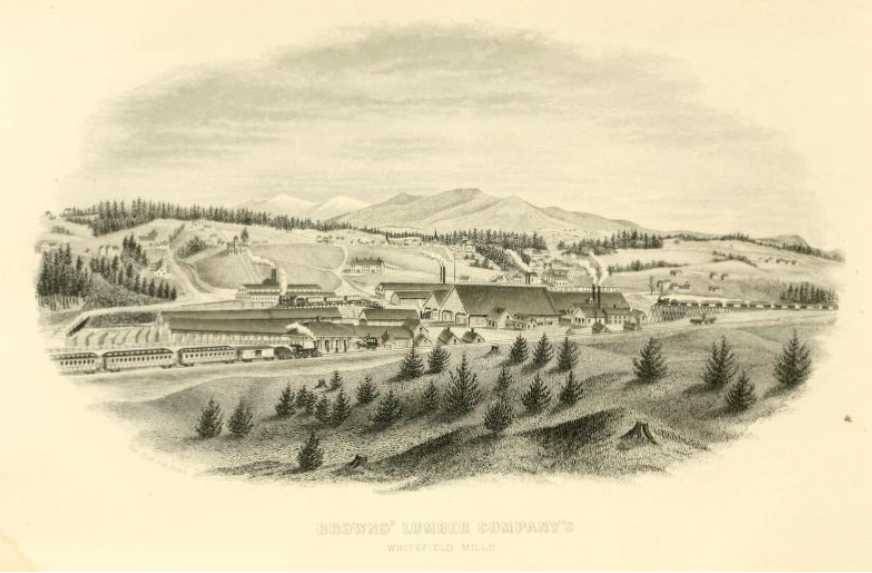
There were, of course, other milling interests, including those of brothers Alson L. and Warren G. Brown, who were unrelated to the Browns of Berlin Mills fame. The brothers conducted business in central New Hampshire until the exhaustion of timber forced them to Coos County. In Whitefield, they purchased the assets of the old White Mountain Lumber Company and set about modernizing the facilities and equipment. By 1872, they could mill 15,000,000 feet of long and short lumber annually. For a time, much of that lumber was extracted from next-door Carroll. The Browns established a local rail line to connect extraction sites to Whitefield, then extended the line to connect to points east and north. By the end of the 1870s, it was carrying passengers.
A work published in 1888 identified the Browns’ Whitefield operation as
the largest and most complete lumber mill in New England. The power is furnished by a 400-horse-power steam engine . . . From small beginnings has been developed in a few years the large mills and manufacturing establishments in Whitefield; a railroad fourteen miles in length, with four engines, running seven passenger trains in the summer season; a repair shop; two mercantile houses, and a well organized series of camps in the woods, under the superintendence of N. R. Perkins.
It seems we should wonder not so much why French Canadians would be in Whitefield as why we have yet to hear of the town. Regardless, French Canadians did come. Now, silent markers in a roadside cemetery stand as the few outward expressions of that history.
In the next blog post, we will look at the challenges of navigating ethnic memory in the region.
Sources
Georgia Drew Merrill’s History of Coos County, New Hampshire (1888), available on Archive.org, remains a valuable reference work, though, as we will see in the next blog post, a complicated one from an ethnic standpoint. Digitized issues of Le National may be accessed on the site of Bibliothèque et Archives nationales du Québec.
Excerpts of Bishop Denis M. Bradley’s diary provided by Barbara Miles and Dennis Pedley help fill gaps in the history of religious organization in the region. Dimond Library staff digitized a master’s thesis from 1942 that will appear in the next post.
See, for more on the effect of French-Canadian immigration in this part of the world, the QTP post on St. Johnsbury, Vermont.
Pingback: Friday’s Family History Finds | Empty Branches on the Family Tree
I love to read about Whitefield where my Mom grew up. She lived there around 1914 (maybe a few years later) to 1928 or maybe 1929. She was a Catholic Canadian with French ancestry although she was anglophone. Her name was Irene Camden and her Dad operated the town’s icream parlor for much of those years. They were from Montreal and returned there when her Dad died when she was 14 years old. Don’t think they had any connection to the mill itself. I visited Whitefield as a teen and remember the lovely town square and gazebo. Must have been wonderful to grow up there during those years.
Thank you for sharing these memories!