Largely, the repatriation colony was a failure. In 1875, the provincial government of Quebec set aside lands in the Eastern Townships for the settlement of return migrants. Policymakers expected that French Canadians who were working in New England mills would be willing to come back to establish farms in remote areas of the province. A small number did, but, ultimately, the conditions were poor and the province had to intervene to resupply the little colony. The population stagnated in numbers and otherwise for years.
The sacramental records of the parish, Notre-Dame-des-Bois, established in 1878, suggests as much. The register opened in March with the wedding of Hilaire Manseau and Célanire Bussière. Ominously, exactly a week later, an elderly resident suffering from aliénation mentale committed suicide. By the end of April, Manseau, aged 22, was also dead. We can read too much into this. Still, in retrospect, it is tempting to see in these tragedies warning signs.
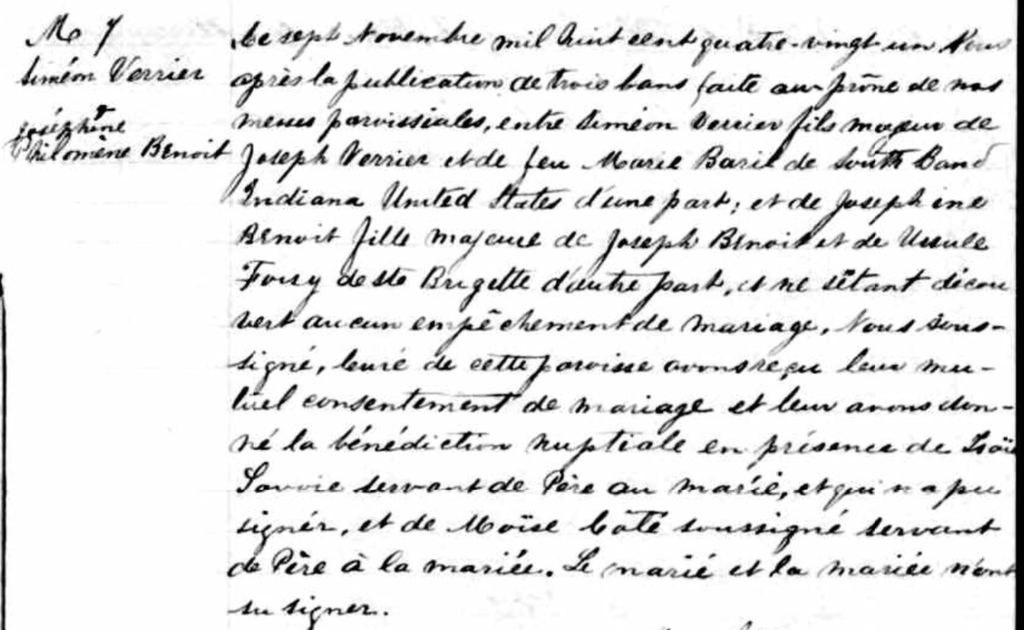
In its early years, the register of Notre-Dame more often provides the places of origin of the European migrants settling in the community than those of return migrants. We find one exception in the marriage of Georges Mercier and Olympe Goulet, in 1880, Georges having come from Biddeford. The next year, we find an unusual connection. Anastasie Benoît married Siméon Verrier, who hailed from South Bend, Indiana.
Going West
Siméon had come into the world in Saint-David-d’Yamaska at the end of the 1840s, but how well he knew the land of his birth is uncertain. According to a later census, Joseph Verrier, his wife Marie Baril, and their children (Siméon among them) immigrated to the United States in 1856. It would have been unusual for the Verriers to move directly to Indiana, which does not register as a major field of French-Canadian migration. As it happens, likely traveling by steamboat through the lakes, perhaps with a journey on the Michigan Central Railroad, they went to western Michigan. There, opportunities were plentiful in lumber, mining, and agriculture.
In 1860, a census enumerator found the family in New Buffalo, a village on Lake Michigan near the Indiana border. Joseph owned real estate valued at $200; he was a farmer. The family was surrounded by German and American migrants. The Verriers may have enjoyed a relatively settled existence. They were still in New Buffalo a decade later.
Well, some of them were. The older children (Siméon among them) had left. Joseph and Marie likely moved to the South Bend area shortly thereafter, South Bend being but 25 miles from New Buffalo and the site of a growing Catholic community. Marie passed away in 1873 and her body was laid to rest in Cedar Grove Cemetery in the Indiana community of Notre Dame. In 1880, Joseph was living with a daughter and her Canadian-born husband in South Bend. By 1900, another daughter, Zoé, and her husband Eugène Poulin, a grocer who had immigrated decades prior, had taken Joseph in. He (Joseph) passed away in 1901.
But what of Siméon? On the eve of his 1881 wedding, he was working as a hired hand for the Ste-Marie family in Chesham, Quebec, which fell under the purview of Notre-Dame-des-Bois. Next door lived his older brother, Joseph (Jr.), his sister-in-law Eveline Senneville, and their children. It is conceivable that Siméon had spent much of the 1870s following siblings to various opportunities.
Return Migrants
The journey of Joseph (Jr.) and Eveline gives a sense of the family’s mobility. As the oldest child, Joseph may have had a deeper or more personal attachment to his homeland. He repatriated. He and Eveline were both living in Baie-du-Febvre, Lower Canada, when they married in 1864. At the time, Joseph was a daguerreotypist, of all things. Their time in Baie-du-Febvre was brief. According to a later census, children born of the couple roughly between 1869 and 1875 were natives of the United States.
It is conceivable that they went to Indiana. More likely, they went to Massachusetts. A resident of Danvers appointed a Joseph Verrier of Saint-Germain-de-Grantham, twenty miles south of Baie-du-Febvre, to manage a financial matter on his behalf in 1879. The two men may have met in the Bay State. It also happens that Joseph would spend his later years in Massachusetts.
Among the French Canadians of Massachusetts, he would have likely learned of the repatriation colony and available land in the Eastern Townships, where, as noted, we find him in 1881. Siméon may have followed.
Siméon’s wedding at Notre-Dame-des-Bois did not lead to a more settled life. The family was farther west in Sainte-Brigide, near Anastasie’s relations, in 1884. In 1886, when they christened a child in La Patrie, in the Townships, the family was living in Scottstown. They were residents of La Patrie two years later. In 1891, Siméon (listed as Samuel) was a pulp mill worker in Hampden Township with his family. We know little of Siméon’s later years, save that he died in Sherbrooke in 1921. Anastasie died at the crèche in Magog in 1936; her body was laid to rest in Waterville, Quebec.
Dispersal
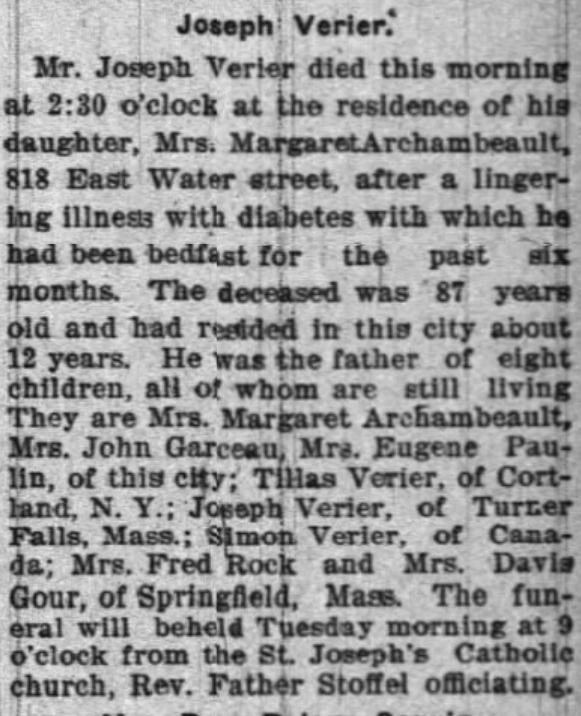
Perhaps most fascinating of all is an obituary that conveys the extent of the Verriers’ cross-border migrations across generations. When Joseph (Sr.) died in 1901, three of his children were living in South Bend; one, in Cortland, New York; two daughters, in Springfield, Massachusetts; and Joseph (Jr.) in Turner Falls, Massachusetts. Siméon was the only family member in Canada.
The relics of a little repatriation colony in Quebec were the momentary end point for one branch of the family. Other Verriers became Franco-Americans and, within another generation, may have no longer thought of themselves as people of French heritage.
Télesphore, Siméon’s youngest brother, was American-born. We don’t know that he spent any considerable time in Canada. Nor do we know how he found his way to Cortland as a young man. But there he went and there he stayed until the end of his life, working many years in a carriage factory.
Back in South Bend, Verrier life continued with Zoé and Eugène Poulin, whose children had personal knowledge of their Canadian grandfather but likely attended English-dominant public schools. Zoé and Eugène may have used French as their secret language as happened in so many Franco-American households at a critical moment in the community’s history.
Ultimately, we cannot say without equivocation that the Verriers either were uprooted from their homeland or successfully transplanted their cultural world. The numbers help make that case. In 1900, Indiana was home to 948 individuals born in French Canada and 877 American-born residents with two French-Canadian parents. It is conceivable that most had drifted down from Michigan, which served as a significant magnet for Quebec immigrants in the nineteenth century. The numbers show that there would be no Little Canada of consequence, yet a French-Canadian population there nevertheless was. Migrant households found one another. In New Buffalo, the Verriers were neighbors of the Garceaus, with whom they would marry. In South Bend, Eugène and Zoé were longtime neighbors of Zotique and Adéline Crépeau. At one point, a Robert Robichaud lived nearby. In 1920, they were also living near Henry LeBlanc, the son of a Canadian migrant.
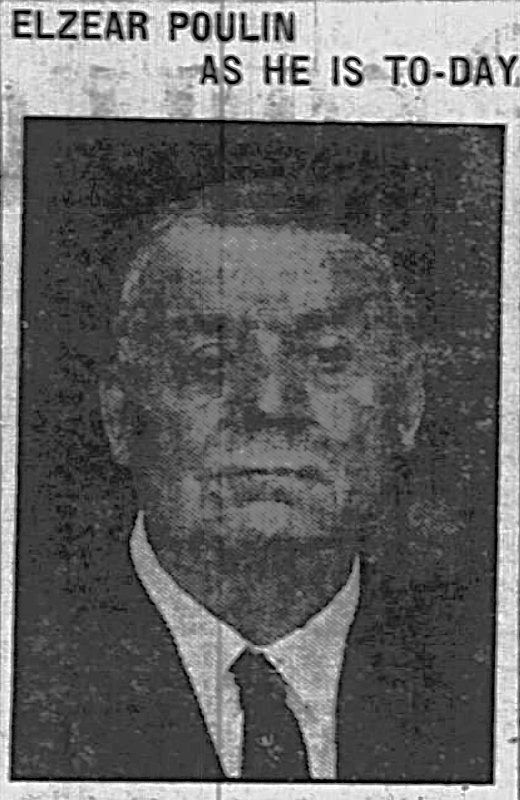
The Verriers were part of a larger cultural network organized around kinship that provided moorings and forced compromises. These kinship ties are in fact just as visible in the Poulin family. Eugène, originally from l’Ile d’Orléans, was one of four brothers who found their way to Indiana. Elzéar Poulin, the last to make his way to the Midwest, had fought as a papal zouave in Italy in the 1860s. Like Eugène, he became a grocer.[1]
Like his paternal uncle, John Poulin, a son of Eugène and Zoé, would put the migrations of the 1850s and 1860s to shame. John studied at the Colorado School of Mines and at Columbia University. In the 1930s, he worked as a geologist in South America. Upon his death in Florida, in 1975, an obituary identified him as a “retired executive of the Sinclair Oil Company.”
The casual—yet highly unusual—mention of South Bend in the records of a failed experiment in Quebec’s Eastern Townships takes us in every possible direction in North America and beyond. The stories concealed in this mention reflect the transnational scale of French-Canadian life and culture from the 1850s to the 1930s. Migration from Quebec to Indiana was not common. But the Verriers’ experiences were.
[1] Elzéar’s son Harry was involved in a high-profile paternity suit in the early 1920s. The wife of a Notre Dame professor accused him of seducing her.
Leave a Reply