Europeans’ arrival on the shores of Lake Champlain, in 1609, came with a thunderous blow. Later deemed a discoverer despite the Indigenous presence, Samuel de Champlain gave his name first to the lake and, eventually, to a town in far northern New York. There, today, the Samuel de Champlain History Center honors his legacy. In nearby Plattsburgh, his likeness stands guard over Cumberland Bay.
A French presence around the lake came in fits and starts. This, after all, remained a disputed region through the colonial period, thus discouraging permanent settlement. It is in the 1780s that we must locate the beginnings of continuous occupation. There was no thunderous blow, this time, and the documentary record of the early years is sparse.
We do know that French-Canadian veterans of the War of Independence and their families formed a large proportion of northern Clinton County’s population at the end of the eighteenth century. Sometimes as squatters, sometimes on state-issued grants, they built log homes, cleared land, intermarried, formed a community, and restored ties to their ancestral homeland. They likely benefitted from the restoration of cross-border commerce in 1796, then endured the challenges of Jefferson’s embargo.
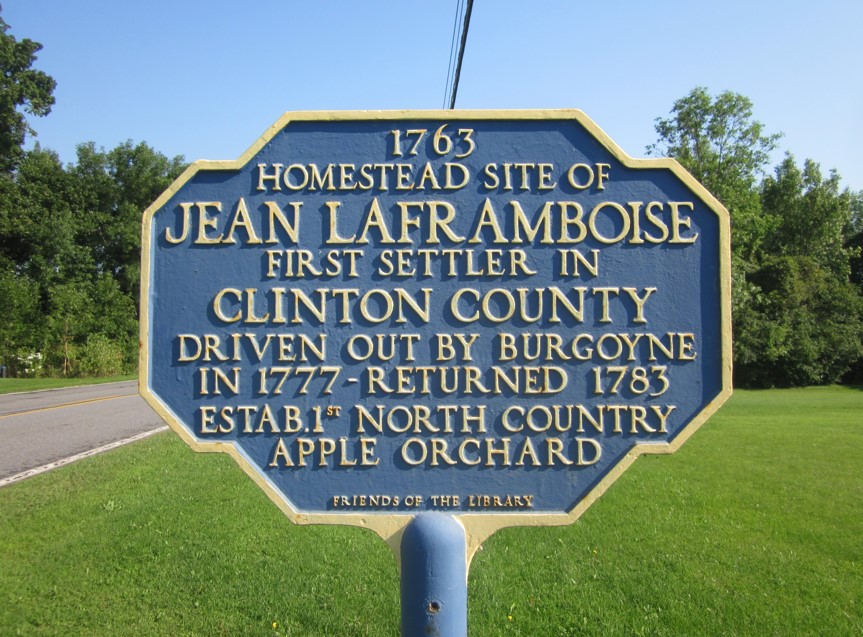
In these early years, the former officers of the Continental Army appear to have maintained their social standing. Jacques Rouse served as a militia captain. Clément Gosselin, perhaps the most famous of the veterans, led for a time Clinton County’s grand jury. François Chandonnet, perhaps too erratic for public office, exerted influence as an innkeeper.
Clinton County quickly filled with English-speaking settlers from Vermont and other areas of New York State. Trade continued to expand on the lake and on the Great Chazy and Saranac rivers. Land increased in value not only by virtue of location, but through the improvements made over time by farmers. This, however, says little of interactions between the Anglo and French-Canadian populations. Questions abound.
In my recent stop at SUNY–Plattsburgh Special Collections, I found faint traces of an answer. I perused the ledger kept by the County Board of Supervisors from 1829 to 1843. This was a critical time. By the end of the period, some French-heritage families had lived in the county for nearly half a century. The region was experiencing a renewed influx of Canadians. Further, the ledger overlapped with the Rebellions of 1837-1838, which, by the way, are entirely invisible in the business transacted by the Board of Supervisors, despite the immense stir they created in border communities.
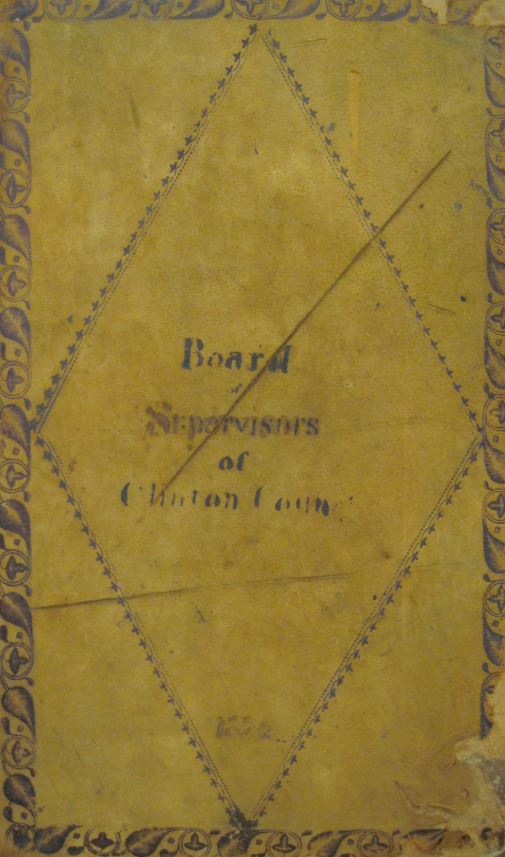
The ledger stands out particularly for the striking invisibility of the French-heritage population in its pages. Hardly might we guess, without outside context, that there ever was a substantial French presence in the county. Surreal, I thought, while flipping from one page to the next; where are the people that I have been writing about?
Granted, there are French names. Frederick Louis Charles Sailly was county treasurer for much of the 1830s. But he was the son of Peter Sailly, an immigrant from France. Peter’s years as a collector of customs would have placed the family in an altogether different economic stratum. The ledger contains passing references to the Alexander Larabee murder trial. Despite the French-sounding name, Benjamin Fasset, who represented the Town of Champlain, appears to have been of Yankee ancestry.
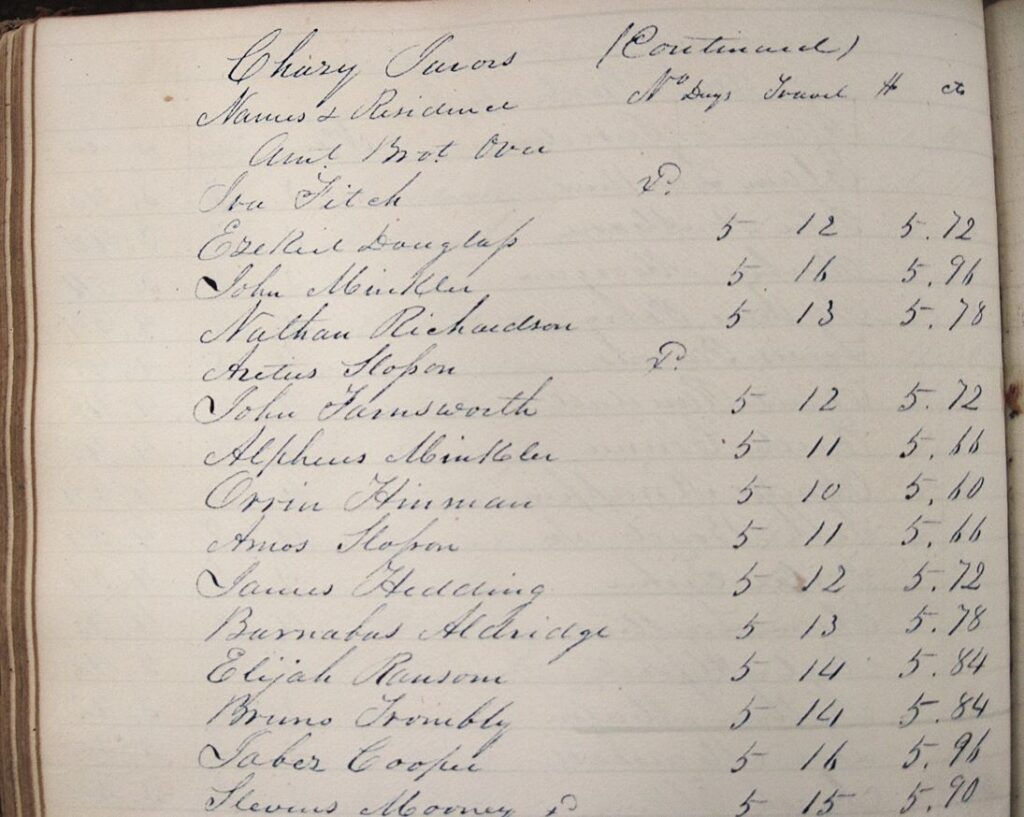
All of this hints at a tenuous connection between the French Canadians of Clinton County and public institutions, almost as two social worlds operating independently of one another. The ledger helps cement that view in one particular respect: it listed all of the men who served as jurors and who were therefore entitled to compensation for their time and travel. Juries were arguably the lowest and most accessible tier of public service. Typically, they did not require special qualifications but citizenship; they were not positions of prestige, and there was a continual need for them. Hundreds of men appear as jurors in this particular ledger.
Yet, even as jurors, or potential jurors, persons of French-Canadian descent are almost entirely absent. Almost, for there are two exceptions. In 1832, James “Laframboiz” (Laframboise) was owed $3.84 for his service as a juror. Laframboise’s family history in the region stretched perhaps the furthest of all French Canadians, for his ancestor had received a lot adjoining Lake Champlain in the days of New France. Seven years passed before the other exception entered the written record. Bruno “Trombly” (Tremblay) earned $5.84 in 1839. The timing of his selection and service may not have been entirely random. According to Sullivan and Martin’s History of the Town of Chazy (1970), the stone house built by the Trombly family in Chazy became a refuge for exiled Patriotes in the wake of the failed Rebellions. The widespread American sympathy for these insurgents may have enhanced Trombly’s profile.
The ledger also includes an exception of a different kind. Joseph François D’Avignon became, on U.S. soil, Francis J. Davignon. He was among those seeking refuge south of the border in the Rebellion era. He quickly made friends, for, in 1843, he was compensated by the Board of Supervisors as a physician—seemingly in an official capacity. He would later serve in the Union Army as a surgeon. Jean Lamarre has written a biography of D’Avignon thanks notably to surviving correspondence.
Laframboise, Trombly, D’Avignon, only… when the region was home to descendants of the Asselins, Hamelins, Lizottes, Marneys, Montys, Paulints, and many others. As always, in historical research, a single answer opens the floodgates of questions. Were local French Canadians rejected from jury duty because the majority were illiterate? because their English fluency was partial? Did public officials apply an unofficial means test that placed French Canadians at a disadvantage?
While we continue to ponder, and attempt to answer, these questions, we are left with the distinct impression that there were two Clinton counties from the 1820s to the 1840s: one public, institutional, and English; the other, to all intents and purposes a Little Canada.
See, for more on Franco-Americans in rural regions, my article in the most recent issue of Quebec Studies.
Leave a Reply