So many of our residents in Whitefield are of French-Canadian roots.
– A Whitefield resident and historian (2026)
The stories buried in Whitefield’s Catholic cemetery are too numerous to cover comprehensively here.
The snapshots below are accompanied by small glimpses of underlying lives. These are derived from New Hampshire vital records, census returns, Quebec parish registers, and a handful of other sources. These individuals are not meant to be a representative sample, but they do reveal that the Whitefield area’s French Canadians came from different regions of Quebec. Lumber seems to have attracted most. Within a generation occupations diversified. At the same time, many migrant families moved to neighboring towns, creating momentary Franco-American spaces that have since been forgotten.
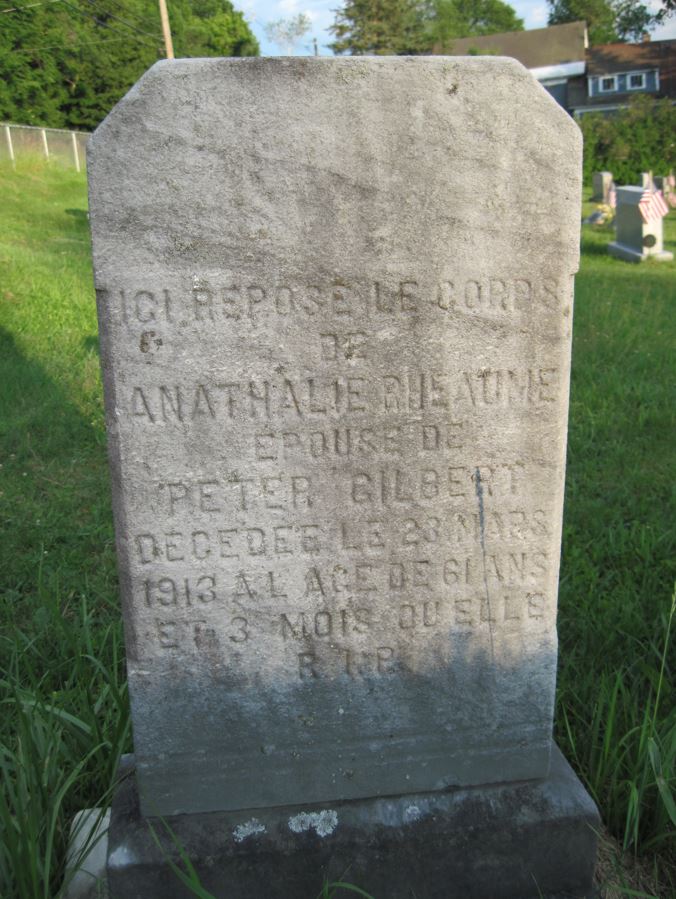
Many of the cemetery’s early stones have French inscriptions. Several tell the story of the Gilbert family. Etienne Gilbert was a pioneer. As early as 1873, when he married Nathalie Rhéaume in Sainte-Marie-de-Beauce, Etienne was a resident of “Wakefield” in New Hampshire. He declared under oath that he had not previously married in the United States.
Etienne—henceforth known as Peter—and his new bride raised a family in Coos County. It became their permanent home. Most likely, Etienne would have crossed the border to work in the lumber industry. By 1900, the Gilbert family had found its way to Dalton, just north and west of Whitefield, where they lived from farming. At that time, French-heritage people born in Canada and American-born children with two such parents amounted to 19 percent of Dalton’s population. (This is just slightly below the proportion of French Canadians in Lowell, Massachusetts, in the same year.)
Etienne, or Peter, appears in the census of 1930—though the enumerator visited several days after his death. He had outlived his wife and several children and, in his later years, had moved to Whitefield to live with his widowed sister, Marceline Lizotte.
Alphonse St-Laurent’s life journey was similar to that of his compatriot from Sainte-Marie. He was living in North Stratford, on the upper Connecticut River, when he married Evéline Ouellet in Saint-Fabien, Rimouski County, in 1881. The couple raised their children in northern New Hampshire. Alphonse worked as a mill laborer in Whitefield before moving the family to Littleton in the early twentieth century.
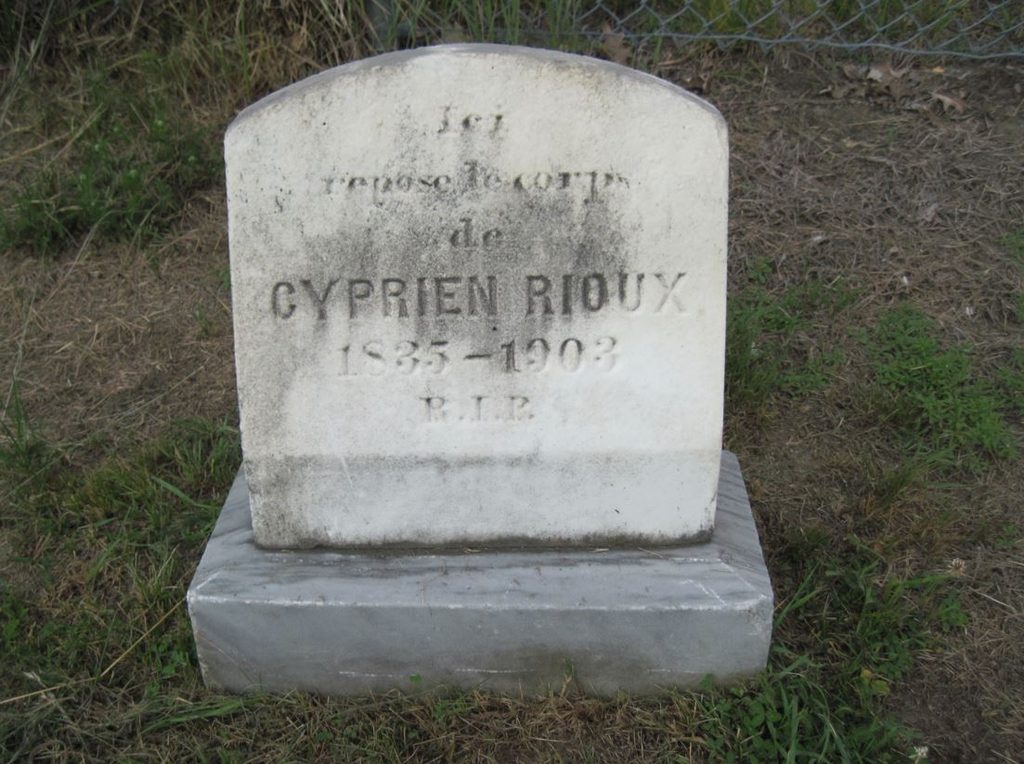
Kinship was at work when Cyprien Rioux immigrated from Quebec with his family in 1892, for his wife, Adèle St-Laurent, was Alphonse’s sister. Alphonse may have sent news of American opportunities to the Rioux family as Cyprien passed middle age. He, Cyprien, died in 1903 and his body was laid to rest in Whitefield. Adèle moved to Littleton to be with some of their children.
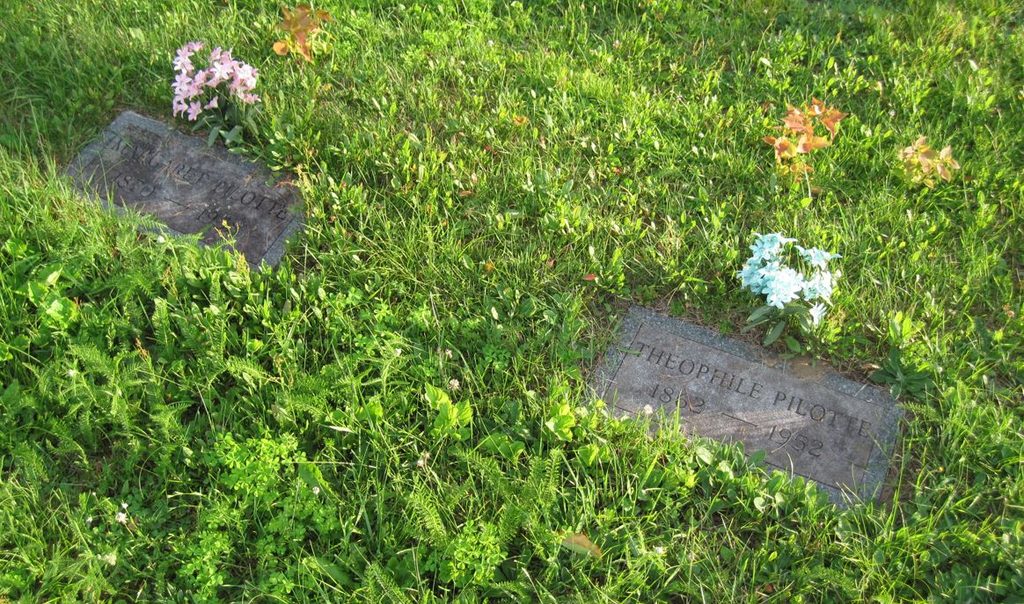
Théophile Pilotte and his wife Marguerite Girard were Canadian immigrants; they married in Fitchburg, Massachusetts, in 1888. Both were from the Frampton area in Dorchester County, Quebec. Land belonging to a Théophile Pilotte, likely our immigrant, was at risk of being sold at auction for arrears in March 1889, which could explain the decision to go to Massachusetts, where cash might be earned more quickly. What came of the parcel in West Frampton we do not know. At the very least, a return to the native land interrupted the journey on U.S. soil: a child of the couple was christened in Frampton in 1894, at which time Théophile was a cultivateur. They immigrated again, definitively, the following year.
In 1900, we find the family in Dalton. Théophile was a teamster, but soon bought land. From then on, the Pilottes lived from farming. Théophile died in 1952 and Marguerite followed in 1958.
Whatever some historians might have us believe about a transient population of lumberjacks, French Canadians planted roots in the region. In 1900, the farming population of Dalton included John and Mary Roberge, Anthony and Elizabeth Bisson, Nelson and Anna Fournier, Joseph and Mary Pilotte, Joseph and Madeline Lizotte, John and Annie Jock (likely Jacques), John and Mary Pockett (likely Paquette), and on. Other French Canadians in Dalton worked in mills or on the railway.
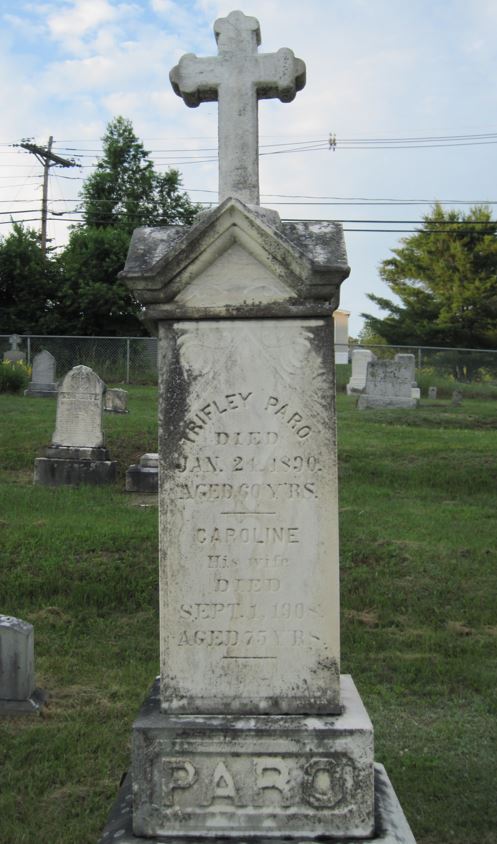
Trefflé Perrault and his wife Caroline Tousignant were living in Stark, New Hampshire, in 1870. They had married in Lotbinière in 1854. Nearly all of their children were born in Canada, indicating that they were recent arrivals to the United States, in 1870.
By 1880, the family was running a large boarding house in Whitefield, the majority of boarders being young men from Canada. Some of them may have soon returned home, leaving no other trace of their American sojourn.
Trefflé passed away in 1890, likely in Whitefield. Caroline died of cancer in Berlin in 1908. The undertaker secured for her funeral was a St-Laurent.
Their son Nelson worked as a mill hand and eventually went into business. In the early twentieth century, he was operating a clothing store in Whitefield, while his New Hampshire-born wife, Clara Weeks, ran the “picture theater.” Clara’s brother was a selectman. The couple would be interred in the non-Catholic Pine Street cemetery.
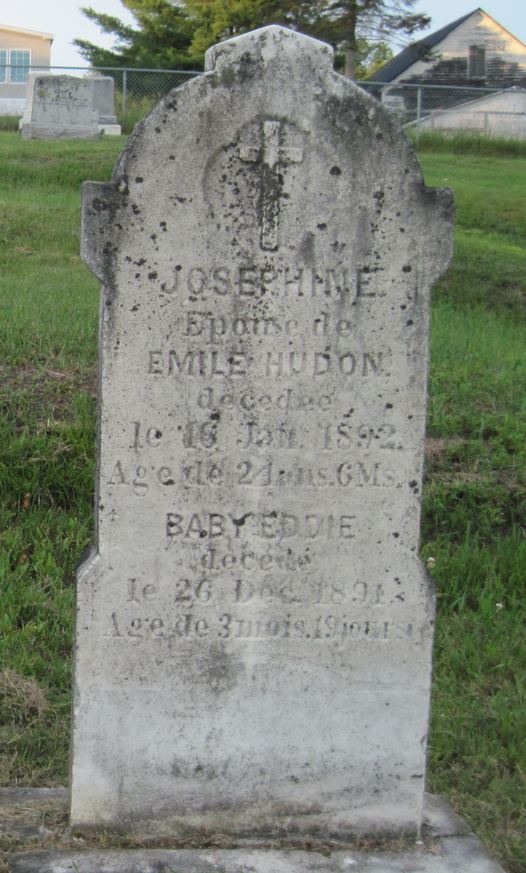
Josephine Mitchell died four months after giving birth to her last child. She was likely the daughter of Peter and Olive Mitchell. We still know little of her and the Mitchells, who appear to have been Canadian.
Josephine’s husband, Emile Hudon, was a native of Saint-Simon, ten miles from Saint-Fabien in Rimouski County. His father, Blaise, was an innkeeper. Emile worked for a time in a mill in Livermore, which today abuts the Kancamagus Highway. Now a widower, he married Annie Levasseur, daughter of Jean Levasseur and Marie Vermette, of Whitefield, in 1895.
In the early twentieth century, Emile and his family moved to Warren, New Hampshire, located southwest of Lincoln. Still a mill worker, Emile died there of a concussion in 1905.
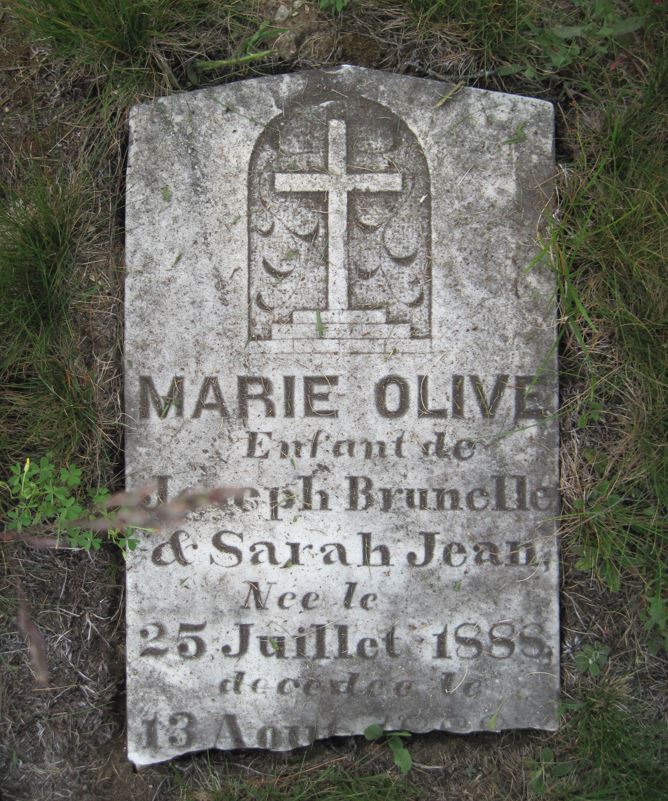
In 1900, Joseph Brunelle and Sarah Jean were living in East Providence, Rhode Island, with their five children. This was a new world for the family. Joseph had spent part of his youth with his parents in Whitefield. His father was working for the Brown Lumber Company in 1880. Joseph likewise became a mill hand. His children with Sarah, Olive included, were born in New Hampshire in the 1880s and 1890s. Olive died less than three weeks into her tragically short existence. The family was back in northern New Hampshire—in Littleton—by 1910. Joseph worked in a tannery while the oldest surviving children were employed in local stores.
Rose Brunelle was Joseph’s sister. She married Arthur Roussel in Whitefield in 1895. Rose was, according to son Amédée’s birth record, a native of Island Pond, Vermont, while Joseph had been born in Saint-Romuald in Lévis County, Quebec. In Whitefield, Arthur and his brother-in-law, Paul Brunelle, worked as mill laborers. Arthur and Rose were in Lisbon, New Hampshire, in 1920.
* * *
Contemporary newspapers also offer glimpses of French-Canadian lives. Migrant Ephrem Tousignant, originally from Sainte-Emilie, was fatally injured in a lumber yard and expired on Christmas Eve, 1884. In 1901, the Journal de Waterloo brought news of Joseph Boucher. Boucher, the paper stated, “an old Canadien who claimed to be 105 years old, died in Whitefield, N.H., at the home of one of his sons. Mr. Boucher was originally from Quebec City, where he had lived for a century. He had resided in the United States for four years.”
At the turn of the 1890s, a baker, Ovide Léger, now in Whitefield, advertised his services in a Plattsburgh paper. Some years later, Dr. Joseph Edouard Coutu, also of Whitefield, returned to Quebec to marry. He was wed to Marie Alexina Germain, of present-day Laval, in January 1895.
This is to say that Whitefield was the end of the line for some—hence the stones—but not all. The cemetery carries the documentary bias of those who remained or at least stayed nearby. Others left and the memory of life in Coos County evaporated. This process began in the 1890s just as Franco-American life in Whitefield seemed to be ascendant. The Brown Lumber Company exhausted its timber reserves. There were commercial and industrial opportunities in Littleton and in Berlin; there was land in Dalton. A fire that destroyed the Brown pail factory in December 1902 may have led other families to seek their bread elsewhere. Another fire occurred in 1908. The bishop of Manchester had found in 1898 that Whitefield’s Catholic population was static and there is cause to believe that its numbers declined at least slightly in subsequent years.
To be sure, French-Canadian heritage endured in Whitefield and across Coos County through much of the twentieth century. But, as would occur later in major mill towns, economic uncertainty led to dispersal and likely helped speed the forces of acculturation. Whitefield’s cemetery does not fully or fairly capture the town’s Franco-American history. It is a helpful snapshot of what was and what could be. It is also significant for conceptual reasons, and might in this sense stand in for Catholic burial grounds from Saranac Lake to Dexter. Its story has planted the seed of a wider exploration of “migrants on the margins” whose lives have too often been invisibilized even within the larger field of Franco-American history.
When I was in Coos County, New Hampshire, in 1966-67, there were many French-speaking people. The Notre Dame Academy served Franco children. On a negative note, whenever I go though Colebrook (going or coming) on a trip to Quebec, I am always struck by how little of the inherent sense of style that I see in Ayer’s Cliff or Magog has survived to characterize the presentation of folks in Colebrook.