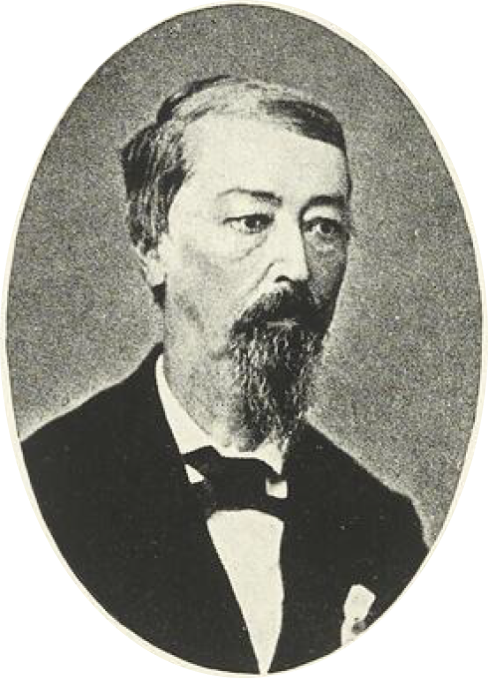
Edouard Lacroix: it’s a common name. When I moved to the St. John Valley, I was regularly asked whether I was related to Edouard Lacroix. Also known as “King” Lacroix, this fellow, a Beauceron, served in Quebec’s legislative assembly and played an essential part in the development of the Allagash region. His lumber interests were far-reaching and included enormous milling facilities in present-day Van Buren, Maine. Lacroix’s career is indelibly tied to the ghost locomotives of the North Maine Woods.
Among the other men bearing the name, we find nearly half of my patrilineal ancestors, distant cousins, and approximately 50 percent of my nephews.
Historians of Franco-American life will have seen the name elsewhere—and probably only in passing. In the nineteenth century, an Edouard Lacroix helped put Detroit on the Franco-American map: he forged connections to other communities, organized his compatriots, and modeled a level of civic involvement that would blossom with later generations.
This Edouard, born in 1814, was not exactly a Lacroix. To be specific: the family’s patronym was Neveu; Lacroix was a “dit” name, which adds a layer of complexity in tracing their lineage and kinship.
The father, François Neveu dit Lacroix, worked as a voyageur as a young man. This may have later inspired his son to seek opportunities in the West. Early in his married life, François became a stonemason, which might have secured for the family a middling economic status. But, in the summer of 1828, a sheriff seized properties belonging to François in and around Montreal for sale at auction, seemingly to settle claims from creditors. We know little of the challenges that the family navigated in the years that followed.
By 1843, young Edouard was in Detroit. Belisle writes that he attempted to establish a newspaper titled L’Ami de la jeunesse. In 1850, he founded Le Citoyen, which appeared for six months—an eternity if we look at the history of the Franco-American press. Lacroix likely had little to show for these endeavors. He set aside the publishing world and became a notary.
His star did not shine until the aftermath of the U.S. Civil War. Emigration from Quebec reached unprecedented levels and Franco-American leaders redoubled in their efforts to connect communities east and west. Lo and behold, out west they found Edouard Lacroix. With George Batchelor and Joseph Napoléon Cadieux, he was one of the few lay figures who straddled the pre- and post-Civil War periods. Jacques Edmond Dorion, for instance, had repatriated in the early months of the war; Ferdinand Gagnon would not appear on the New England scene until 1868. Lacroix may have seemed outright ancient as young professionals organized conventions in the second half of the 1860s.
In 1871, at the Worcester convention of French Canadians, a small committee presented the white-haired figure from Detroit with a gold-capped cane. But his labors were not complete. Lacroix chaired the organizing committee for the Chicago convention held the following year.
Franco-American authors Alexandre Belisle and Félix Gatineau both acknowledged Lacroix and, if briefly, his cultural engagement. Neither author had time for controversial topics that might split their contemporary audience. They were intent on projecting a united front, past and present, in service of the ideology of survivance. As a result, we miss part of Lacroix’s story.
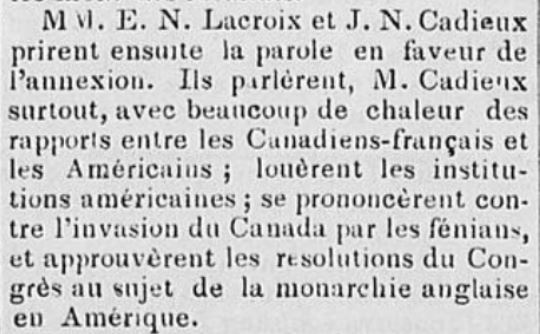
As early as 1847, he was committed to the Democratic Party. He was still a Democrat more than thirty years later. His political opinions did not stop there. At the Detroit convention of 1867, alongside Cadieux, he spoke in favor of the American annexation of Canada—a view that had a circulated in immigrant circles with varying levels of popularity for nearly twenty years. The economic struggles faced by his parents may have encapsulated, in his view, the fate of Canada under British rule.
The cultural and political pieces merged momentarily in letters he sent to Montreal’s L’Opinion publique in 1872. With passion, he outlined the history of his adoptive home—a history of Detroit in which French Canadians might recognize themselves. The letters are very much the stuff of late nineteenth-century historical writing. They celebrate every imaginable virtue the French founders of Detroit may have possessed. But that was not the end of it. Lacroix stated, unrepentantly,
Blessed are the regions of New France that were favored to pass under the flag of the American Union; at least these remained… free, so their prosperity has only increased. But what of the others—what became of the regions under the British banner? Nothing… they are eaten up by misery, emigration weakens them, monopoly kills them. It is because they lack freedom and because foreign domination crushes them with all of its weight.
The spirit of annexation was still present.
Oh, and there was a twist: Detroit had been established in 1700, not in 1701, in his view. The chief historical authorities agreed with him on this point, he stated. So much for Detroit’s ongoing 325th anniversary celebrations—at least in the fantastical mind of Edouard Lacroix. The chief authorities of our day say otherwise. He at least gets credit as the first Lacroix to delve into the history of French North America.
Edouard Lacroix died in Detroit in 1887. He was, at this time, yesterday’s man, not least because he had been afflicted with paralysis for many years. His passing seems to have earned little attention outside of his community. His funeral was nevertheless marked with the usual honors of Detroit’s Société Saint-Jean-Baptiste and Société Lafayette.
By his presence, his energy, and his efforts, Edouard Lacroix helped put Detroit (an old outpost of New France) on the Franco-American mental map. Today, he reminds us that the city’s francophone history outlived the colonial period and the era of the fur trade.
Sources
See, notably, Alexandre Belisle, Histoire de la presse franco-américaine et des Canadiens-Français aux Etats-Unis (1911), and Félix Gatineau, Historique des Conventions générales des Canadiens-Français aux Etats-Unis, 1865-1901 (1927).
Newspaper sources include, on the loss of family properties, the Quebec Gazette, August 21, 1828; on Lacroix’s involvement with the Democratic Party, the Detroit Free Press, February 26, 1847 and September 8, 1880; on his cultural engagement, Le Pays, May 11, 1867 and October 20, 1869, and La Minerve, September 28, 1874; on the history of Detroit, L’Opinion publique, March 14 and 21, April 4 and 25, and May 9, 1872. His death was reported in the Detroit Free Press, April 24, 1887.
4C3R (:
Pingback: Friday’s Family History Finds | Empty Branches on the Family Tree