After a friendly nod to the Saguenay region in the last blog post, the time has come for something more substantial—and for something that fits the season.
Followers of the blog will have read or encountered a fair number of travel narratives, from Bishop Plessis’s account of the Maritimes to the cross-border excursions of Jean-Baptiste-Eric Dorion and Henry David Thoreau in the 1850s.
Thoreau’s reflections are especially interesting as an outsider’s gaze on Lower Canada—a foreign land not merely in the geopolitical sense, but culturally and religiously as well.
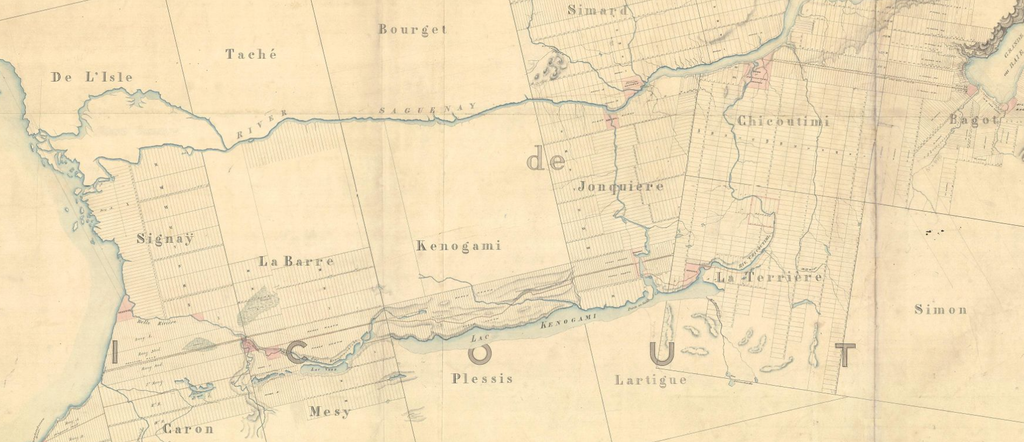
A decade later, at the dawn of the 1860s, we stumble across another outsider’s gaze, though one that comes with a twist. Sixteen-year-old Stanley H. Holt traveled north and spent a winter in the Saguenay–Lac-Saint-Jean region, where he was essentially a stranger. Yet, Holt, who left a journal of his experiences, was foreign to the Saguenay, not to Lower Canada, having grown up in Quebec City. He was culturally acquainted with French Canada and could enjoy a social proximity that was closed to Thoreau.
Holt’s journal does not tell why he went to the Chicoutimi area. It is unlikely that he went there because he “wished to live deliberately.” His father had died while he was still a child, at which point he fell into the care of his older brother Charles. Through the winter of 1861-1862, in the wilds of Canada, Holt impatiently waited for Charles’ letters, including a final missive that would enable him to settle his accounts in the Saguenay and draw him back to Quebec City. Was this exile punishment, or an education of sorts? L’histoire ne le dit pas, but through the winter Holt alternately suffered and learned, as we will see.[1]
We know about this journey through the diligence of Holt’s descendants. His daughter married and migrated to Australia, where the diary passed into the hands of the next generation. Clive Turnbull, a grandson, published the document in 1972. Copies survive in several locations in North America, including in the collections of the Acadian Archives in Fort Kent.
Although he did keep the diary, Holt might have had some thoughts about its posthumous publication. His reflections are sometimes intimate, written with self-awareness but also as a personal outlet in moments of loneliness, of which there were many. We must remember also that he was contending not only with distance from family and isolation, but with the challenges of adolescence that often transcend eras.
The trip to the Chicoutimi area in August 1861 was smooth enough. A steamship brought Quebec City passengers to Tadoussac, at the mouth of the Saguenay River, in fourteen hours. It was likely a different ship that reached Grande-Baie the next day. Waterways, not roads, connected the region to the outside world. Local decisionmakers were beginning to look ahead, however. The following March, days before his departure, Holt recorded, “The councillors of Hébertville held a great meeting today at the mill to arrange about sending Dumais and two men to explore between this and Quebec to see if there’s any possibility of making a direct road. It’s to be done by subscription.”[2]
Within his first few weeks in the region, we get a sense of the shy teenager who kicked himself for failing to make connections with two agents of the Hudson’s Bay Company:
In the afternoon McKenzie passed the house like a nabob (all persons going to Lake St. John have to make a portage of about a league on the road in front of Dumais’) in a charrette with the canoe fixed up like an awning and two or three voyageurs following. I, like a fool, was too shy to ask him in to take a cup of coffee. One of the men, however, stopped to see Philippe and he told me Mr. Skene and McKenzie are going to take a week to make the tour of the lake shooting. Might have been invited if I hadn’t been such a fool.
Soon, more worldly concerns intervened. On September 9, Holt wrote, “Was very sick last night and all today with the diarrhoea caused, I suppose, from eating black bread and omelette constantly.” At this point, it may be worth noting that at the census of 1861, the family had four domestic servants. In January 1862, mild weather forced Holt to change from thick undergarments to silk ones. In other words, he came from means and his time in the Saguenay forced an adjustment in his way of life, at least when he was not boarding with local families.

As winter fell, items Holt had taken for granted became luxuries. “Have hard work to live here, can’t even get black bread or pork,” he wrote in December. “I always used to think that Murray Bay [La Malbaie] was the poorest place I ever saw but there is no comparison between it and this place—not even an egg or piece of butter can be got for love or money.”
Additionally, the cold was often unbearable and, on one occasion, almost fatal. On December 1, Holt fell through the ice at Lac Vert just south of Hébertville. He managed to keep his head above the frigid water. The presence of his companion, Dumais, made the difference. He fetched poles on the shore and succeeded in pulling out Holt who, by this point, was numb and exhausted. Dumais built a fire on the shore and Holt gradually recovered. The same month, our diarist was grazed by lead shot when a loaded gun resting on a sleigh discharged on its own. The great frozen north was no joke.
Holt spent a great deal of his time fishing, hunting, and reading. In the new year, he purchased a copy of Charles Dickens’ Bleak House at the Hudson’s Bay Company post; it helped carry him through long moments of solitude. He also made efforts to improve his French and learn “Indian,” as he put it.
A historian wishes in retrospect that Holt had been more ethnographic in his diary entries. He did however leave tantalizing hints of customs that may not have been specific to the Saguenay–Lac-Saint-Jean region. “The people of Hébertville are afraid to stir out of their houses tonight,” he wrote on All Saints’ Day, “as they believe that all the dead come out of their graves and lie upon the tomb to beg prayers and only return tomorrow night. Masses were held all day in the church for the souls of the dead.” Despite the opportunity to immerse himself in a different world, denominational boundaries remained seemingly impassable. On Sunday mornings, while his occasional hosts or neighbors attended Mass, Holt seized the opportunity to give himself a “thorough washing.”
Washing up was an issue in a different way. In October, from his modest lodgings, he stated, “The Boulanger family intend moving [out] tomorrow, I’m happy to say, as although I hadn’t to act as cook and grubbed [ate] first rate, yet I didn’t like to have to wash my face and hands for every meal, brush my hair and all that style of thing.” It is unclear whether the Boulangers’ expectations of mealtime courtesies extended to their entire cultural world.
A sense of French-Canadian customs and Holt’s view of social fineries appear again on January 1, 1862:
As everyone knows it is the custom for all the Canadians to go visiting each other on New Year’s and when a man enters a house he has to go round and kiss all the girls in the company and a woman vice versa. I had stood it all like a martyr, letting myself get kissed by the pretty ones, but when an ugly one came I made tracks. I happened to be talking very earnestly to old Hébert with my back to the door and was hem’d in on all sides when I saw the most hideous looking article come pegging in. I tried to bolt but it was no go, when the old hag tried to kiss me, I dodged and caught her a whack on the nose with my head. There was a titter heard all around, but I didn’t care.
He made notes several times on the opposite sex, notably comparing Native and French girls.
Holt appears to have left the region in the second half of March, 1862, returning with or without permission to his brother’s roof and to a more comfortable setting. He may have been unhappy with many aspects of his Saguenay sojourn, but it stands to reason that he left having learned a great deal and acquired stories to last a lifetime. He likely gained a better appreciation for his position of privilege, too.
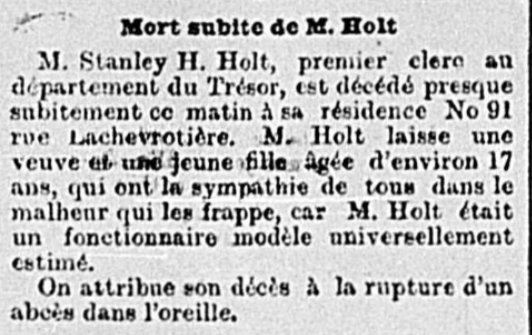
As a young man, he joined the civil service in Quebec City; he would be employed in the provincial treasury department. In 1873, he married Louisa Adelaide Ouimette of Hawkesbury, Ontario. They resided on La Chevrotière Street, a stone’s throw from the legislature, and had one daughter. Holt died in his forties in 1892. An obituary in L’Electeur depicted Holt as “a model public servant who was universally appreciated.” His near-Siberian exile may have shaped the character that was so esteemed by family, friends, and colleagues.
[1] An explanation is potentially found in Holt’s December 31 entry. “I’m going to write to Charles next mail and ask him if I can go and board at the Blairs,” he writes. “I would learn French just as well as here—they all speak it just like English and have a tutor who, they say, is a famous French master.” It may well be that Holt was in one of the most francophones areas of the colony precisely to learn French.
[2] Holt’s time in the Saguenay intersected with another historical event. On the ship to Tadoussac, he met Emile Dumais, who was then taking steps to establish an agriculture-focused newspaper. The prospectus for Kamouraska’s Gazette des Campagnes appeared in September 1861 and the first full issue followed on November 1. It is unclear whether this is the same Dumais who appears later in the diary.
Leave a Reply