For your friendly, neighborhood director of archives, October was intellectually rich. Maine Archives and Museums, the Center for French Colonial Studies, and the Institut d’histoire de l’Amérique française (IHAF) held their respective annual conferences. All three yielded fascinating insights and proved particularly special for the engaging conversations with colleagues. The professional and scholarly organizations behind these events foster a welcoming environment where more and more people are brought to the table—where, over time, the table is made bigger.
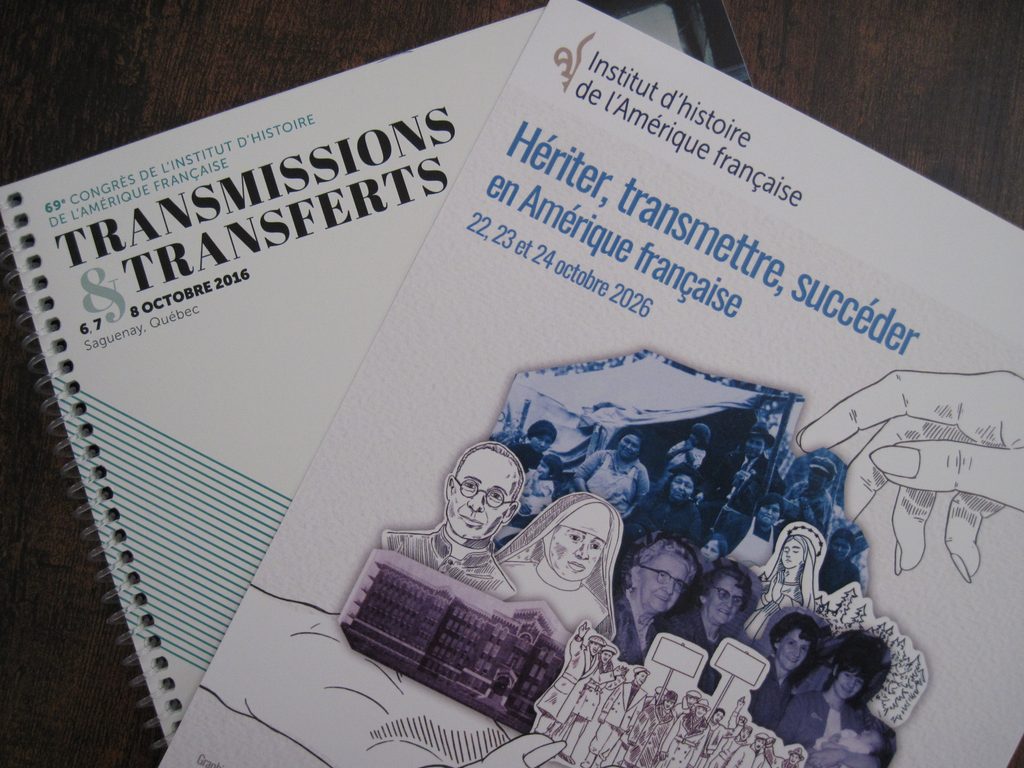
Led by François-Olivier Dorais, the IHAF conference committee hit the ball out of the park. This was the organization’s first time in Saguenay since 2016, also an event that I attended. By traveling from one location to another, year after year, the IHAF helps showcase regional history in addition to novel research undertaken across Quebec and beyond.[1] The Saguenay conference coincided with Chicoutimi’s 350th anniversary celebrations and the region was well represented in the program. The conference opened with a roundtable on the history of trading posts, locally and across Quebec, at La Pulperie de Chicoutimi. A conversation with Gérard Bouchard on his recent work, Terre des humbles: Les Saguenayens 1840-1940, served as the other bookend. One session that notably featured historians Yves Frenette and Marc St-Hilaire likewise drew attention to the Saguenay–Lac-Saint-Jean region.
Although by no means a representative sample, each IHAF congrès provides a snapshot of the kind of history being undertaken in Quebec—the trends and trajectories of the field. This one was no different. The sessions were light on political and military history as traditionally conceived, though I was very pleased to find a panel on the politics of the Union era (1841-1867). Justin Dubé and Sophie Imbeault continue to shed light on this misunderstood and little-studied period. Far from being confined to a single block, Indigenous history was sprinkled across sessions. Nineteenth- and twentieth-century work dwarfed research on the French colonial era. Modestly, minority francophone communities had their own time in the sun. More common at the conference were law-adjacent papers, including two panels on notarial practices as they related to the seigneurial system, inheritance, familial conflict, etc. All are valuable contributions to our understanding of French North America.
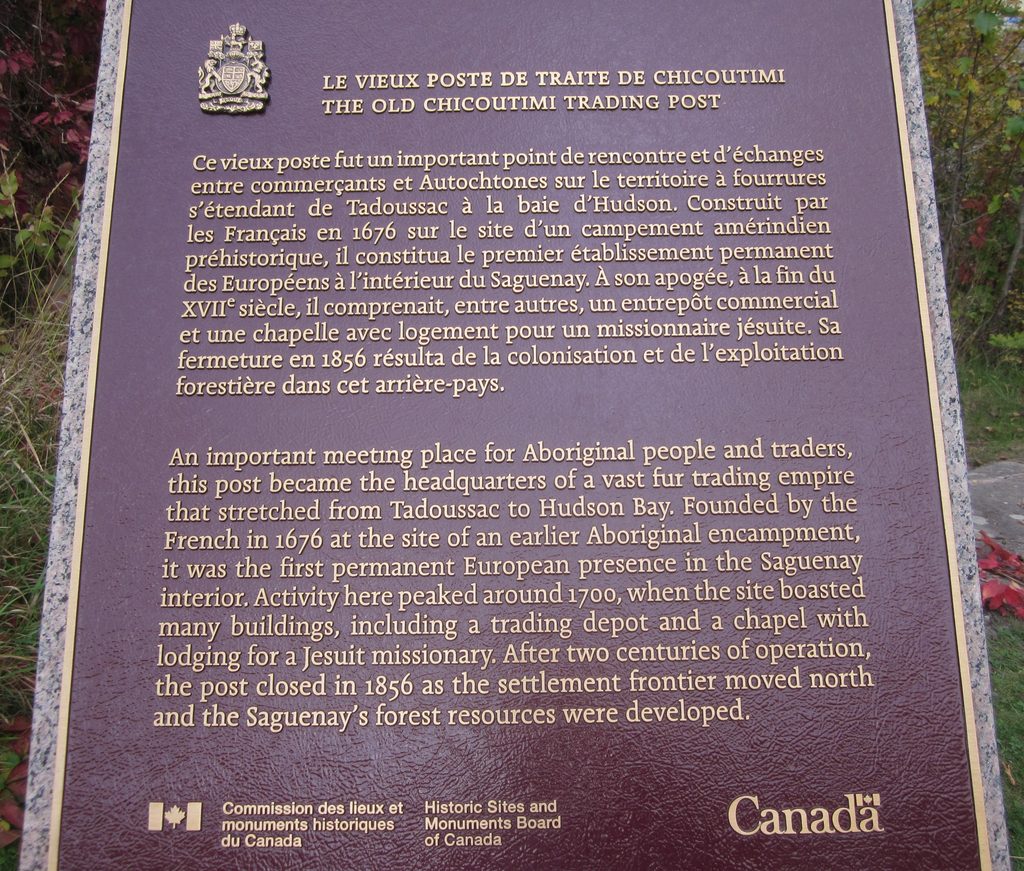
For all of the stimulating panels and conversations, it was something from the opening roundtable that stuck with me above everything else. As we learned, organizers of Chicoutimi’s 350th anniversary program needed to figure out how to frame the establishment of a trading post in the area in 1676. Was Chicoutimi really 350 years old if the site had been frequented by Indigenous people for millennia? Was the anniversary a matter of permanent settlement? If so, the committee and the wider public needed to navigate the complicated history of Native-settler relations in the unceded territory of the Ilnuatsh.
All of this led to a larger question: how to hold and honor two subjectivities simultaneously—or, to put it differently, how to reconcile distinct experiences within a single narrative. The organizers’ answer may seem obvious in retrospect, but it was the product of careful reflection and discussion. They chose to place anniversary celebrations under the banner of la rencontre, the encounter. Rather than telling a French-Canadian story, they made the Native-settler encounter the focal point, each side carrying its interests, its values, and its preconceptions into a single social and geographical site. In other words, Chicoutimi was not to be an Indigenous story or a European story but one of meetings, exchanges, alliances, frictions, and struggles.
In a disciplinary world still dominated by national history, a focus on sites rather than on cultural groups promises significant insights. This sense carries into my work on ethnic history and helps refine my thinking on the subject.
Franco-American history, like the Franco-American identity, teeters on a hyphen. This hyphen represents the meeting of the French-Canadian and American cultural worlds; it centers a specific group around which gravitated the society of the home country, Yankee America, Irish America, etc. But a different landscape comes into view if we momentarily take the hyphen out of the identity and out of the group—if the hyphen is centered in specific social and geographical spaces. This displaces normative experiences and allows us to discover more subjectivities.[2] Engagement becomes the narrative.
To an extent, historians have explored how Franco-Americans have engaged with other ethnic and racial groups. We can read about street fights, assimilationist Irish bishops, and the Ku Klux Klan. Yet, the depth and seriousness with which that work has been undertaken is open to debate. History succumbs as easily as fiction to stock characters. In misrepresenting the other, we miss the true nature of the encounter.
There is no suggestion here of moral equivalency between the actions of an embattled minority (albeit one that regularly staged blackface performances) and those of the KKK. It is rather a matter of exposing the complexity of exchange, which included intermarriage, marriages of convenience in unions and politics, instruction from Irish nuns, contact with l’autre in local stores, sports culture and entertainment, etc.
These sites were a form of contested terrain with all of its uncertainty and unsettledness. Conflict emerged from indeterminacy. In this regard, even when discussing mill cities, we might draw from the insights of borderland studies, a field that privileges space over specific ethnic, racial, or even national lenses. Shelby Balik’s Rally the Scattered Believers (2014) in particular may help us refine our analysis. This work is not the story of a specific denomination but of different groups carrying values and interests in existing physical space, each in hopes of organizing it culturally and institutionally.[3] Whereas the power relations between French-Canadian immigrants and their neighbors were most often uneven (and varied from one field of migration to another), there is a case to be made for the minority’s ability to reshape the host society.
These are all very preliminary thoughts. They will continue to evolve, as they should. For the time being, all of this is to suggest that Franco-American history has yet to yield all of its secrets and, more significantly, we stand to gain by looking laterally to the broader context of historical research.
[1] This “beyond” includes l’Acadie, as an unplanned meeting of the “Acadian delegation” on the Rivière-du-Loup ferry made plain. Researchers also traveled from Manitoba and Maryland.
[2] This extends my reflection on ethnic history as one of many tools, as opposed to the only and obligatory means of understanding the Franco-American experience.
[3] Balik’s subject matter is reminiscent of the conflict over Catholic space in urban New England with competing territorial and national parishes.
Leave a Reply