The anniversary of the Webster-Ashburton agreement of 1842 awaits us on August 9. The treaty resolved many outstanding issues. For the purposes of this post, it settled, once and for all, the location of the northeastern boundary between the British colonies and the State of Maine.
In the St. John Valley, the treaty had a long prologue that erupted as the Aroostook War—the bloodless Aroostook War, mind you. In the 1830s, interest in lumber led authorities, settlers, and lumbermen on both sides of the St. John River to secure once and for all either American or British control of the region. Public officials on both sides sought to warn off or arrest the other country’s agents. Troops were dispatched and barracks and blockhouses erected.
Of the two countries, the British side had been first in asserting its authority and jurisdiction, and had done so as early as the 1780s. Following an exchange with the governor in Quebec, the lieutenant governor of the newly created colony of New Brunswick had granted lands on both sides of the St. John River to Acadian families. The numerous Cyr, Daigle, and Thibodeau families were well represented in this initial cohort, which began making its home in the region in 1785. Gradually, in the early nineteenth century, French Canadians spied new opportunities away from the old and overpopulated parishes of the St. Lawrence lowlands. They sought land among and around the Acadian “charter families,” to use historian Béatrice Craig’s expression. Over time, such surnames as Bouchard, Caron, Michaud, Ouellette, and Pelletier came to outnumber the Acadian ones.
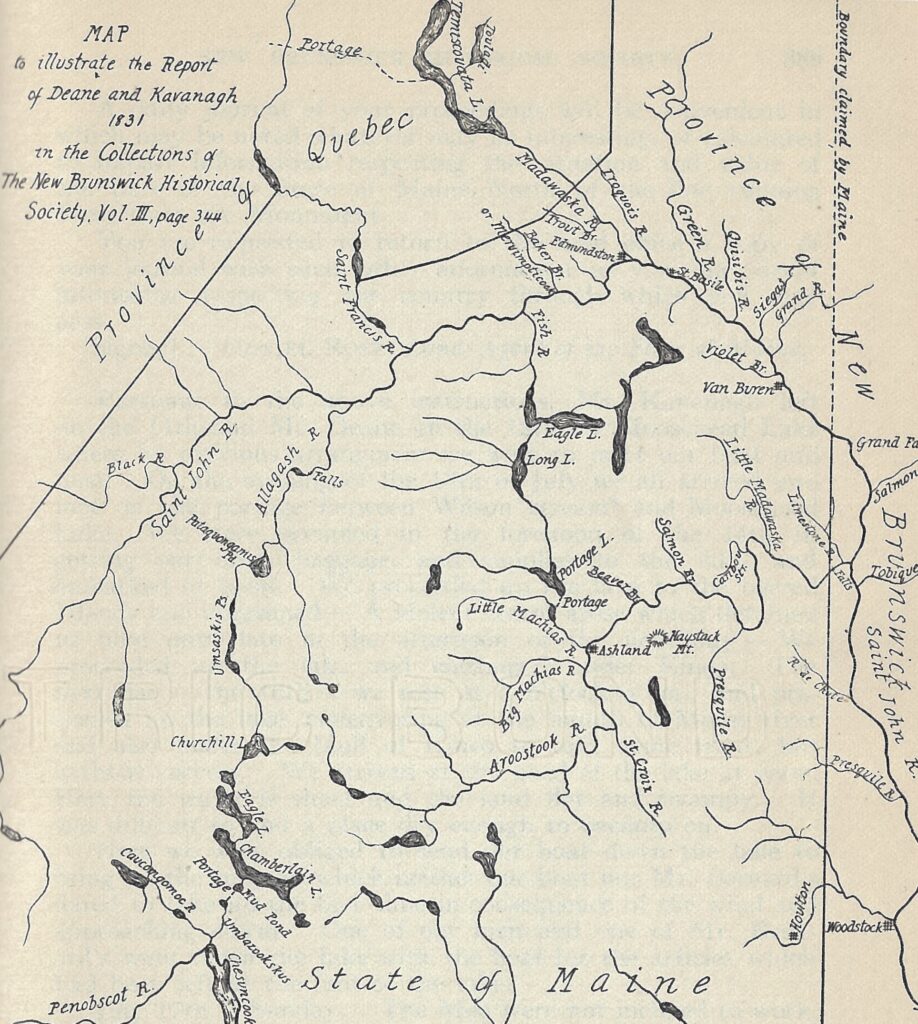
But always looming over agricultural settlement was the geopolitical specter of logging. Timber was being cut without licenses on public lands—or, specifically, public lands claimed by the British. American lumbermen began to clear the most precious timber, pine and spruce in particular, in areas they believed to be Maine. In the 1830s, that included areas well north of the St. John River.
It is in this context, in 1831, that the State of Maine dispatched John Deane and Edward Kavanagh to the St. John Valley. Theirs was essentially a fact-finding mission. They were to report on the progress of settlement and natural resources in the region. The State also expected an account of the existing population—still predominantly French—and its land claims. Kavanagh was especially well suited to the task. A Catholic, he had studied in Montreal. He would later become governor of Maine.
After a long journey through the lakes that lead to the Allagash River, Deane and Kavanagh visited or attempted to visit every household in the region, no small feat. Most residents shared information about the size of their holdings, their improvements, and from whom they held the land.
There is no doing justice to the full report in this short post. But we should say something of the opinions and allegiances of Acadians and French Canadians at this time.
A telling encounter occurred on July 29, 1831, on the south bank of the St. John River, seemingly in the vicinity of present-day Grand Isle. The American emissaries wrote:
We proposed the same questions to Simonet Hebert which we had done to others, and which they had all readily answered. He asked many questions and the object of the mission was fully stated to him in French and English. We showed him the Resolve and Commissions under which we acted, and stated to him distinctly, that he must do as he pleased, he must act voluntarily, but if he gave no account of his claims, he must judge what effect it would have in the arrangements, which the States should adopt. We should not report his possessions. He asked us if those, who had deeds from the British would not hold their lands; we told him they would not on that account, and that the British deeds would be of no farther use than to shew the antiquity of the possession. He and his father, Simon Hebert, and his brother Joseph, have directly and indirectly been much favored by the British.
Later the same day, a similar encounter took place with the father:
We called on Simon Hebert, we proposed the same questions to him as we had to others, showed him the Resolve and our Commissions and he refused to give any answers. We told him we did not wish to compel any man to answer, every other person except his son Simonet had answered freely, and he must judge for himself. We could not report anything as being claimed by him, and he must take the consequences. He persisted in refusing. His son Joseph Hebert was present and refused. Simon Hebert is very much in favor of the British and opposed to this State. He had been much favored by them, and has, by their aid, dispossessed several settlers, and he and his family are now enjoying the fruits of their labors. Whenever the settlers are quieted by the State, if ever, it is to be hoped, that such as have been unjustly dispossessed, will be restored, and that those persons, who are hostile, will not be promintly [sic] favored. Let them seek favor of the British of whom they would like better to receive it, than from us.
The implications were clear. Deane and Kavanagh were applying pressure and stating that if residents did not cooperate, the State of Maine would not recognize the grants they had received from New Brunswick—if and when the region became formally American. It is little wonder that the two commissioners were able to draft a near-complete census of the region.
Still, at the same time, a “loyalist” faction was also applying what pressure it could. Around the Héberts, we find multiple entries stating “Next, S[outh] B[ank], is a possession of which the man living on it refused to give any account.”
Deane and Kavanagh met British magistrate James A. McLauchlan, who rejected their pretensions, five days later. Still, McLauchlan appears to have accompanied them some of the way on the north bank—perhaps to better report on their activities. His presence may have mollified the Acadians at the eastern end of the valley. Irishman Francis Rice, who had been dispatched to help organize the local militia, was more intransigent. Rice was “doing all he can to coerce the French and extend and enforce British usurpation . . . He treated us civilly, but the people relate acts of oppression against him.”
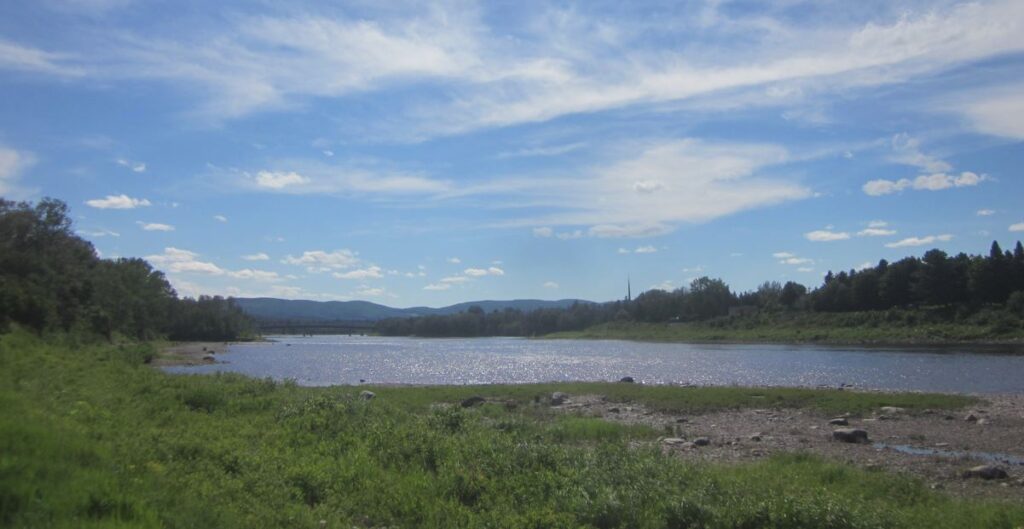
The general tenor of the report supports the notion that the Acadian-dominated eastern half of the valley, more protective of its claims, tended to favor the British side of the conflict. French Canadians had mostly infiltrated the western half; they were more likely to be renting, squatting, or landless. They had greater interaction with the Americans settling on the upper reaches of the St. John River and its tributaries. Joseph Pelletier, whom we have previously met on this blog, is the case in point. Shortly before his passing, in 1840, he hoped to be compensated for his part in helping to uphold American claims in the region.
The mission of 1831 inadvertently created a flashpoint. Within weeks of Deane and Kavanagh’s tour, an emboldened John Baker organized a town meeting under American statutes. In a spirit of confrontation, he held it at the house of British militia captain Pierre Lizotte, another “loyalist.” Having likely conspired in advance, the predominantly American group selected Lizotte as their delegate to the Maine legislature. The idea may have been to win over the French population by nominating him. Lizotte refused and, in September, signed a deposition detailing the meddlesome activities of the American commissioners. They had declared Lizotte a citizen of Maine, while visiting his home, and sought to gain his trust and influence by waving before him the prospect of a legislative seat.
Following Baker’s latest antics, British militia were ordered to the territory to make arrests. The ringleader escaped. But this renewed assertion of British power quieted matters until 1837. Then, five years and a bloodless war later, the lands occupied by the Heberts and Lizottes did in fact become U.S. soil. According to the Webster-Ashburton Treaty, “All grants of land heretofore made by either Party, within the limits of the territory which by this Treaty falls within the dominions of the other Party, shall be held valid, ratified, and confirmed to the persons in possession under such grants, to the same extent as if such territory had by this Treaty fallen within the dominions of the Party by whom such grants were made.”
The verbal claims and pledges made by Deane and Kavanagh were thus silenced.
Further Reading
The Deane and Kavanagh report was reproduced in volume 9 of the Collections of the New Brunswick Historical Society (1914). A significant portion has been reproduced by Chip Gagnon on his website. Roger Paradis presents John Baker’s actions and context in volume 52 of the Dalhousie Review (1972).
For those who dont like reading online, the Deane and Kavanaugh Report is reproduced in full as an appendix in Thomas Albert’s “History of Madawaska” English translation, available from the Madawaska Historical Society.
Thank you Ken!
Fascinating stories, Patrick.
Do you know, were indigenous people part of the survey or affected by the boundary setting?
The Wəlastəkwewiyik long had a village at the confluence of the Madawaska and St. John rivers. The British survey of the 1790s essentially drew a square around the village and allocated the remainder of lands in the region to Acadian settlers. It imposed a Western property system on the Wəlastəkwewiyik’s traditional hunting and fishing territories. With the reservation lying entirely north of the St. John River, American agents did not feel the need to engage with the Indigenous band after 1842; they simply recognized and upheld the existing Acadian lots.