Pamphile LeMay (1837-1918) is little known to recent generations of Quebeckers. But he was once a literary celebrity. Like many of his contemporaries, a civil service position enabled LeMay to dedicate time to his leisures. He wrote poetry, novels, and plays; he also translated Longfellow’s Evangeline: A Tale of Acadie into French. His original works capture some the older traditions of rural French-Canadian society.
Below are excerpts of LeMay’s Fêtes et Corvées, an overview of celebrations and rituals in his home province, which appeared in 1898. The excerpts focus on winter holidays, but the work also addressed other annual festivities. The French version is available online.
* * *
Christmas
In Franche-Comté and almost everywhere in France, the tronche replaces the iconic Christmas tree.
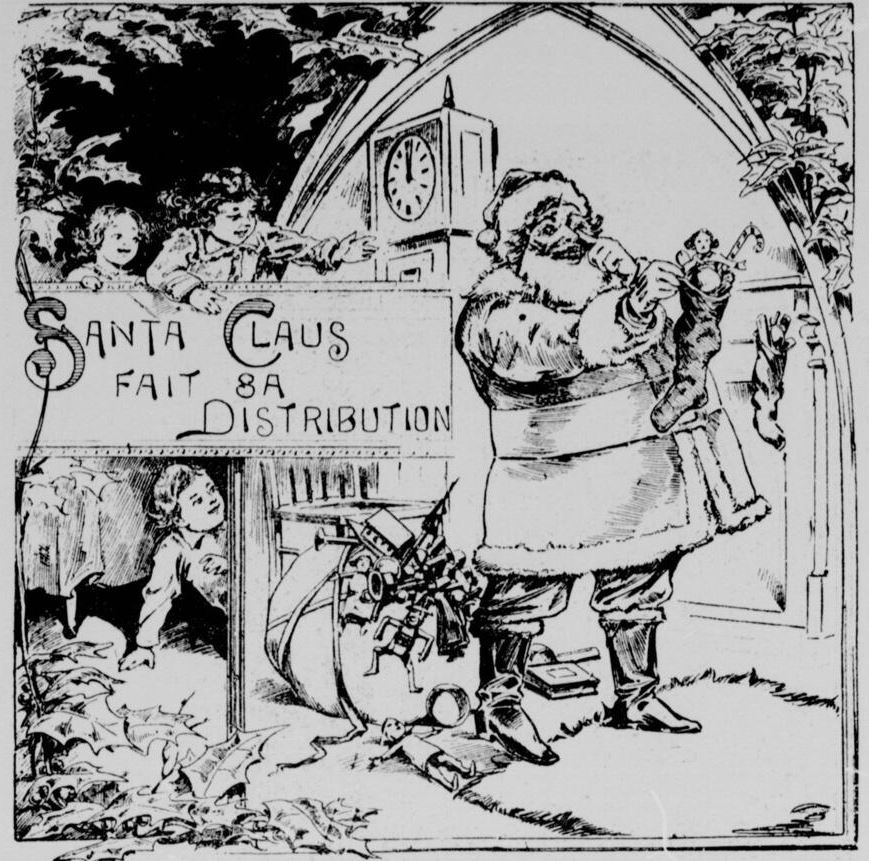
The tronche is an enormous pine log that is placed ceremoniously in the kind of massive chimney that still survives here in some places. Under this log are hidden the presents that the little Jesus has brought to obedient and well-behaved children. On Christmas morning, the family kneels before the log and prays. Then, the father slowly lifts the heavy tronche and the candy and toys suddenly appear before the wide-eyed children. Here, young children hang their socks from the foot of their bed. They fall asleep while dreaming of the candy that the little Jesus will leave as they slumber.
Christmas night is rich in prodigies if we are to trust our grandmothers. I have not verified the stories that I heard and I cannot swear to their veracity.
Yet it seems that during the night, as on the Day of the Dead, the deceased rise, leave their earthly homes, and gather to kneel before the cemetery cross. Then comes a priest in a white surplice and golden stole: this is the last pastor of the parish. He recites the prayers of the Nativity and the dead piously answer. After, the specters stand, turn towards the village of their birth and the home where they passed, and return to their coffins. What this story lacks in truth it makes up in poetry.
Another story that meets the tastes of our times, and that has cursed misers with insomnia, is the one that teaches that, during the night of Christmas, the sand of riverbanks, the rock of hillsides, and the depths of valleys open up, letting their hidden riches reflect the glow of the stars and the moons . . .
A far more unusual story than the preceding, and far easier to ascertain, is this:
During this extraordinary night, men—I nearly said women—do not talk any more than usual, but animals receive the magnificent gift that enables them to conceal their thought: speech! Yes! Bulls and cows, horses and ewes speak strange thoughts that would surprise their masters. With a plaintive voice, they say, oh! how the hay is dry and the oats are rare. They recall their frolics in the prairie and shake with regret the chain that holds them captive. They think… but this will be endless if I share all that animals think of us.
New Year’s Eve
Woe to those who cry on New Year’s Day, for their eyes will still be red at Christmas, an old man of our village used to say . . .
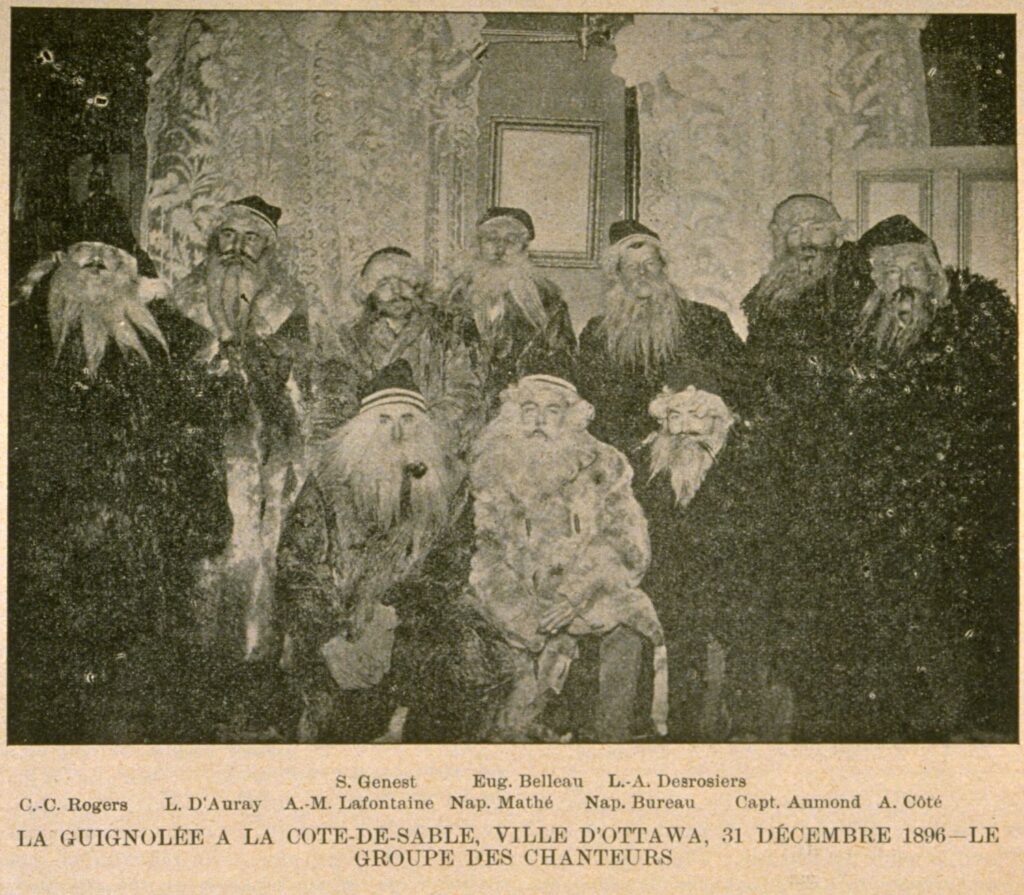
In olden days, in all parishes and all villages, the Ignolée was sung on New Year’s Eve. Those who sang it were called Ignoleux, a moniker they deserved. Armed with long bats and large bags, they went from door to door, singing on the threshold with greater sense than rhyme:
Greetings master and misses
And all of you who dwell here
We have made promises
To visit you once a year…
They marked time with their bats and, with their bags, they collected the chignée. They were greeted with pleasure and people gave generously, for the chignée—a piece of fresh pork shoulder—was destined to the poor of the area. Alas, the selfishness that appears everywhere reached even into the hearts of the Ignoleux—Auri sacra fames! (cursed hunger for gold!)—and these Ignoleux ultimately lost their kindness and kept for themselves what they had received for others. From this time, the ancient institution of the guignolée was condemned.
New Year’s Day is essentially a religious holiday for Christians. We set aside work and business to come to the foot of the altar to thank the Lord for the years we have seen and to pray that He not take us from the world of the living too soon. Eternity is so long!
Carnival
So we come to the fat days. Do you hear the measured trot of horses, the clear ring of bells, the soft sweep of blades on the snow? Do you hear veiled laughs from under the sleighs’ heavy blankets? All day, on all roads, the carriages are about. Friends are off for dinner with friends, kin visit kin. Everyone makes a call or hosts . . .
It is cold and gin is served to warm up, though it would be served even without the cold. Men sit and talk about a thousand things: horses and the harvest, government promises, taxes, and the next elections. The women talk just as much and, if the latest news doesn’t suffice, they edit, review, correct, and expand on old news. Girls form a circle; their feet are burning with the urge to dance. Here comes the fiddle player, carrying under his arm the preciously guarded instrument, a real Canadian stradivarius . . .
However, dancing is not for everyone. For some, a game of quatre-sept is worth all of the other amusements put together. We must not resent these individuals, for the years that extinguish other passions may bring us that of quatre-sept. These courtesans of the cards, worth much more than other kinds of courtesan, have long sat down to play. They face off two against two—honor is at play. By their attentiveness to the cards they hold and play, we might think they are determining the fate of Conservative and Liberal candidates . . .
The characteristic trait of carnival is the masquerade. Yet even the masquerade is being abandoned. It is no longer performed except on Mardi Gras.
Formerly, a serious man and a no-less serious woman would wear an impossibly grotesque mask and the strangest clothes. The man would don skirts and the woman, breeches. Driven by a mysterious coachman, they would go from door to door—drinking, eating, and dancing better than any others, to the great delight of the guests. Sometimes, curious persons would manage to lift the mask and spy, behind a grimace of painted cardboard, a sweet face. Nowadays, in most parishes, only young people and children take the trouble to cover themselves in soot—to scare other children.
For more on winter and holiday traditions in French Canada:
Leave a Reply