But what will it take to give life to those who gave Vermont a second life after the Civil War, after the momentous diaspora that emptied the Green Mountain valleys and piedmonts: the Canadians who took over marginal dairy farms? the Irish who made the railroad work? the Springfield and Bennington Jews who processed mountains of shoddy? the Italians, the Poles, the Swedes, the Irish, the French Canadians who emptied the stables of Shelburne Farm, manicured Arlington lawns, waited on tables at Clarendon Springs, and met the indignities and assaults of being a maid in the white compounds of Saint Albans or the Hill District of Burlington? Who has produced this history of Vermont?
– Joseph-André Sénécal, Vermont History (2003)
Sénécal was not writing about Coos County. But he may as well have been.
Thanks to Manchester and Nashua, we might think that the Franco-American history of New Hampshire has in fact been written. This is true if we reduce the Franco-American identity to its urban, industrial expressions—an idea that has the effect of impoverishing Franco-Americanness, for, if the textile industry is dead and the national parishes are a thing of the past, aren’t Franco-Americans as well?
The Franco-Americans of today have much more in common with the small, self-selecting groups that gathered in hinterlands often without any supporting cultural infrastructure. In this sense, there may be something in Whitefield that is especially relevant to the present.
Significance is one thing; narrative is another. As this historian sees the matter, there are two overarching challenges in writing this ethnic history.
First, very few people care about ethnic history that is not their own. We can lament that “Yankees” have failed to write about Franco-Americans. But how many Francos have produced comparative works that include the stories of Irish, Polish, and Portuguese immigrants?[1] Or that focus meaningfully on intercultural relations? Erasure occurs across the board.
A related challenge: we must resist the temptation of thinking that ethnic history is the only kind of history to be written about Franco-Americans. As historians, we have to learn to cleave stories from different angles. From one angle, you may have a “traditional” ethnic history. A different cut may reveal a gendered history; another, an economic history that connects all people of a certain class. Franco-Americanness is present throughout the story, such that, as all of these pieces intersect, each will reveal an aspect of the ethnic. In this sense, it is possible to write about ethnicity without writing ethnic history.
Otherwise stated, if done well, cleaving might acknowledge the ethnic element without necessarily making it the focus (though a focus it might also be). If done well… for, at times, cleaving can miss the story entirely and, in this regard, the case of Whitefield is instructive. Three major works tell its story, and their limitations quickly become apparent.[2]
The first, published in 1888, was the History of Coos County, New Hampshire, written in part and assembled by Georgia Drew Merrill. Like Abby Hemenway’s comparable work on Vermont counties, Merrill’s book chiefly mentioned people of French descent in connection with colonial-era warfare. Otherwise, French Canadians appeared—sometimes between the lines—in discussions of the Catholic Church in the county. That was it, largely.
Several generations later, in the 1940s, University of New Hampshire student C. Douglas McIntyre wrote a master’s thesis titled “A History of Whitefield.” From the historical standards of the twenty-first century, one struggles to be kind to this study. The primary sources are few and the analysis, at best light. It is also heavily reliant on the 1888 work. The word “French” appears sixteen times in the thesis and not once does it refer to local residents. (“Canadian” appears once—to designate the border.)
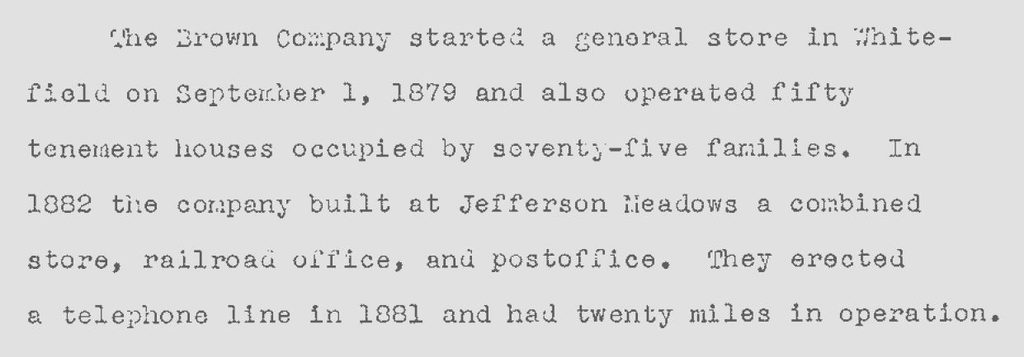
The final work is an article published in Historical New Hampshire in 1972. This was Gordon B. McKinney’s “The Land No One Wanted: An Economic History of Whitefield, New Hampshire.” This was a properly historical work, though it too rested on Merrill in addition to a small number of town records. McKinney wrote, “Most of those who worked in the mills were local residents, but nearly all of the lumberjacks—at least half of the Brown Lumber Company work force—were French-Canadians. Their number grew so rapidly that by 1893 St. Matthews Catholic parish in Whitefield was able to complete a major building project.” So the Canadians enter and depart from McKinney’s work, not least with the implication that these people were not local residents.
So, admitting that no one should be compelled to write a strictly ethnic history, we are still left with nearly a century of historical writing without it—that is, with hardly any acknowledgment of who and what Whitefield residents were. We might think, from works of Franco-American history and works of local history alike, that the town had no French-Canadian presence of consequence.
But we have stones. On Route 142, there are monuments bearing French names, and not just a few. Behind those stones are sources attesting to an ethnic presence: New Hampshire death records, census returns from both sides of the line, the parish registers of Quebec, and tantalizing newspaper articles. As far as Whitefield is concerned, no one has even scratched these documents. Many generations later, we are left to believe that the dead have taken their stories and their secrets with them.
There is something in it for us in letting them speak again.
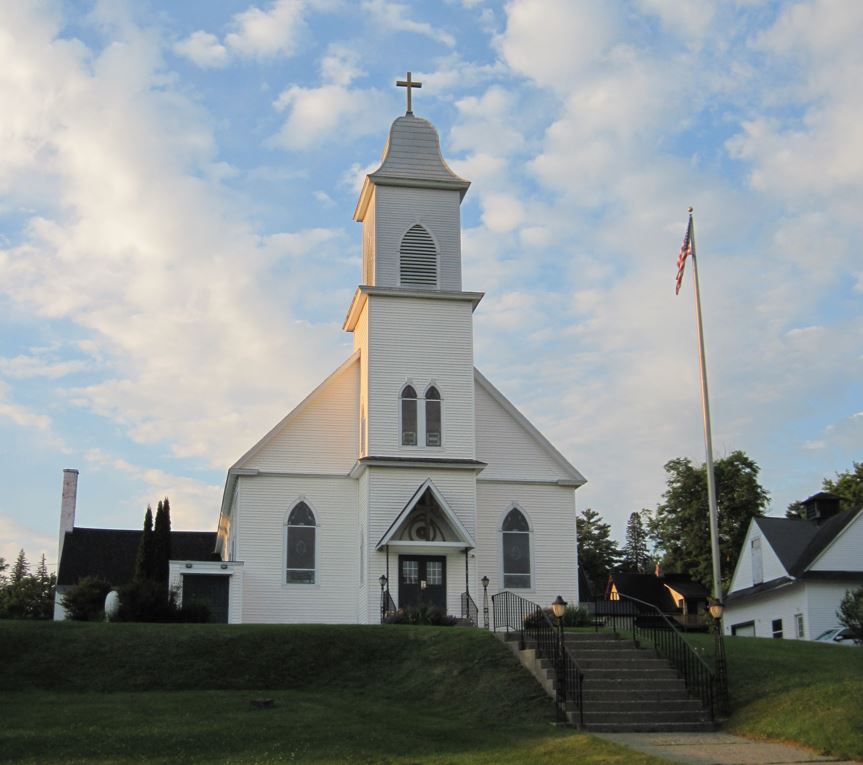
In the final post in this series, we will look at the grave markers and the stories that lie behind them.
[1] Yes, Irish immigrants and their descendants appear in works of Franco-American history. But when are they more than foils or persecutors? When are we allowed to understand their perspective?
[2] As, of course, the limitations of my work will be apparent within a generation.
Leave a Reply