In December, we learned about Pamphile LeMay’s Fêtes et Corvées, an overview of celebrations and rituals in Quebec at the end of the nineteenth century. That blog post focused on winter holidays. This time, we turn to spring, summer, and fall traditions which, year after year, marked the rhythm of life in rural French Canada.
LeMay’s book is available online in its original French version. The following excerpts have been translated by your faithful blogmaster.
* * *
The Feasts of St. Joseph and St. John
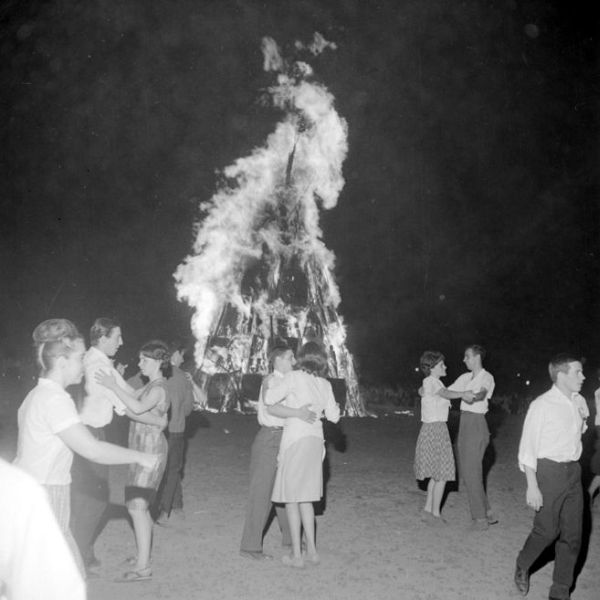
In 1638, there is mention, for the first time, of honoring St. Joseph with cannon salutes and fireworks. Father Lejeune states, in fact, “The feast of the glorious patriarch St. Joseph, father, patron, and protector of New France [on March 19], is one of the great solemnities of this country. On the evening preceding this day that we cherish, we raised the flag and fired cannon. Bonfires commissioned by the governor were of a spectacle such as I have seen in France.”
However, ten years later, in 1648, the zeal was diminished and fires were snuffed. “On the eve of St. Joseph’s day, there were no bonfires as was tradition,” wrote Father Lejeune. “I was in part the cause, for I did not relish a ceremony unaccompanied by religious devotions.” St. Joseph’s day was condemned . . . For the last time, in 1661, we find mention of the feast as a popular, secular holiday, but we know with what brilliance and magnificence the religious celebration was carried down to us . . .
Our fathers were not satisfied with lighting bonfires in honor of St. Joseph; they sought to please St. John the Baptist by burning, also, on the eve of his feast [June 24], entire firs that had been dried for the occasion. I cannot give an exact date for the first St. John’s day bonfire along our shores, but I see that in 1636 the day was celebrated in Trois-Rivières with cannon salutes and all sorts of innocent pleasures the night prior . . . However, St. John fires were not lit at all homes nor in all parishes; for more than two centuries, echoes of this gay celebration did not reach beyond the parishes placed under the protection of St. John.
Harvest Time
The harvest is almost entirely packed in the barn and awaits the primitive flail or the voracious mill brought through the march of progress. But one piece is not yet in storage. Stalks that have met the reaper have yet to be bundled. Judging by the group that we see working, that piece will not wait much longer. Protected by the ancient red leather mitt, boys and girls bend down to gather the wheat and rise, successively or as a group, to come and lay the bundled stalks . . .
There is only one bundle left to tie—the last one, the big bundle. The workers double their efforts. Two long ties come together as a belt that hugs its soft waist. It is made to stand. Flowers are attached to the ears and ribbons to its straw skirt. Then, hand in hand, the workers dance rounds. They exhaust their repertoire of old folk songs and fill the sky with laughter, whispers, and shouts . . .
At last, the big bundle is placed on a large wagon, the harvesters pack in around it, and the horse—decorated with red or blue pompoms, all depending on its political leanings—advances at a slow but steady pace, listening to the cry of the axle or thinking of the inequality of conditions. It carries on to the barn where the bundle will sleep its last slumber, forgotten by the small and the humble.
Corn Husking
A pyramid of Indian corn has appeared almost miraculously in the room, that is, the kitchen—for our farmers know only of three rooms: the cuisine, or kitchen, the chambre, and the cabinet. The kitchen is the main room and the majority of our lives is spent there. I don’t mean anything malicious by saying so. I mean to say that the kitchen is on its own practically the entire home. There, the pot is brought to a boil, we welcome friends and family, we eat, and we work. The chambre is something else. It is used on the four great holidays and for suppers during carnival. Gentlemen are always welcomed there, as are the pastor and the church trustees. The cabinets are the bedrooms, where we awake for the first time and go to sleep for the last. So, in the middle of the kitchen, a pyramid of ears of corn warmly enveloped in their skirts rises . . .
The husks fall in bunches, pile up, and soon form soft cushions. The workers cling to one hope, the hope of finding a blé d’Inde d’amour—that is, an ear of red corn—for such an ear surpasses any talisman. Not only does it keep you from bad luck during the evening; it grants you a sweet privilege, that of kissing anyone you wish. Sometimes the holder of this happy find hides both his joy and his corn cob, and surreptitiously lays a kiss on the cheek of an unsuspecting party—only then showing, in the midst of laughter and applause, the red cob. At other times, the finder instantly shouts with joy and brandishes the ear like a trophy. Eyes dart around for the likely recipient of his affection. Often, the favored girl, who isn’t without her suspicions, betrays herself by blushing. The red corn cob may be used only once, but try to find a law that isn’t flouted! I have seen a red cob in an épluchette where all of the corn was yellow; I saw the same one come out some twenty times from improvised husks. It had come from a different husking party and I suspect it had been painted. Foresight can be an excellent thing . . .
Girls that find a blé d’Inde d’amour cannot hide their emotion, nor their joy, but typically they do not avail themselves of the privilege it conveys.

Linen Bees
Do you wish to find the linen workshop? Spy the blueish smoke rising in spirals over the trees, near the entrance to the woods. A brook babbles nearby. A handsome notch, cut from the bank of the brook, has been chosen as the arena where linen makers may skillfully and hastily ply their trade. Linen making, like an épluchette, is a corvée (a bee), but a happy and pleasant one. It would be tedious work to beat—alone—seventy-five to a hundred handfuls of flax in a day. To stanch boredom and muster courage, friends are invited. No scene can compare to this active band that breaks, crushes, presses, and beats the flax with indefatigable arms, and while ceaselessly laughing, chatting, and singing. Yet, this is hard work, for the flax cries and convulses for some time before losing its light bark and straw, during its metamorphosis as soft and shiny strands of silk . . .
Like an ancient vestal, the chauffeuse—for generally it is a woman who dries the flax—maintains under the rack a fire that must not expire until day’s end. The rack is a sort of wide ladder, not very long, that sits on four poles planted in the ground. On this ladder, with its rungs simply placed across rather than fitted, the flax is spread in relatively thin layers. The flax must be quite dry to break apart into a thousand strands under the wooden machine . . . When corvée days are over, and there is not a bundle of flax left in the barn, but instead a hundred laces of linen in the attic and a number of bundles of rough twine in the shed, the time comes to pay the linen makers. A party is organized . . .
For more on nineteenth-century rural life:
Leave a Reply