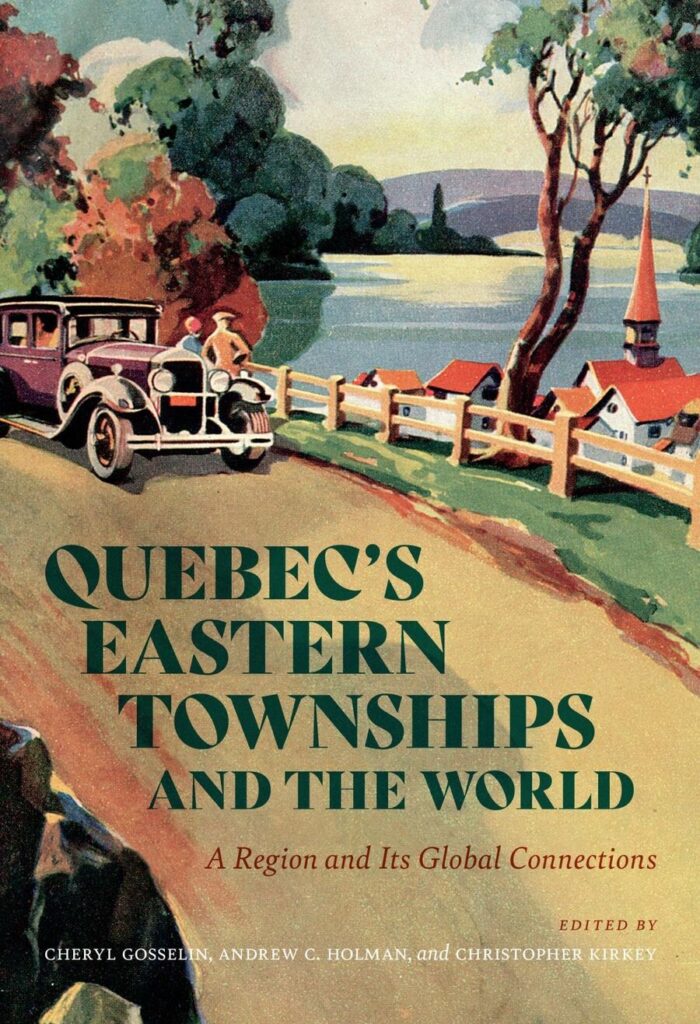
A sneak peek of a book that speaks to my experience and interests was among the surprises of the last ACQS conference, in Quebec City—a happy surprise for the individuals involved in the project. Since then, Quebec’s Eastern Townships and the World has appeared in print and it has not disappointed. Edited by Cheryl Gosselin, Andrew Holman, and Christopher Kirkey, this collective work places the Eastern Townships in contexts and networks that transcend Quebec’s present boundaries.
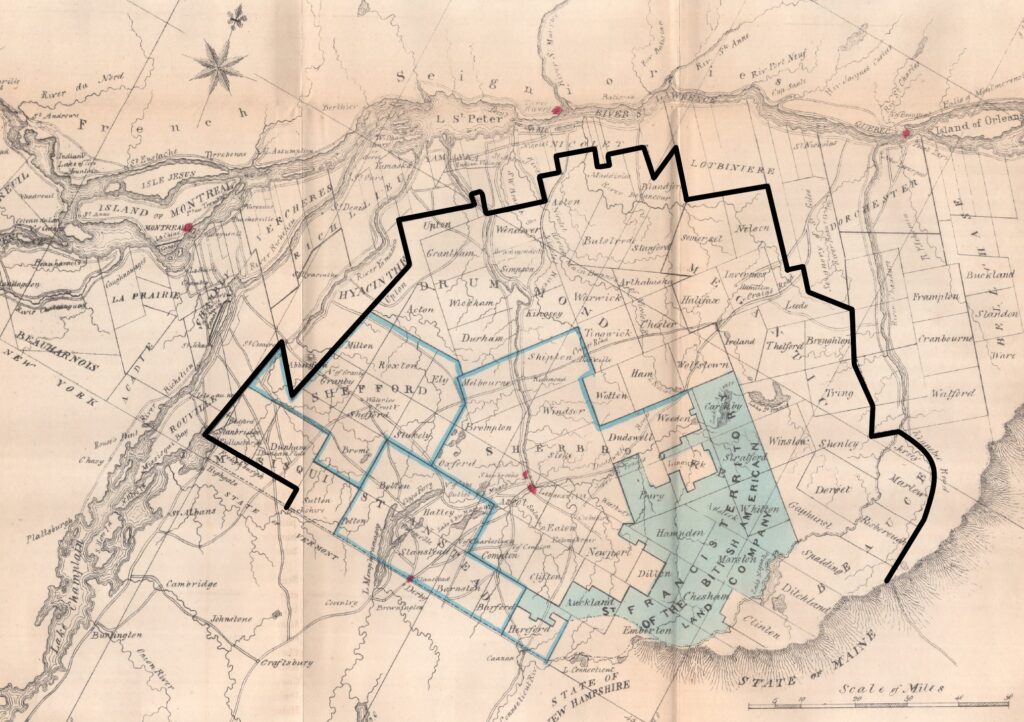
The Townships are a historic region of the province easily identified, even on current maps, from the grid-like pattern of land grants. At the time of the U.S. Revolutionary War, French settlers had begun to form communities along the Chaudière River and to work their way up the Yamaska. Their settlements grew under the system of seigneuries issued by the French colonial regime. Between the Chaudière and the Yamaska lay a section of the historic homeland of the Wabanaki that remained closed, largely, to permanent European settlement until the 1780s.
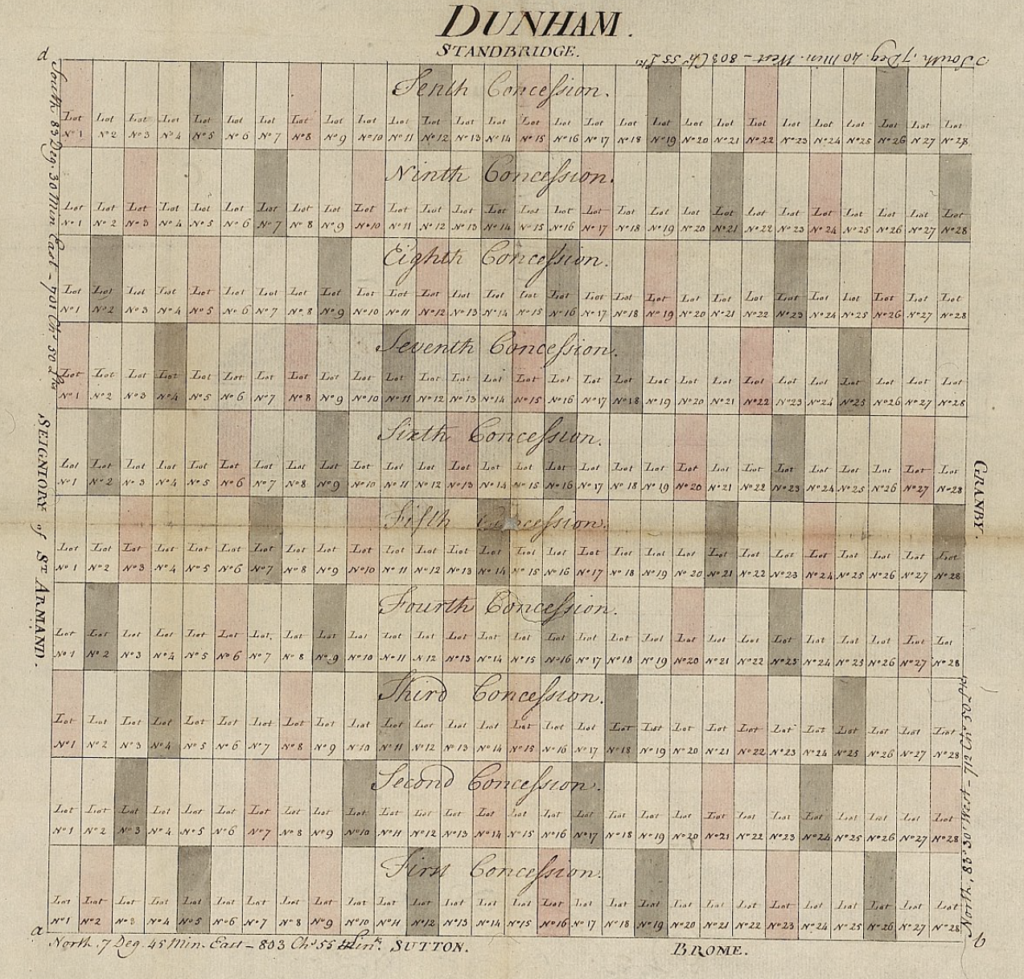
The arrival of American refugees, the Loyalists, and the end of the American war decided the fate of the region. To compensate the loyal population and develop this remote region of the colony, the British colonial government encouraged prospective settlers to organize and apply to form townships. The earliest townships were erected in the southernmost areas: along the new international border and along the old seigneuries. Dating from 1796, the Township of Dunham was the first to come into existence.[1]
Although outside of the Eastern Townships as a region, other townships would be created around Lower Canada, including in areas south of Montreal (Godmanchester, Hemmingford, Hinchinbrooke, etc.).
On the heels of the Loyalists came “late Loyalists,” by which we mean land-hungry Americans who were not displaced politically.[2] Settlers also came from the British Isles. Some townships were soon home to distinctive clusters of Irish and Scottish immigrants. Then came French Canadians—first as a trickle and then as a flood.
Here and there, in the first half of the nineteenth century, adventurous or desperate Canadiens tried to make a fresh start in the Townships. My great-great-great-great-grandfather, Antoine Bombardier, was among them; his presence in Dunham is ascertained as early as 1825. He was then a neighbor of Charles Roy and Pierre Brissette, who had also come from Saint-Césaire. Antoine’s granddaughter, Mary Jane, married a Lacroix. The Lacroix clan had likewise come from Saint-Césaire at the end of the 1830s; they were among the first French Canadians in nearby Brome Township.
In the 1840s and 1850s, the Townships became entwined with the United States in new ways. While navigating a string of crop failures, Lower Canada experienced rapid population growth. For lack of options, families had begun migrate to Vermont and New York State to support themselves. At this time, there was little to distinguish the predominantly English-speaking Townships from the border states, the main difference perhaps being that the latter offered more opportunities for wage labor. At the turn of the 1850s, Catholic missionaries called upon the colonial legislature to provide incentives for French-Canadian settlement of the Townships and therefore keep them in Lower Canada. Emigration to the United States Canada continued, but, incrementally, the ethnic balance of the Townships did shift. A prior QTP blog post has studied the Townships’ migratory connection to Vermont.
As Quebec’s Eastern Townships and the World highlights, emigration is only one dimension of the region’s transnational history. The book’s chapters touch on five ways by which the Townships have engaged with their wider context since the eighteenth century:
- The legacies of the Indigenous peoples whose ancestral territory never conformed to our modern boundaries.
- Close ties to the United States during the Civil War era, particularly in the form of Canadian enlistments and then Jefferson Davis’s momentary stay in Lennoxville.
- Engagement with the world through (e.g.) local news coverage and sporting events.
- The image of the Townships projected to the world in postcards and the works of Louise Penny.
- Recent expressions of pluralism—and its limits—in the Townships’ religious landscape and in educational opportunities in border towns.
The question of the Townships’ distinctiveness naturally arises. Could the chapters appear with only minor changes in studies of Quebec’s other regions?
The region’s landscape—which molded its economic fate—, its close relationship with the United States, and the populations that developed it are important aspects of its unique character. Beyond “objective” characteristics, the editors remind us that “the Eastern Townships [have] existed, perhaps most importantly, in the minds of Quebecers as a distinctive place.” Indeed, local historical societies, the Eastern Townships Resource Center, the Journal of Eastern Townships Studies (colloquially, JETS), the promotional work of Tourisme Cantons-de-l’Est, and works like Quebec’s Eastern Townships and the World speak of the region as a discrete object of inquiry. With the latest work, the discrete object is placed in a wider context that finally does justice to its historical journey.[3]
On a personal level, both at the ACQS conference and in reading the book, it was a pleasure to discover this in-depth study and rediscover a region that shaped my ancestors and me. The book project involved four of my former professors at Bishop’s University as well as scholars from New England whom I greatly admire.
On a broader level, the editors have given readers from the Townships, from other areas of Canada, and from the United States a terrific opportunity to learn about a region of Quebec that easily disappears in overarching histories of the province. I hope QTP readers will pick it up and, as the summer season nears, see the Townships for themselves.
[1] In French-language publications, in the mid-nineteenth century, it was common to refer to the region as the Townships de l’Est. Cantons eventually emerged as the closest translation of “townships.” The provincial government created an administrative region named Estrie in 1981. This, however, is not an exact equivalent of the Eastern Townships, for it has never covered the entire historic region lying beyond the seigneuries. The Région touristique des Cantons de l’Est corresponds more closely to that region.
[2] Many of the American settlers maintained a relationship with the United States. For instance, my Webster and Leavitt ancestors, who came from New England, had many descendants who, after several generations, followed opportunities back to the United States.
[3] The book adds fruitfully to the 800-page reference work Histoire des Cantons de l’Est (1998) edited by Jean-Pierre Kesteman, Peter Southam, and Diane Saint-Pierre. It also adds substantially to the works of the most prolific historian of the Townships, J. I. Little, who contributes a chapter.
My father’s side of the family is from the Eastern Townships. I got to get this book.
I think you’ll enjoy it — it offers a bit of everything. I remember you mentioning that your ancestors had gone to Salmon Falls, N.H. Is that the branch that came from the Townships? I am discovering more and more connections between the northern areas of the Townships (notably Arthabaska County) and Seacoast communities like Newmarket and Somersworth.
My ancestors were there too. Anglophone Free Will Baptists from Vermont and New Hampshire to Coaticook and Compton, who 100 years later would return to the US, leaving little behind but their tombstones.
Pingback: This week's crème de la crème - April 11, 2026 - Genealogy à la carteGenealogy à la carte