Canada was a close witness of the Civil War. A great many of its sons even took part in it, such that the events of this great tumult do not find us all indifferent. The episode that Mr. Tremblay resurrects belongs to American history by its stage, but belongs to ours by virtue of the actors who played upon it.
So declared La Presse in January 1885 in its review of Rémi Tremblay’s recent novel, Un Revenant. Tremblay, a former journalist and now a translator, had himself enlisted and fought in the U.S. Civil War. Twenty years later, he revived his experiences and entwined elements of fiction. On September 8, 1884, Montreal’s La Patrie, owned by Honoré Beaugrand, began publishing the end result serially. The full story appeared as a single volume at the end of that year. The reception was largely positive.
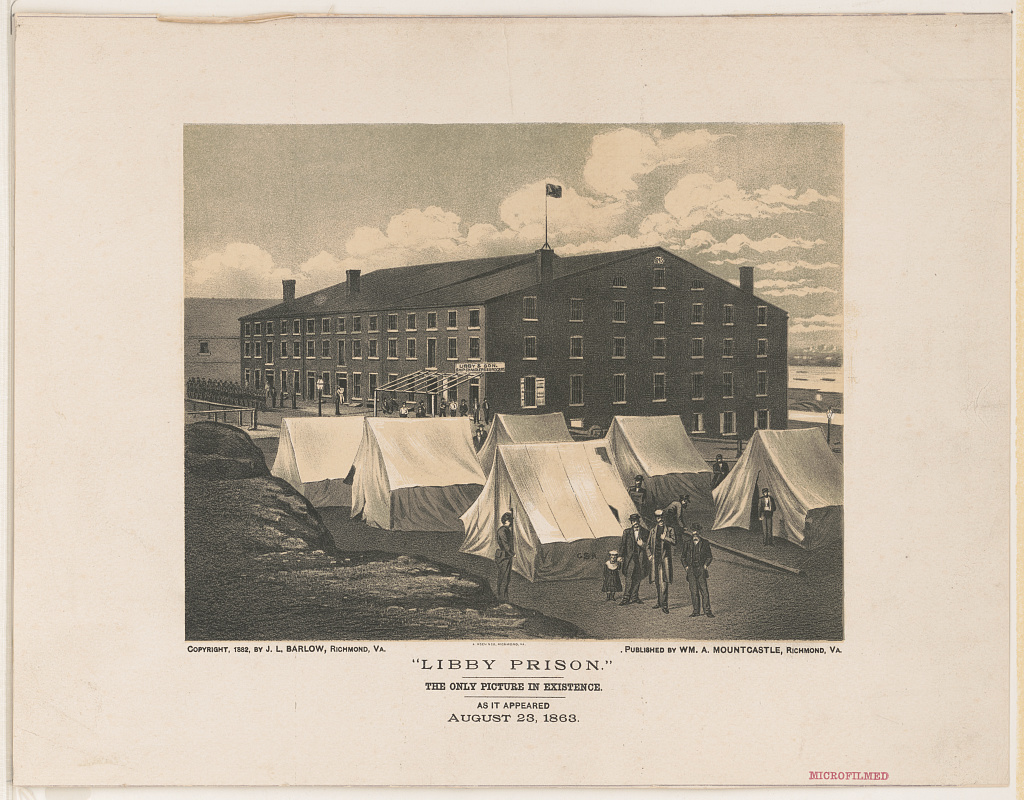
The author’s life journey was complicated and, in retrospect, is not easily traced. Tremblay was born in Saint-Barnabé, six miles north of Saint-Hyacinthe, in 1847. In the 1850s, the Tremblay family appears to have lived a semi-itinerant life, finding work in a half-dozen American mill towns. They repatriated from Woonsocket to Lower Canada at the start of the U.S. Civil War. In 1863, aged only 16, Tremblay crossed the border and enlisted in the Union army. He fought in the brutal battles of the summer of 1864. Taken prisoner by the Confederates, he spent months in the Libby Prison in Virginia. As the war neared its end, he was released and rather than reporting to his regiment, he deserted and returned directly to Canada.
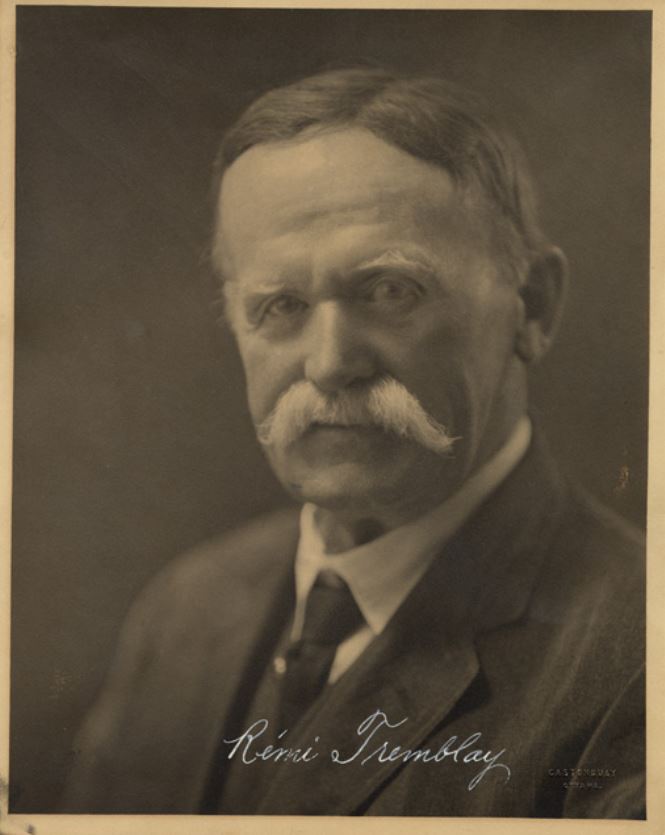
Tremblay’s American adventures were not over. He moved to Woonsocket around 1868 and became involved in journalism. He wrote for the Vermont-based Protecteur canadien and became a correspondent of the Pionnier de Sherbrooke. He moved to the Eastern Townships in the 1870s. He continued to work in journalism, including as translator for La Minerve, while supporting the Conservative Party. In 1884, he became a translator for Parliament in Ottawa, which seems to have provided him with the freedom to write Un Revenant. Only the next year, he left his position to serve as editor of L’Indépendant in Fall River. This did not prevent Tremblay from returning to Canada, resuming as a government translator, and then taking an active part in politics—this time against the Conservatives. His public attacks on his former allies for the hanging of Louis Riel would cost him his job. He returned to the civil service in the 1890s and spent his later years travelling. He died in the Caribbean in 1926. His death was front-page news in Ottawa.
Tremblay’s life was one of movement. He was never quite of New England, or of the Eastern Townships, or, until his later years, of Ottawa. Through his career, Tremblay was embroiled in countless controversies—political, religious, and sometimes personal. Surprisingly, he has yet to benefit from a full-length biography, though Jean Levasseur’s articles come close to a full portrait of this complicated figure. This merits mention, for Tremblay’s place in historical memory is likely entwined with the relative invisibility of Un Revenant. Tremblay is little-known today; he typically appears in passing, in historical works, for his involvement in the controversies of the day. His engagement with Franco-American cultural life was significant but brief. He did not become a Gagnon or a Lenthier.
Then there is the literary aspect of his work. Un Revenant has not entered the consecrated canon of Quebec literature like Jean Rivard and the twentieth-century romans de la terre. It remains buried with the historical fiction of Joseph Marmette, also unknown to present-day Quebeckers. Tremblay’s novel being largely apolitical, it may be that subsequent writers, literary critics, and journalists saw it as light literature that did not say much about the times or about “the nation.” Certainly it intersected little with the culture of survivance that existed on both sides of the border. Further, whereas Beaugrand’s Jeanne la fileuse provided Franco-Americans with an origin story and legitimacy, Un Revenant has little to say about the life of ordinary expatriates.
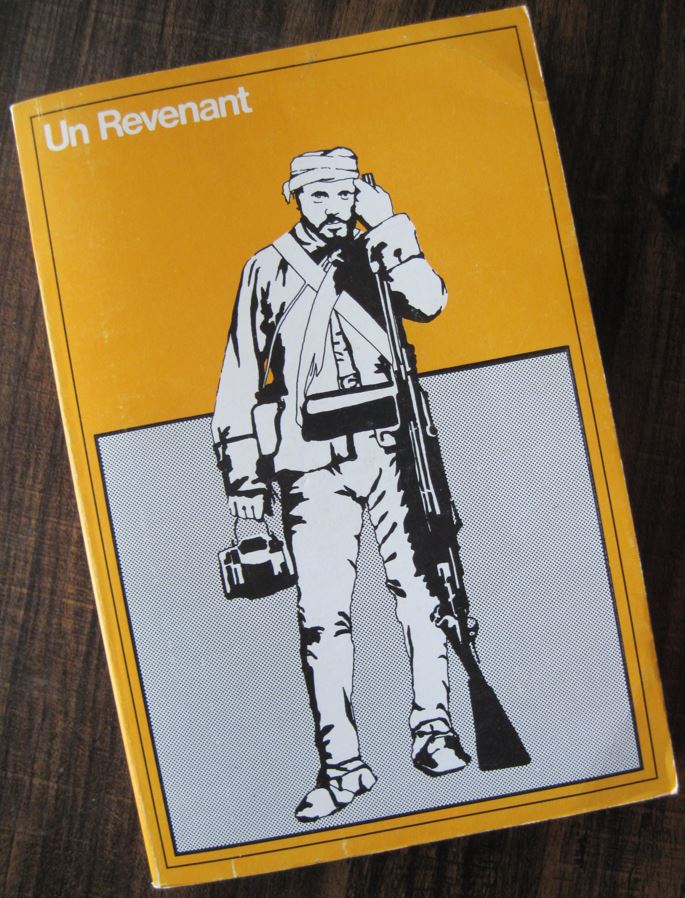
So, what is this seemingly light piece of literature? The novel begins with Léon Duroc, a young man who, while on an errand in Montreal, is swindled of money that his employer placed in his care. To reimburse the amount and restore his reputation, Duroc travels to the United States and joins the armed forces. He sends the enlistment bonus to Canada and joins his regiment in Virginia. In the ranks, he meets fellow Canadian Eugène Leduc and they become inseparable—that is until Duroc is wounded and presumed dead. The focus turns to Leduc, the hero through two-thirds of the novel. Having lost his friend, Leduc deserts, spends time in a Confederate prison, briefly joins a Confederate unit, and lands in a Southern prison again. An exchange of soldiers in the final weeks of the war puts him at risk of execution, for desertion, by the Union army.
The latter part of the book takes us back to Lower Canada and to those who swindled Duroc. We also learn about the fate of Louise Latour, Duroc’s love interest. This scaffolding leads to the predictable ending implied in the title: the return of the soldier long presumed dead.
Margaret Langford translated the novel into English several decades ago. Her version’s title, One Came Back, misses the double meaning of the French one. A revenant can be a person who returns in a literal sense, as Duroc does, but it can also be a person who died and who returns as a ghost or spirit. As Duroc is believed to have died, his reappearance is also an apparition. There is yet another meaning: we might believe that the war changed both Duroc and Leduc in a profound way and that they were born anew from the trauma of battle. In any event… two came back.
Un Revenant is an adventure novel with a dose of romance as Louise awaits the return of her suitor and, upon learning of his death, swears never to marry. From a twenty-first century perspective, much of it feels wooden. The characters speak like every moment is an opportunity for oratorical prowess. Louise is a one-dimensional model of chastity, faithfulness, and obedience. The two soldiers are, similarly, physical incarnations of core virtues. They are strong and won’t suffer any challenge to their character. Leduc, at least, is somewhat unpredictable. The events he traverses in the interest of self-preservation make for a lively and suspenseful read.
These experiences also offer a realistic account of the Civil War from someone who lived it. Through the two soldiers, Tremblay presents the horrors of the last year of the war, including trench warfare and futile charges that we often associate with the First World War. The depiction of conditions at Libby Prison is as horrific as it is eye-opening from a historical perspective. With the benefit of distance, Tremblay could have succumbed to nostalgia, as some survivors did, and depicted the war as a romantic struggle. His characters highlight the messiness, ambiguity, and occasional madness of a war that nevertheless produced “a new birth of freedom.”
As we saw, the novel was largely apolitical. Still, Tremblay connected it to the public discourse of his time and to Beaugrand’s work, which was political. Beaugrand subtitled his novel, which had appeared in 1878, Episode de l’émigration franco-canadienne aux Etats-Unis; Tremblay, Episode de la guerre de Sécession aux Etats-Unis. Beaugrand interrupted the narrative to editorialize about Canadian politics, the cause of emigration, and the dignity of migrants. Tremblay did no such thing, but he did put in the mouth of his characters, shortly before the epilogue, words that echo Beaugrand’s.
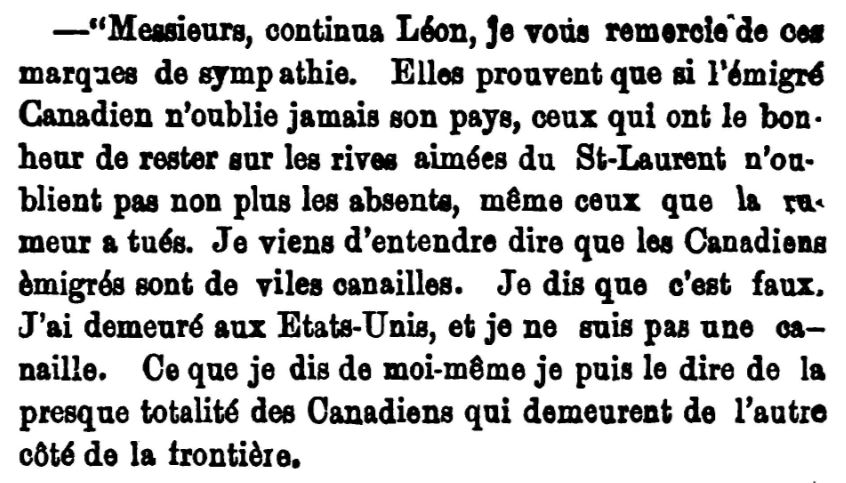
Duroc’s reappearance in the village he had left years earlier, which hastens the end of the story, occurs during a debate between candidates for a House of Commons seat. One of them, Bagoulard, pressed on the issue of emigration, states that it is the rabble (“canaille”) of Quebec that migrates to the United States. Invited on stage, Duroc responds:
I have just heard it said that Canadian emigrants are but a vile rabble. I say it is false. I have lived in the United States and I am not a scoundrel. That which I say of myself can be said of the near-entirety of Canadians who live on the other side of the border. Among the discerning crowd before me, there are a great many men who, like me, tasted the bitterness of exile. I ask you: are they not all hardy and honest workers who would honor any nation? . . .
And who are those who come here to sling mud at these honest tradesmen? In the present case, it is a man whose vile debauchery has become the legend and lore of the principal city of the province . . . I am not an orator, but I am an honest man, which is worth much more. I conclude with a word of my thinking: the Canadians who have emigrated to the United States are honest workers and the rabble is to be found among those who denigrate them.
This summarizes, in abridged and much more natural form, Beaugrand’s editorial. Tremblay could have depicted the United States as a land of apostasy and pauperization. But, in the novel, Leduc earns enough in New England to open a store in the Eastern Townships, while Duroc makes a small fortune from investing in Southwestern mines.
Not coincidentally, Tremblay’s relationship to budding Franco-American communities paralleled Beaugrand’s. Duroc’s speech shows that expatriated Canadians were still fighting on two fronts in the mid-1880s, that is against the slanders of American nativists and of opinionmakers in Quebec. Both fought the latter through their novels; they also had on-the-ground experience in Fall River, where they carried the struggle for survivance alongside exiled compatriots. Months after the publication of Un Revenant, Tremblay was in Massachusetts and helping to lead the charge for national parishes.
The meaning and legacy of literary works are always in motion. But, nearly a century and a half later, understandings of Un Revenant have crystallized—perhaps not favorably—and enable us to sort out the significance of Tremblay’s work. As Constance Gosselin Schick stated in The French Review (2002), the challenge of this novel lies in its disparate elements: it offers a little bit of everything. This “failure” to meet contemporary and subsequent literary conventions may have impeded its legacy. It is neither a pure adventure novel nor a pure treatise on migration, among the many things it might be. The novel’s artistic qualities do not meet modern tastes. However, this is not to say that it should remain obscure.
Like Canuck, Un Revenant requires a sense of its context and its author’s journey to be fully appreciated. It is an artifact, which by no means undercuts its value. Bracketing the story, we find social criticism that is actually meant to uphold “traditional values” as they were understood in the 1880s. Through his work, Tremblay broadened French Canada’s horizons geographically without displacing la patrie or its ideals. He revealed another intersection of the day: the hope of providential expansion versus the security of a provincial, agrarian nationalism. Importantly, as La Presse argued, he pulled the curtain on a moment of North American history that touched 15,000 French Canadians and their families, inaugurating for many of them an embattled relationship with Americanness. Feelings surrounding that relationship have changed little since the 1860s.
Further Readings
Tremblay’s novel was reissued several generations ago by the National Materials Development Center for French. Margaret Langford’s translation appeared in 2002.
Tremblay published his memoirs in the 1920s. Rather than recounting to the fullest extent his experience of the Civil War, he referred readers to the corresponding sections of Un Revenant with the implication that Leduc’s adventures were his own. As noted above, Jean Levasseur’s articles, particularly in Quebec Studies and the Journal of Eastern Townships Studies, provide valuable biographical information and context. In a review, Kenneth Munro identifies the political figures represented in the novel under pseudonyms.
André Sénécal does not categorize Un Revenant as a true Franco-American novel, though it shares characteristics with the genre, notably its commitment to feminine respectability and a setting divorced from the lived realities of ordinary Franco-Americans. See, for a picture of Quebec literature at the beginning of the 1880s, Prosper Bender’s Literary Sheaves.
On Jean Rivard:
On French-Canadian migrants in the Civil War era:
On Tremblay and personal battles south of the border:
Leave a Reply