In Query the Past’s last post, we explored the history of Newmarket, New Hampshire, as an industrial and post-industrial town. From the 1870s to the 1920s, opportunities in manufacturing attracted hundreds of French Canadians. These migrants laid the basis for a lasting Franco-American presence that endures to this day.
The present blog post provides brief profiles of some of the earliest Canadians in Newmarket. It looks forward and back from the census of 1880 to trace these Canadians’ places of origin, their occupations, and any further migrations. This is not a comprehensive list of all Canadian families in Newmarket at the time, but a glimpse of those that we have been able to trace back to Quebec.
* * *
COTE
In 1880, Ephrem and Domithilde Côté were living in Newmarket with their three young children. The household also included four boarders. All were Canadian-born. Ephrem was a laborer; his wife worked in a mill.
Young Ephrem had been living with his parents in Halifax South, in the northern districts of the Eastern Townships, in 1871. In 1874, he and Domithilde Lefebvre dite Boulanger married in nearby Saint-Julien, where their daughter Eloïse (Louise) would be baptized several years later. A marriage contract signed before notary Florent Deguise on April 11, 1874 laid out more than the parties’ duties to one another. Ephrem pledged to feed, care for, and support his parents. This financial responsibility and the needs of a growing family may explain the decision to earn money in an American mill town.[1]
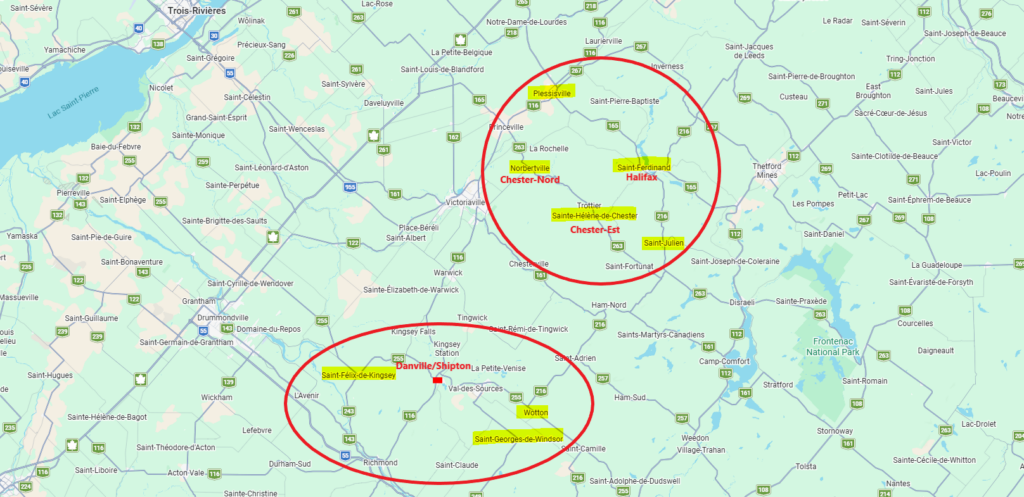
We do not know how long the family stayed in Newmarket. The Côtés were living in Fall River in 1900. The return for that year’s census states that they had first immigrated in 1875; their son Joseph would have been born in Maine shortly thereafter. Joseph married Anna Godbout in Fall River in 1901; the record of their union gives his place of birth as Biddeford. Newmarket was thus one stop among many in the pursuit of opportunities in U.S. mill cities.
LABRANCHE
Isaac Labranche, his wife Agnès Côté, and their six children also lived from mill work at the turn of the 1880s.[2] They were fairly recent immigrants, though the birthplace of some of the younger children seems uncertain. They were neighbors of the Montminy and Millette families.
Isaac and Agnès had married in Saint-Bernard, 18 miles south of Lévis, in 1855. This was Isaac’s second marriage. Agnès was more than twenty years his junior. A decade later, the family was living in the Eastern Townships. Isaac was still a day laborer. In 1865, he leased a plot of land in Saint-Georges-de-Windsor for six months. He did not vacate the plot at the expiration of the lease despite warnings from its owner, merchant Félix St-Denis, to do so. On November 17 of that year, François Alexandre Brien and a fellow notary visited Labranche to give him fifteen days to leave, after which additional costs and interest would apply. The family’s struggles in the 1860s serve as a backdrop to the eventual decision to migrate.
Isaac and Agnès became semi-permanent residents of Newmarket. While still residents of the town, they appeared before Brien in Danville, Quebec, on November 25, 1885. Also appearing were Majorique Labranche, a son from Isaac’s first marriage, and Michel Laflamme, their son-in-law. Both of these men were cultivateurs (property-owning farmers) in Saint-Georges-de-Windsor. Isaac was now elderly and “incapable de gagner sa vie,” that is, unable to support himself. Majorique and Michel each pledged to provide the aging couple with an annual pension of $6.
Isaac and Agnès died in Newmarket. Several sons remained in Newmarket, one daughter repatriated, and son William married Rose Labonté in Fall River, Massachusetts, in 1897.
Isaac and Agnès appear to have been the ancestors of all of the Labranches who occupied places of local civic influence over the course of generations.
MONTMINY
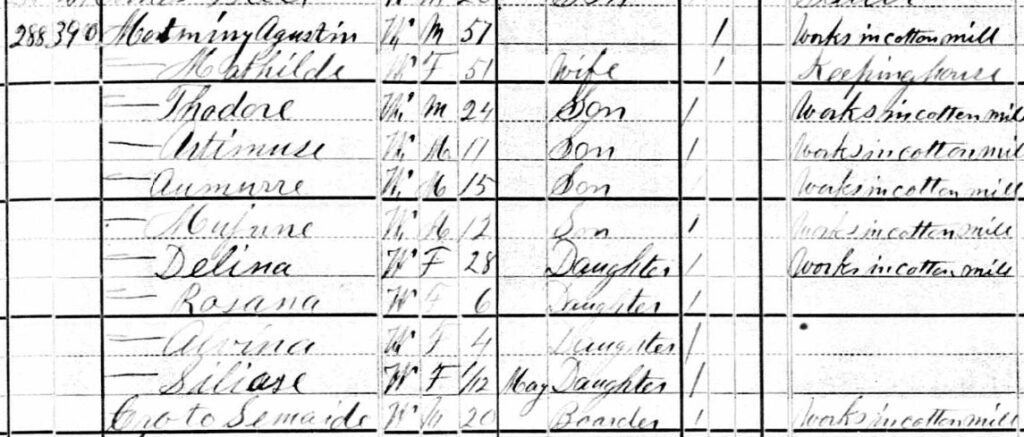
Whereas Ephrem and Agnès Côté immigrated early in their married life, the Montminy family came much later in their life cycle. Augustin Montminy and Mathilde Boucher had married in Lotbinière County, where they seem to have settled, in 1850. In Newmarket, in 1880, Augustin, aged 57, was working in the mill; Mathilde, 51, kept the home. The household included eight of their children who ranged from one month to 28 years in age. The five oldest—including four sons—worked in the mill like their father. Only the month-old child was American-born. Delvina, the oldest, was a widow. Her husband, Honoré Ramsay, had passed away at the age of 25 in 1876. With the Montminy family in Newmarket was Sémaïde Croteau, aged 20, a boarder who worked in the mill.
Son Gustave married in Saint-Gilles-de-Lotbinière three weeks after the enumerator’s visit in 1880. There was no mention of American residency in the marriage record. In fact, Gustave’s parents were said to be “de cette paroisse.” Evidently, their time in the U.S. was seen as short-term. Interestingly, the bride’s father was mentioned among the witnesses, but not the groom’s. It seems Augustin and Mathilde were unable, perhaps for financial reasons, to attend the wedding.
Augustin died in Dover, New Hampshire, in 1888.
SAURETTE DIT LAROSE
The Saurette dit Larose family was in Newmarket just long enough to be reported by a U.S. census taker. In 1880, the enumerator identified the household members under their more English-friendly name, La Rose. The father, “Newell” (Noël), was working as an unspecified laborer. Julie, his wife, kept the home. The five oldest children still at home, who ranged in age from 12 to 24, all worked in the local cotton mill. Ten-year-old Marcelline was attending school. The youngest child, Georges, was aged 4.
Noël, a native of Saint-Damase, Lower Canada, and Julie had married in the Yamaska parish of Saint-Césaire in 1846. They raised a large family—thirteen known children over the course of thirty years—in the nearby parish of Saint-Paul-d’Abbotsford. They lived from farming. In these respects, there was little to set the Saurettes apart from the great mass of French Canadians in the southern districts of Lower Canada.
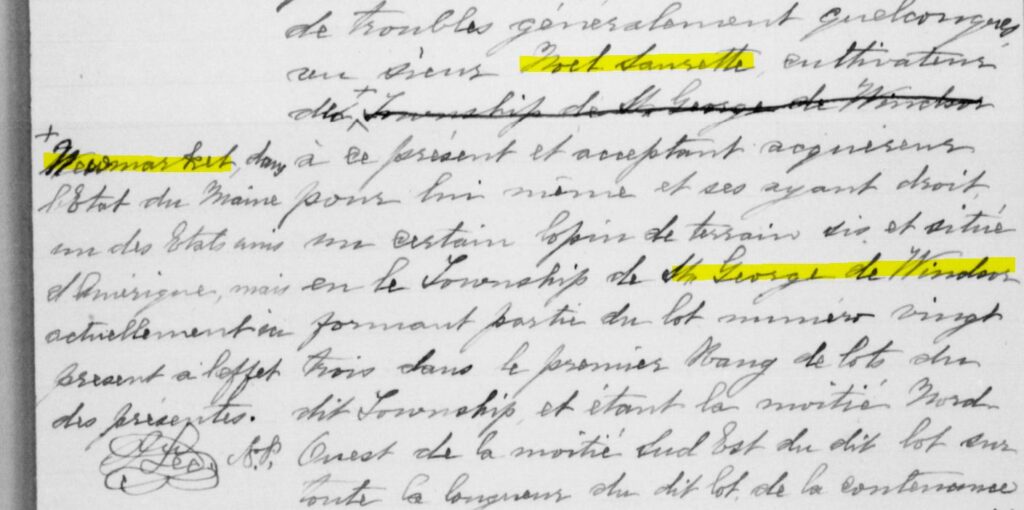
On April 28, 1882, before notary Joseph Ledoux, Noël (identified under Saurette), still of Newmarket, purchased a 50-acre plot with its buildings in Saint-Georges-de-Windsor. Had he learned of Saint-Georges and its opportunities from the Labranche family? Regardless, this was an opportunity that might provide the family with a sound future and enable Noël and Julie to retire quietly. The plot’s former owner, Léopold Marcotte, may have struggled to make mortgage payments that then amounted, with interest, to $300. Noël accepted these obligations and paid Marcotte an additional $55 to close the sale.[3]
Noël and Julie were still in Saint-Georges and living from the land in 1891. With them was their youngest son, Georges, said to be a native of the United States. He likely inherited the plot; he was listed as a cultivateur when he married in 1894.
George’s sister Marcelline married in Somersworth, New Hampshire, in 1896. Their mother, a widow, had by then returned to Newmarket.
HAMEL
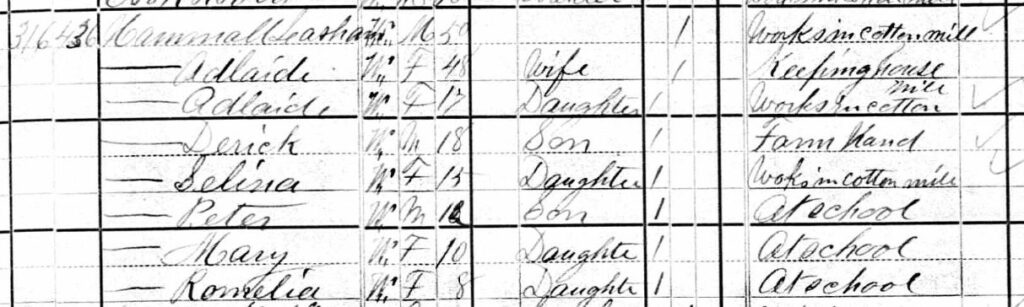
The Hamel household was one of the largest French-Canadian family units in Newmarket when the enumerator visited in 1880. “Leasham,” aged 50, and “Adlaide,” 48, had nine children, two sons-in-law, and two granddaughters. They also housed a boarder. They were reliant on the mills for their livelihood, though one son worked as a farm hand.
Onésime Hamel, of Shipton, Lower Canada, had married Adélaïde Forest, of nearby Windsor, in Saint-Félix-de-Kingsey in 1850. Onésime’s sister Emilie married on the same day. The family was living in Danville in 1871.
Whatever their hopes may have been, the Hamels’ move proved to be permanent. Onésime died in Newmarket in 1896 and his wife followed in 1902. According to her death record, Adélaïde had been a resident of the town for 29 years.
Their son Moïse, a sawyer, died from Bright’s disease in Vermont in 1903. Also in 1903, another son, Télesphore, married Angèle Dumais in Coaticook, Quebec. In this case, both parties were then residents of Lewiston, Maine.
HAMEL
Ephrem Hamel, son of Onésime and Adélaïde Forest, and Olive Bélanger, married in Danville in 1874. In 1880, both spouses were working in the Newmarket mills. They then had four young children. Five young people, aged 19 to 23, all Canadian-born and mill workers, were boarding with the Hamels.
The family repatriated. Ephrem and Olive died in Danville at very early ages in the 1880s and 1890s.
HAMEL
The census of 1880 records Mathias and Mary Hummall, aged 48 and 49, with six children, one son-in-law, one daughter-in-law, and three boarders. The household’s entire income came from the mills.
Mathias Hamel was a younger brother of Onésime. He had married Marie Des Neiges Doucet, of Windsor Township, in Wotton in 1854. They were living in Danville in 1871.
They moved to Saint-Georges-de-Windsor. Per a contract signed before notary François-Alexandre Brien on October 5, 1875, one John Murphy promised to sell Mathias a quarter-acre plot with its buildings in Danville Village for $1,000. Murphy had received $100; the remainder was to be paid over the course of seven years. This obligation may explain the decision to move to Newmarket.
Now a widower, Mathias was living with a son named Onésime in Nashua in 1900.
FOREST
Edouard and Monique Forest were past middle age in 1880. In Newmarket, the three daughters then living with them all worked in the cotton mills. Boarding with them were ten young adults.
Edouard was an older brother of the Adélaïde who married Onésime Hamel. He (Edouard) and Monique Millet or Millette had wed in Saint-Félix-de-Kingsey, just west of Danville, in 1845.
In 1871, Edouard was a cultivateur in Wotton Township. The household included ten children ranging in age from 5 to 23. They already had some experience of the United States: a census taker had captured the family in Lewiston the year prior. In Maine, the oldest children were mill operatives.
Son Benjamin Noé Forest married in the parish of Notre-Dame-des-Bois, just east of the repatriation colony of La Patrie, in 1878. The parents were listed as also living in this parish. The parish had just opened, reflecting the influx of migrants. Did the Forests repatriate yet again—only to then move to Newmarket? Either way, the move to Newmarket appears to have been definitive.
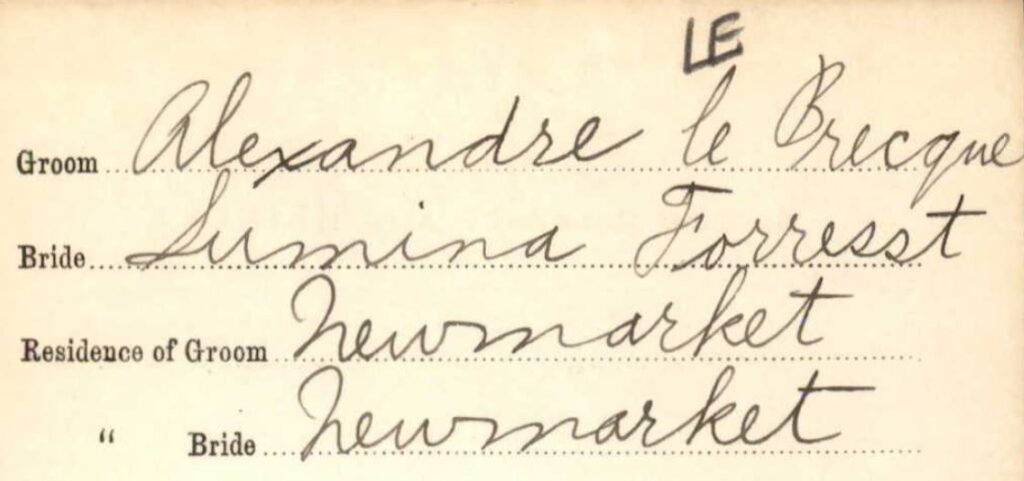
Daughter Lumina married Alexandre Labrecque in Newmarket in 1882. The officiant was Catholic priest Denis A. Ryan. Monique died of paralysis (likely a stroke) in Newmarket in 1893. Edouard followed in 1894; old age was given as the cause in his case.
BERTHIAUME
François Berthiaume and Julie Dallaire were, in Newmarket, neighbors of Mathias Hamel. With them were five children who worked in the cotton mill.
The parents had married in Lauzon, Lower Canada, in 1841. The family was living in Chester-Est, Arthabaska County, in 1871.
On April 24, 1880, before Rainville, François Berthiaume père of Chester-Est sold a 50-acre plot and various home furnishings to merchant Victor Roberge of Saint-Norbert. The exchange was valued at $143. Berthiaume claimed a droit de réméré—the right to buy back his property—for twelve months. This was a testament to the Berthiaumes’ uncertain situation. Their time in Newmarket was, in fact, relatively brief.
When son Stanislas married in Saint-Ferdinand-d’Halifax in 1882, François and Julie were residents of Saint-Julien. Stanislas would move to St. Johnsbury, Vermont, where he died in 1946.
BOURBEAU DIT BEAUCHESNE
Israël Bourbeau dit Beauchesne and his wife Julie Allard were also in Newmarket. Israël had no occupation in 1880; Julie kept the home. Everyone else worked in the cotton mills: four minor children; two adult sons with their respective wives; and boarders Louis Lambert and Marie Cloutier.
Israël and Julie had married in Plessisville, northwest of Saint-Ferdinand, in 1844. Before notary Louis Rainville, on October 26, 1875, Israël purchased two 58-acre plots in Chester-Est that abutted Halifax Township. He paid $100; the remaining $600 were to be paid over the course of ten years. The former owners had acquired one plot from the sheriff and another through a judgment against Clovis Beauchesne, seemingly Israël’s nephew.
On the same day, Israël sold the second plot to Aurélie Beauchesne of Thompsonville, Connecticut, then represented by Clovis, for $300. Israël had received $100 for the transaction. Aurélie was almost certainly his niece and Clovis’s sister.
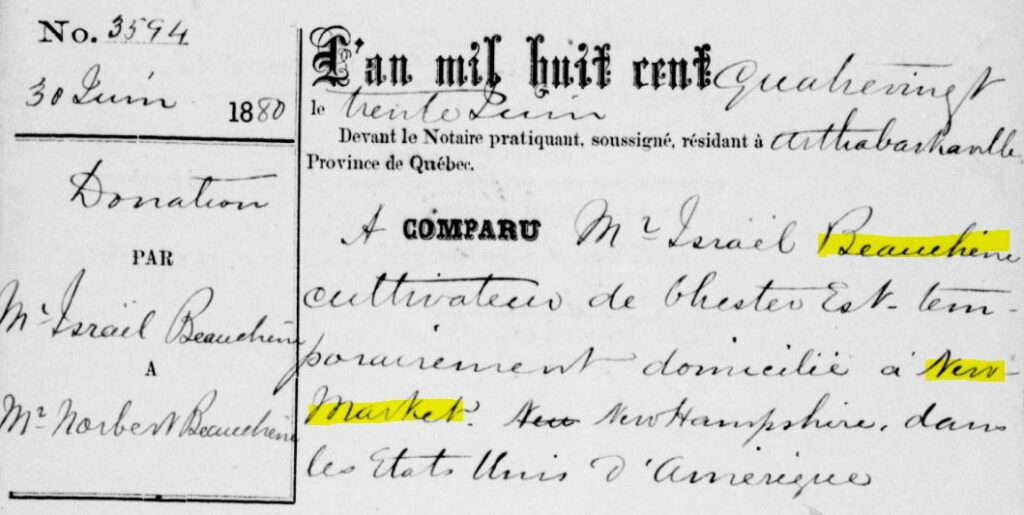
Work in the Newmarket mills may have served to meet financial obligations. Either way, the family remained connected to its homeland. Through a Rainville contract dated June 30, 1880, two weeks after the census taker’s visit, Israël Beauchesne, “temporairement domicilié à New-Market, New Hampshire,” donated a plot to his son Norbert, also of Newmarket.
The following year, the Canadian census captured Israël and Norbert seemingly on the same plot in Chester-Nord. They were cultivateurs. Norbert and his wife Joséphine were parents of a son born on U.S. soil in January 1881.
On August 20, 1883, before Rainville, Clovis Beauchesne sold a plot in Chester-Nord. This he did on behalf of Aurélie with the assent of the latter’s husband, Michel Croteau. Aurélie was still in Connecticut; this was the plot for which she had received title in 1875. The purchaser paid Israël directly, thus relieving Aurélie of outstanding charges.
Israël and Julie spent their later years in Saint-Adrien-de-Ham, east of Danville, where they passed away in 1895 and 1915 respectively.
CAMIRE
In 1880, the household of Jacques Camiré and Mélanie Mailhot depended entirely on the cotton industry for its income. They had children as young as 6 and 8 years of age working in the mills. According to the census taken that year, only the oldest child, Célina, was attending school—though she too was said to be a mill worker. With them were five young boarders who were similarly employed. These boarders are believed to have been close relatives.
Jacques and Mélanie had married in Bécancour. Their children were born and baptized in Saint-Norbert.
After the Newmarket sojourn, the family settled in Sainte-Hélène-de-Chester, where Jacques passed away in 1889. But some children either stayed in or returned to Newmarket. Their daughter Marie married Jean Labonté there in 1896. Marie died of tuberculosis at age 33 in 1908.
It is no coincidence that Léon Camiré, a resident of Chester-Est in 1871 and 1881, later settled in Newmarket, where he became the first French-Canadian selectman. He had lost his father at a young age. He would have learned about the New Hampshire Seacoast from family—in occurrence, Jacques and Mélanie, his uncle and aunt, perhaps upon their return.
* * *
This small sample of families confirms much of what we find in the historical literature on the grande saignée. French-Canadian families needed cash. They migrated at different stages of their life cycles to meet their needs—either to address shortfalls or to meet financial obligations that would provide for a more stable future. That future was often envisioned as lying north of the border, in Canada. We know, of course, that many families chose to stay. In both cases, moves were rarely definitive. Through the migratory process, many families established a foothold or connections across the Northeastern states—the Forests in Maine, the Côtés in Massachusetts, the Beauchesnes in Connecticut, and so forth.
Zénon Bélanger and one branch of Côtés immigrated from the Bas-du-fleuve region; other regions of Quebec contributed to the migration to Newmarket. Still, the census reveals that as early as 1880, Newmarket exerted a special draw on two areas of the Eastern Townships. This was not unusual; other New England towns and cities had osmotic relationships with specific Quebec regions. We are still left to wonder how this process began as far as Newmarket is concerned. Was this the work of an industrial recruiter? Or of a few families that tried their luck in a strange land—perhaps after being lured away from Rollinsford and Somersworth—and invited their kin to join them? Regardless, family networks and word of mouth in the rural parishes of Canada were certainly factors.
Sources
This exploration of early Newmarket families is still in its initial stages; a definitive list of sources will come later. Key collections include the U.S. and Canadian census returns from 1870 to the turn of the twentieth century; parish records retrieved from the Drouin Collection; the digitized Archives de notaires collection of the Bibliothèque et Archives nationales du Québec; NosOrigines; and New Hampshire, U.S., Death Records, 1678-1974, accessed on Ancestry.com.
[1] This may be the Ephrem Côté of Halifax Township who acquired a small plot from Isaïe Côté by virtue of a contract dated October 22, 1875 (notary Augustin Schambier). The plot was located in the parish of Sainte-Hélène-de-Chester. Payments on the property would have called for cash most easily accessible across the border.
[2] Agnès, it should be noted, was not a close relative of the aforementioned Côté. Yet another Côté family immigrated separately. Emile Côté, whose parents had moved to Lewiston from Quebec, married Elmire Grandmaison in Newmarket.
[3] In Saint-Georges and nearby parishes, they joined a community of repatriates from U.S. mill towns, among them the Larocques and the Boulays. More about this in my next book.
Leave a Reply