This blog post follows an article titled “Silent But Visible? French Canadians on Stage and Screen,” which appeared in the fall 2021 issue of Le Forum, the quarterly publication of the Franco-American Centre (University of Maine). The article later appeared here and provides context for the present post.
A condensed, French-language version of this post was presented at a workshop titled Les révélations daoustiennes, de Julien Daoust à la Franco-Américanie held last November. That version will appear later this year in the CRILCQ’s Nouveaux cahiers de recherche. Please cite appropriately.
* * *
They were a new kind of men to Buck (of which he was destined to see many more), and while he developed no affection for them, he none the less grew honestly to respect them. He speedily learned that Perrault and François were fair men, calm and impartial in administering justice, and too wise in the way of dogs to be fooled by dogs.[1]
This excerpt of The Call of the Wild reminds us that Jack London—among many other authors—made space for French Canadians in his work. It also serves as a metaphor for the space that English-speaking novelists, playwrights, and screenwriters were slowly creating for their neighbors in the early twentieth century. On U.S. soil, immigrants and their descendants had perhaps yet to win the affection of their American neighbors, but slowly they were gaining their trust. This occurred as Franco-American communities embraced a language of whiteness and rose to positions of power. The later marches and rallies of the Ku Klux Klan reveal how uneven that progress could be. It remains, still, that French Canadians in the United States benefitted from growing visibility in literature and the performing arts.
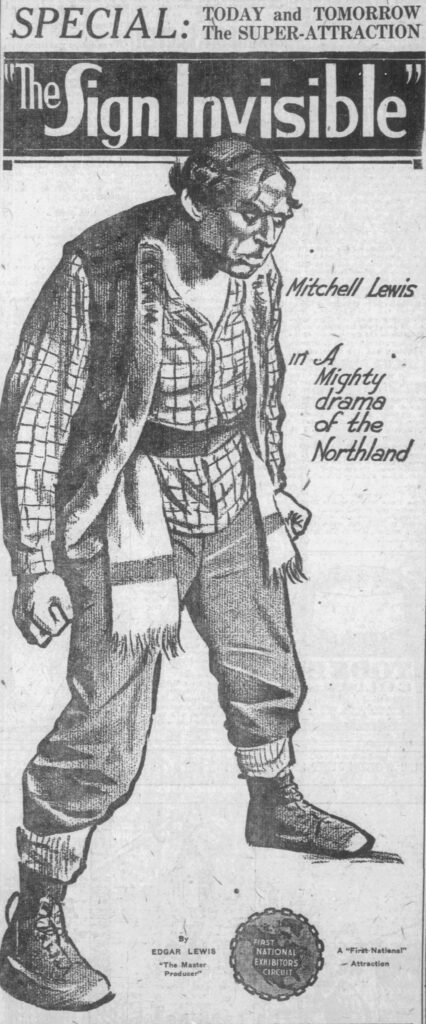
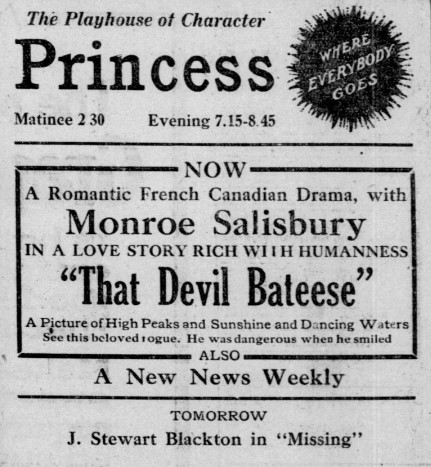
Beginning in 1907, playwrights and screenwriters frequently included French-Canadian characters, though they evinced little interest in the mill workers of New England or the ordinary farmers of the Province of Quebec. Like Jack London’s characters, French Canadians were, as guides, trappers, and miners, set in the wilderness as heirs of the coureurs des bois. For several decades, North American audiences encountered fictional Canadiens who, amid the peaks and valleys of nativism, enjoyed a generally positive depiction. Though laced with stereotypes and well-worn tropes, the cultural association with the wild actually played in French Canadians’ favor. The earthy mix of ruggedness and honest, simple living provided an appealing contrast to modern urban life.[2]
As a trend in performing arts, “Canuck chic” emerged between 1907 and 1910, but this was not French Canadians’ first foray into the United States’ collective imagination. School children long learned about the contest with France for domination of North America. The Rebellions of 1837-1838 drew attention and sympathy in the press. Henry Wadsworth Longfellow’s Evangeline also shed light on the continent’s francophone history. While Canadians were settling in large numbers in the U.S. Northeast and Upper Midwest, Americans were reading about the immigrants’ ancestors in the works of historian Francis Parkman. Jack London’s Perrault and François were not particularly unusual characters from this standpoint. Nor were the stage and screen productions of the early twentieth century the first performances of a canadianité.
French Canadians on Stage
In 1889, a play unlike any other premiered in San Francisco. Titled The Canuck, its lead character was French-Canadian.[3] San Francisco and Los Angeles had francophone communities in the second half of the nineteenth century, but there was likely another source of inspiration. The playwright, McKee Rankin, was Canadian-born and could draw from his personal interactions north of the border. Rankin navigated the United States’ complex ethnic and racial landscape just as he navigated the highs and lows of the performing arts. In the 1880s, he departed from standard practice by casting a Chinese man to play a character of the same origin in one of his plays. This was a public relations stunt (he advertised “A Real Live Chinaman”) rather than a genuine commitment to racial representation. In fact, Rankin endorsed blackface minstrelsy by playing the titular character in a stage adaptation of Uncle Tom’s Cabin. Rankin’s work—and theater in general—thus exemplified the unequal relations and racial drama playing out across the country, all while tantalizing audiences with perceived exoticism.[4]
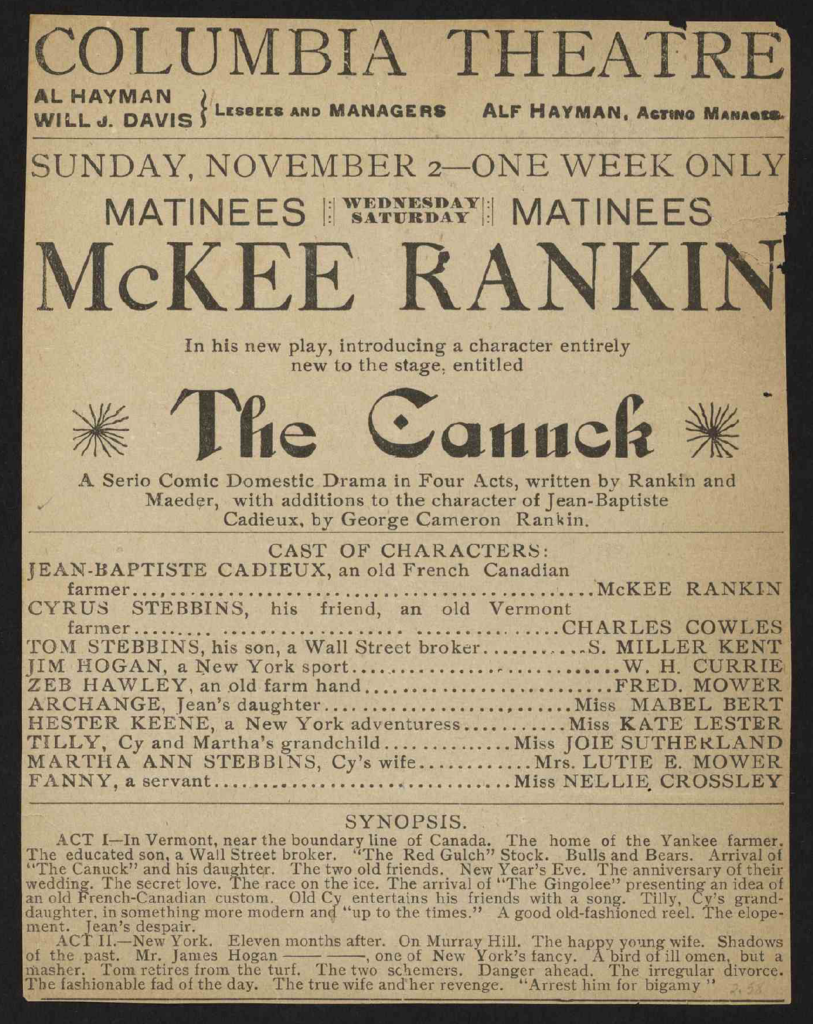
A four-act play, The Canuck centers on Jean Baptiste Cadieux, an immigrant farmer in Vermont. Cadieux befriends a Yankee neighbor, Cyrus Stebbins. Their respective children, Archange and Tom, fall in love and elope. Stebbins finds them in New York City and brings Archange back to her father. The reunion appears to occur in Cadieux’s native parish in Canada. The challenge of reconciliation between father and daughter is complicated by the arrival of a woman claiming to be Tom’s first wife. She is ultimately revealed to be an “adventuress” who was never legally married to Tom. Old Jean Baptiste stands out for “his funny dialect, his quaint dress, and his big, simple heart”; he is “a noble character, one which can forgive, and calls for strong work.” Another reviewer described him as “a diamond in the rough, a man of rough nature and tender feelings.”[5]
Early considerations of the play in the press—no doubt fluffed by Rankin—described the lead character as “an entirely new type to the stage.”[6] Rankin and his troupe presented the play from coast to coast and, in most places, Cadieux undoubtedly was a new type. However, legal proceedings undertaken in 1893 gave The Canuck an alternative origin story.
In a suit launched against his brother, George Rankin claimed original authorship of the play. George stated that he had penned a shorter version titled L’Habitant in Sault Ste. Marie in the winter of 1884-1885. Fleshed out in several acts, this play was performed in Montreal in June 1885 with George playing the lead role—named, in this case, Robidoux. The amateur playwright believed in its success and had it copyrighted in the United States as Jean Baptiste. Allegedly, George then left the script in the care of an acquaintance and McKee stole it. An eventual financial settlement between the brothers was left unfulfilled, according to George. Through the controversy, McKee maintained that he had created the “new type”: he had played a similar character, named Dufard, in a farce staged in the early 1870s.[7]
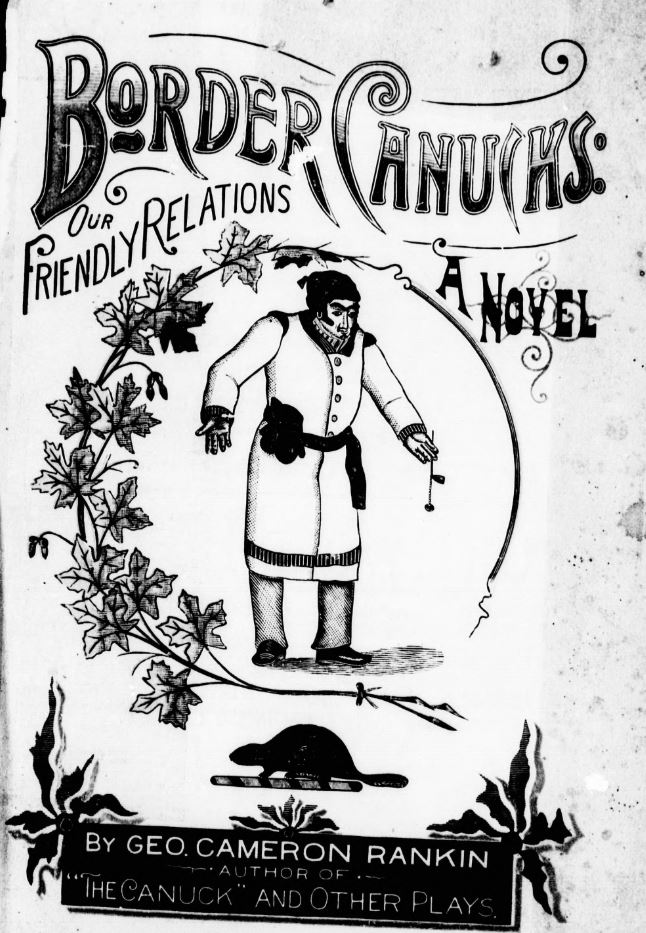
Meanwhile, George had penned a novel titled Border Canucks. A local newspaper described the book as “an uproariously funny account of a race on the ice between Canadian ponies.” It opens with a French Canadian named Jacques Laforge and his English-speaking friend, who inquires about Jacques’ wife—Archange. Amid the French but also Irish dialect speech, we find a humanizing, sometimes ethnographic, depiction of French Canadians in the border region. Like his brother, George Rankin was fleshing out the theme of L’Habitant.[8]
As for The Canuck, a Quebec City paper quoted a positive review from New York in 1890. It acknowledged prejudice that French Canadians faced and the happy contrast offered by the play. The portrayal of the lead characters seemed to be a celebration of all of the virtues of the habitant.[9] The play finally came to the Province of Quebec the next year. The French-language press encouraged readers to attend and offered praise. For La Justice, Cadieux was a noble and generous character. Fittingly, at intermission, the orchestra played French-Canadian standards. Performances that today may seem cartoonish were appreciated and lauded at the time.[10]
Drummond and Dialect
By the mid-1890s, McKee Rankin had turned away from The Canuck. Still, his “new type” survived and, in the hands of one author in particular, it found a new home in poetry and recitations. In 1897, The Canuck returned to Montreal, though not through Rankin. A separate troupe, led by Alexander Kearney, who transformed into Cadieux, played at the Théâtre Français. Rankin had continually adapted and refined the script to meet audience tastes. The version presented in Montreal reflected this evolution. The play now included two poems that Kearney, in his role, recited, both authored by Dr. William H. Drummond. The poems, “De Papineau Gun” and “De Bell of St. Michel,” fit neatly in the play as examples of French-Canadian dialect speech. Thus, as Rankin’s work slowly lost its luster, it engaged with an author, Drummond, who brought new attention to French Canadians.[11]
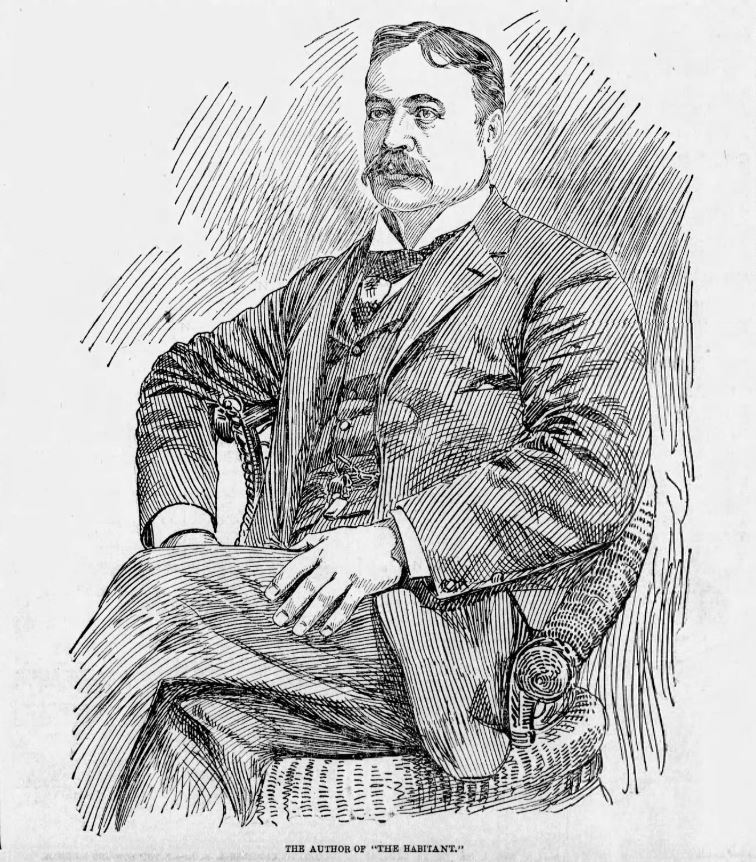
The Canuck intersected with Drummond’s work in another way. Famed poet Louis Fréchette reviewed the remake of The Canuck in 1897 and drew attention to the added verses. Then, months later, he penned a French-language introduction to Drummond’s first published collection, titled The Habitant and Other French-Canadian Poems. Fréchette brought francophone legitimacy to his counterpart’s work. He believed Drummond had created a new, perceptive depiction of the ordinary French Canadian without falling prey to caricature or vulgarity. What’s more, the poet’s sympathetic glance was among the materials that would help cement the union of “la grande famille canadienne.”[12]
Building on Drummond’s previous publications in the same vein, The Habitant was a great success. Its poems were reprinted across the United States and Canada. Local clubs organized recitations in dialect speech. Drummond received innumerable invitations that only enhanced his fame. In 1903, for instance, he entertained the highly exclusive Calumet Club of New York City. By then he had been admitted to the Royal Society of Canada and received an honorary degree from the University of Toronto.[13]
With the accolades came controversy—which George Rankin again sparked. The debate revolved around the authorship of “The Wreck of the ‘Julie Plante,’” which featured prominently in Drummond’s collection, though the poem, which was put to a popular melody, had been in circulation for decades. Rankin ascribed authorship to Frank Morton, a ticket agent in Detroit, who, inspired by the French-Canadian population of the area, would have penned the piece in 1869 or 1870. “In due course,” Rankin stated, “as the result of my intimacy with Morton, I heard him sing the song so repeatedly that I picked it up myself, and was the first and only one to blend it into a dramatic production, with his entire consent and approbation.” Indeed, Rankin brought “The Wreck” into the first incarnation of The Canuck, in 1884-1885, and adapted it by replacing Lake St. Clair (east of Detroit) with Lake St. Pierre (downriver from Sorel, Quebec). The song remained in the play as George’s brother McKee brought The Canuck to wider acclaim. Naturally, Drummond rejected George Rankin’s allegation of intellectual theft. The song had been penned in 1869 or 1870, but by none other than himself and the reference to Lake St. Pierre had appeared in the original. Dialect speech was now a hot commodity.[14]
Representations and Reception
Fréchette, as noted, took no issue with this form of literature or entertainment. He and other French-Canadian commentators—though not all—accepted as well-meaning Drummond’s intentions. “Having lived, practically, all my life, side by side with the French-Canadian people,” Drummond wrote in The Habitant, “I have grown to admire and love them.” It was his desire to acquaint English and French Canadians and to give life to the latter as they would express themselves in the English language. Though we know the genre as dialect speech, the author was firm: this was not French dialect but the reality of communication across linguistic barriers.[15]
In the wake of Drummond’s premature death in 1907, Pierre Lorraine would echo his purpose. To have French-Canadian characters speak like figures out of Tennyson would be to rob them of their local color. A parallel might be found in Robert Burns’ efforts to represent Scottish speech. “This form of language,” Lorraine explained, “was not leisurely invented to add a grotesque element to certain comical situations—it is a form that exists, and that in fact exists exactly as Drummond wrote it. There is no charge: it is the English that the paysans canadiens speak.”[16]
Naturally, other readers and observers would disagree, describing the language that Drummond put in the mouth of French Canadians as misleading, insulting, and reductive; or yet, they would challenge those who interpreted the poems—despite the author’s own claims—as the ordinary tongue of Quebec’s farming class.[17] In any event, as with all art, once released, Drummond’s work could be used to all ends and in ways that were less than affectionate. Undoubtedly it was so used in areas of the United States where relations between immigrants from Quebec and their Anglo-Saxon neighbors were still uneasy.
Other authors explored different paths. Gilbert Parker, today better known as a First World War propagandist, was likely capitalizing on McKee Rankin’s play when he released the novel Pierre and His People in 1892. Parker, too, was said to have developed a new type. Montreal’s Herald opined in 1894 that “[u]ntil Gilbert Parker . . . indicated the undeveloped mine of material for romance that lay buried in the records and traditions of British America, no writer of note had suspected its existence, and Canada was almost an unknown land to readers of fiction.” Parker was not merely adapting The Canuck and the likes in novel form, however. In Pierre and His People, the title character, a “French half-breed” (a Métis man), spoke standard English. The same was true of The Lane that Had No Turning, which he wrote and published after Drummond had brought acclaim to dialect speech. Pierre Lorraine seemed to prefer Drummond’s work; it was perhaps his view that dialect produced more authentic characters.[18]
Conclusion
From 1885 to 1897, authors created French-Canadian characters in plays, novels, and poetry. These authors vied for paternity of the “new type.” Their works responded to one another in ways that muddle the origins of the character. Parker and Drummond undoubtedly noticed the success of McKee Rankin’s play, but one of the play’s first documented incarnations, then a production of George Rankin, included a song claimed by Drummond. In any event, while Frank Morton may have created a parlor act that endured for decades, the turn of the 1890s announced a new phase in the representation of French Canadians and their culture. Jack London was by no means innovating when providing Buck with companions Perrault and François—and the stage was almost literally set for the flurry of productions that came from 1907 onward.[19]
But why French Canadians in the first place? An easy but only partial answer lies in the need to complicate well-worn plots revolving around rivalries, love triangles, and betrayal. Playwrights needed to continually create audiences for their work; they needed to titillate prospective theater-goers. They could do this with gimmicks and with the introduction of exotic characters whose culture might bring a layer of complexity. Dubious mimicry around language could create comedic moments in recitations and plays. At the same time, unsuspecting audiences sensed that they were traveling and catching a glimpse of authentic French-Canadian culture, especially as writers and performers claimed authority through their interactions with French-heritage neighbors in Ontario and Quebec.
These depictions commonly but did not universally involve dialect speech, which, as a form of canadianité, had a long life. In Vermont, for instance, local recitations persisted alongside the Canadian-focused stage and screen productions of the early twentieth century.[20] Writers, artists, and audiences of French-Canadian descent engaged with dialect speech and at times benefitted from it. In the interwar period, Daniel J. Trombley (signing as “Batiste”) capitalized on the fashion by publishing dialect works in Vermont. Much closer to our day, Maine radio personality “Frenchie,” played by Ernie Gagné, faced a firestorm of controversy for his “dumb Frenchman” jokes as well as his forced accent. Franco-Americans fell on both sides of the debate. Dialect has survived in other forms in our day. While some performers’ intentions may be noble, there is no disentangling the literary works from the reductive and insulting ways in which they were used.[21]
Fictional characters of French-Canadian or Acadian origin are now few in American media. It is something that many Franco-Americans regret, but we should recall the unresolved challenges that come with ethnic representation. What would these characters look and sound like? Would we only allow “real live French men and women” to play them? What would we consider a fair and honest portrayal of the culture? That we now have much more discerning audiences does little to answer these questions satisfactorily.
[1] Jack London, The Call of the Wild (London: Heinemann, 1903), 12.
[2] Patrick Lacroix, “Silent But Visible? French Canadians on Stage and Screen,” Le Forum, vol. 43, no. 3 (fall 2021), 26-29.
[3] “Here and There,” Boston Sunday Globe, May 26, 1889, 10; “The Alcazar Theater,” Sunday Chronicle [San Francisco], September 22, 1889, 3.
[4] “The Stage – Bush-Street Theater,” Daily Examiner [San Francisco], March 8, 1885, 3; “Bush Street Theater,” Sunday Chronicle, March 15, 1885, 7; “Opera House!” Muskegon Daily Chronicle, October 23, 1886, 2. Rankin married Kitty Blanchard, who, despite the name, appears to have had no French-Canadian connection. With actress Mabel Bert, Rankin had a daughter, Doris, who went on to marry legendary actor Lionel Barrymore. Rankin’s life and career are the subject of David Beasley’s McKee Rankin and the Heyday of the American Theater (Waterloo: Wilfrid Laurier University Press, 2002).
[5] “Alcazar Theater,” Sunday Chronicle, September 29, 1889, 3; “Opera-House To-Night,” Vicksburg Evening Post, February 23, 1891, 1; “Amusements,” Daily Evening Item [Lynn, Mass.], May 9, 1891, 8. Longer synopses appear in “Choses et autres,” La Justice [Quebec City], August 11, 1890, 4, and Louis Fréchette, “L’Habitant,” La Presse [Montreal], April 17, 1897, 9.
[6] “Alcazar Theater,” Sunday Chronicle.
[7] “‘The Canuck’ – Interesting History of a Well Known Play,” Evening Record [Windsor, Ont.], April 4, 1893, 2; Beasley, McKee Rankin, 246-247, 254-257; “Amusements – Alhambra Theater,” San Francisco Chronicle, January 4, 1871, 4.
[8] “Between Heats,” Detroit Free Press, July 24, 1890, 8. The novel is available online on Canadiana.
[9] “Choses et autres,” La Justice.
[10] Louis Fréchette wrote of the dialect speech in The Canuck, “C’est bien un peu exagéré, mais c’est fort amusant, et d’un effet de sympathie très pénétrant dans les moments pathétiques.” See “A travers Québec,” La Justice, September 30, 1891, 4; “Notes locales,” Le Franco-Canadien [Iberville], October 8, 1891, 3; “Théâtre,” La Tribune [Saint-Hyacinthe], October 9, 1891, 7; Fréchette, “L’Habitant.”
[11] Drummond was the son of a Royal Irish Constabulary officer. The family immigrated to Lower Canada when Drummond was ten. He then lived in L’Abord à Plouffe (present-day Laval), Saint-Eustache, and Montreal. As a physician, he worked in the Eastern Townships before settling definitively in Montreal. He continued to practice medicine even while enjoying literary success. See “Refreshing Comedy,” The Gazette [Montreal], April 13, 1897, 5; Fréchette, “L’Habitant”; Mary Jane Edwards, “Drummond (Drumm), William Henry,” Dictionary of Canadian Biography; Pierre Lorraine, “Le Poète de L’‘Habitant,’” Le Journal de Françoise, November 2, 1907, 234-238.
[12] William Henry Drummond, The Habitant and Other French-Canadian Poems (New York City: G. P. Putnam’s Sons, 1897). See, on the release of Drummond’s Habitant and the question of faithful representation, “Notices of New Books,” Montreal Daily Star, November 13, 1897, 3.
[13] “Calumet Dines ‘Canayen,’” Brooklyn Daily Eagle, January 17, 1903, 16; Edwards, “Drummond (Drumm), William Henry.”
[14] The melody of the song was “Blow Ye Winds.” The origin story was still up for debate in 1927, when a Michigander stated that the poem may well have dated to the 1840s. See “Who Wrote This Old Song?” Daily British Whig [Kingston, Ont.], July 27, 1898, 6; “Dr. Drummond and the ‘Julie Plante,’” Montreal Daily Star, November 21, 1900, 6; Howard Weeks, “Lore of Detroit River Defies Historian,” Feature Section, Detroit Free Press, April 10, 1927, 5. McKee Rankin’s biographer details George’s allegations against Drummond and concludes, “George had a wry sense of humor.” Were his claims a hoax? See Beasley, McKee Rankin, 354.
[15] Drummond, The Habitant, xi-xii.
[16] Lorraine, “Le Poète de L’‘Habitant,’” Le Journal de Françoise, November 16, 1907, 250-253 (transl. P. Lacroix).
[17] “Causerie littéraire,” Le Devoir, February 7, 1914, 1; “Drummond et nos habitants canadiens,” Bulletin des recherches historiques, vol. 35, no. 10 (October 1929), 631-632; Ernest Martin, “Le français des Canadiens est-il un patois?” Le Canada français [Quebec City], vol. 21, no. 1 (September 1933), 72-90.
[18] Gilbert Parker, Pierre and His People (New York City: Peter Fenelon Collier, 1894); “Gilbert Parker,” Montreal Daily Herald, March 8, 1894, 5; Parker, The Lane that Had No Turning (Toronto: George N. Morang and Co., 1900); Lorraine, “Le Poète de L’‘Habitant,’” Le Journal de Françoise, February 1, 1908, 330-334.
[19] McKee Rankin may get special credit for expanding access to the French-Canadian “type” and, crucially, reorienting audience interests from the Old West to northern themes. See Beasley, “McKee Rankin: The Actor as Playwright,” Theatre Research in Canada.
[20] See, e.g., “Class of Young Women Give Social,” Brattleboro Daily Reformer, March 18, 1919, 1; “Newport Locals,” Caledonian Record [St. Johnsburg, Vt.], November 18, 1921, 5. In the latter case, the reading was described as a “delightful and sympathetic interpretation.”
[21] “Side Lines,” Springfield Reporter [Vt.], October 3, 1940, 2; Elizabeth Edwardsen and Christine Young, “Adieu, Frenchie,” Sun-Journal [Lewiston, Me.], February 12, 1993, 1, 10; Young, “Frenchie Discovers Friends,” Sun-Journal, February 18, 1993, 9; Germaine Roberge et al., letters, Sun-Journal, February 20, 1993, 5; Ernie Gagné, “When Funny Might Not Be…,” Voyages: A Maine Franco-American Reader, ed. Nelson Madore and Barry Rodrigue (Gardiner: Tilbury House, 2007), 350-354.
Another thought-provoking piece, Patrick!
There is that “there” and “now” question that lingers over ethnic representation in the now.
Which leads me to two personal stories.
(1) I’m digging into my Uncle Arthur’s scrapbooks from his vaudeville days to work up a piece for a digital genealogy magazine. Seems vaudeville was an “equal opportunity offender” when it came to highlighting the miscommunications that come from the borderland where cultures meet. And also a great equalizer. In just the first few pages of theater clippings, I’m finding him performing on the same stage as Edgar Bergen, The Three Giants of Rhythm (a dance group from Harlem), a woman known for her Bat Dance, and Jean Carroll (a doyenne of comedy).
(2) A childhood guilty of creating parodies from our own dialect. Think of the dwarves’ song from Snow White (Hey, ho, it’s off to work we go). The American Optical company was the work to which “we go” in Southbridge MA. We used to chant “Hay-o, Hay-o, it’s off to da work we go. Make two, tree bucks for two-tree hours, Hay-o, hay-o, hay-o, hay-o.” As best I can remember, little kids marching about making a parody of cartoons with the accent we heard all around us busted up the adults. We have the youngest brother to thank for that! (:
Thank you, Ann! Your examples perfectly encapsulate the challenge of dissecting and discussing these ethnic tropes. At one time they were a ubiquitous form of cultural currency… and folks didn’t give them a second thought. Sometimes they were actively embraced by the subject group. On the flip side, in the long term, they had a negative effect on self-perceptions and probably created a barrier to mutual understanding. This poses a challenge when trying to approach our historical actors with a measure of empathy. Thank you for sharing these thoughts — now I have to google the Three Giants of Rhythm.