They weren’t ten feet tall.
In the midst of dissertation research, I stumbled across words to that effect. In an interview, John F. Kennedy reflected on the men who had preceded him in the White House, particularly Franklin Roosevelt, who now seemed larger than life. Hindsight had enlarged them. In truth, Kennedy stated, they were ordinary, fallible men—as fallible as his own administration—, caught up, like him, in the exigencies of the time.[1]
Undoubtedly, in the past, some presidents were gifted with unusual knowledge, skill, integrity, and empathy. History books, movies, and countless monuments have consecrated their memory and nourished endless admiration. But these presidents, well, they weren’t ten feet tall.
That is a generally useful mantra, one that we should retain in genealogy as in the affairs of the nation. We should acknowledge the ordinariness, the imperfections, the humanity of the humans who preceded us. In honest ancestry research, we should not turn our trees into perfectly groomed artifacts of the past; we should, rather, shake them until every branch has delivered its secrets.
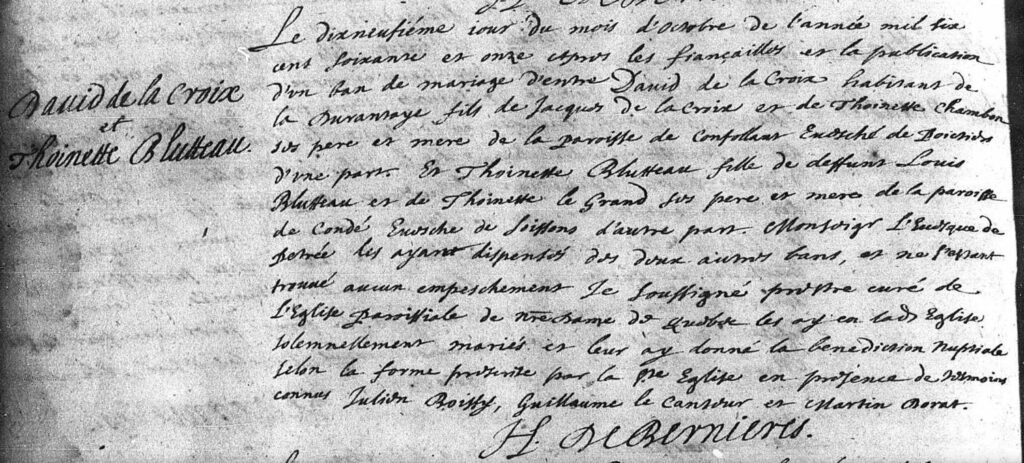
Take Joseph de la Croix. He wasn’t ten feet tall. Neither were his wife or their neighbors, as we learn from the events of 1683.
La Croix left France—we don’t know why, we don’t know when. In October 1671, he was on a conveyor belt of weddings performed in quick succession at the church of Notre Dame in Quebec. His wife, Antoinette Bluteau, was a fille du roi of whom likewise almost nothing is known. We can nevertheless be certain that she passed away, partly because more than three centuries have elapsed and partly because La Croix remarried in 1681. The second bride was Barthélemie Maillou, who had crossed the ocean with her parents. (We have strong evidence that she too has since died.)
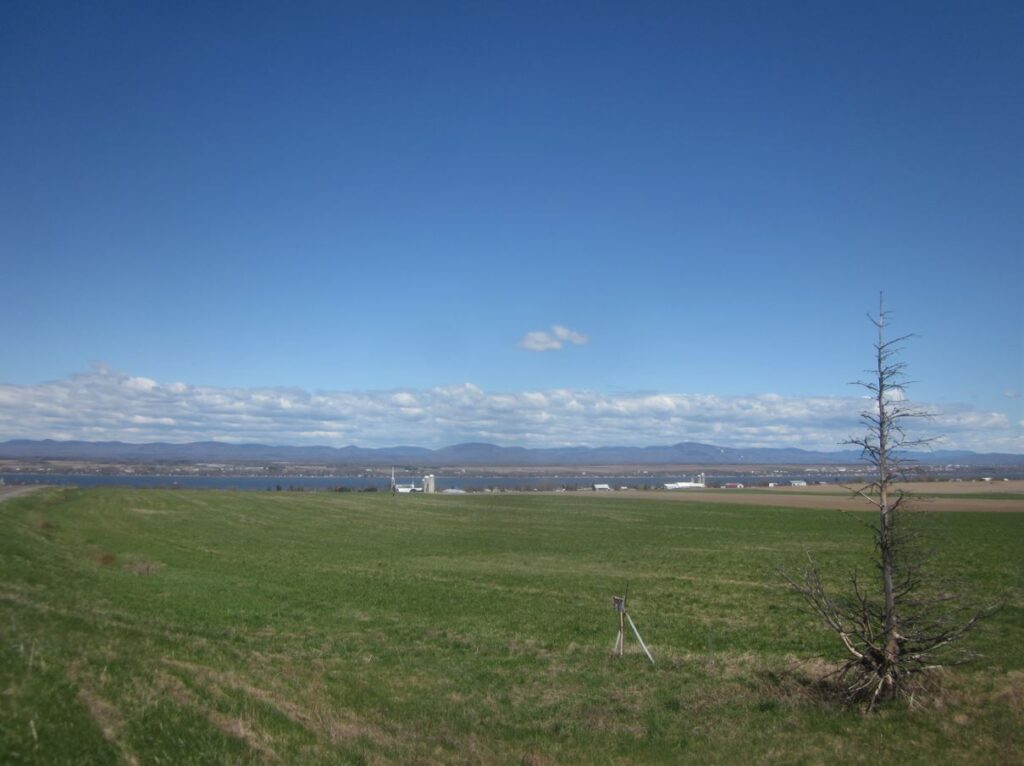
The couple lived in what was slowly becoming Saint-Michel in the seigneurie of La Durantaye, 14 miles (23 km) east of Quebec. After crossing an ocean, their horizons narrowed to a small cast of characters whose homes also fronted the St. Lawrence River. Among their neighbors we find the names Davenne, Drapeau, Goureau, and Patri.
Oh, and let’s not forget Julien Boissy, who had been on the same conveyor belt in October 1671. In fact, Julien first appears in the records of New France as a witness at Joseph de la Croix’s wedding. He also served as a witness when Joseph and Barthélemie baptized their first child. Proximity, friendship, kinship, collaboration in the face of a new and hostile environment: a recipe for an enduring bond. The Breton (Julien) and the Poitevin (Joseph) exemplified the colonial melting pot that fused the diverse identities of pre-Revolutionary France into the French-Canadian people.
Well, until 1683.
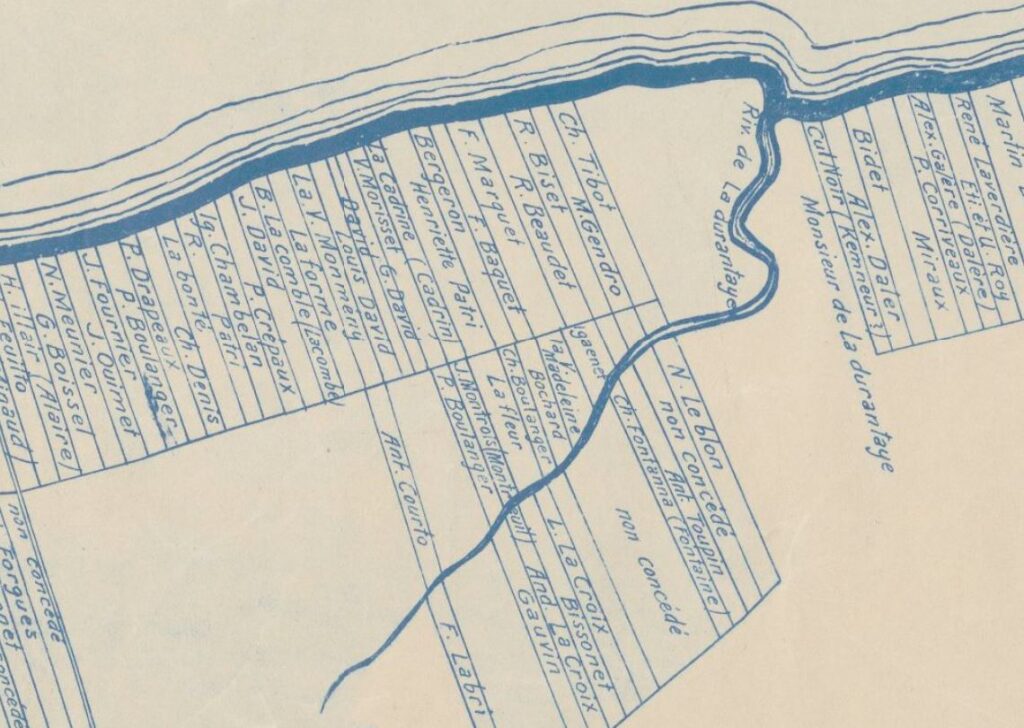
Joseph de la Croix had pigs. That is the first thing we need to know. In early October 1683, Joseph let his pigs out to forage—as he usually did, and as his neighbors did. On this particular day, the pigs wandered into the Boissy garden and began eating the peas. Julien had married a fille du roi named Françoise Grossejambe who, now, seeing a crop evaporate, intervened. The Boissy household had dogs and, answering an age-old question, Françoise let the dogs out. The dogs must have posed a very real threat to the pigs, for Joseph responded by throwing rocks at the dogs. The cycle of retaliation had begun. Françoise approached Joseph, slapped him, and grabbed his hair. He answered with blows in an attempt to free himself. Having done so, he walked away, but Françoise followed him and again seized his hair. Mrs. La Croix, Barthélemie, seeing her husband thus assaulted, grabbed a root and hit Françoise’s head with it.
Now, the records mention a mysterious, unnamed female witness who sided with the La Croix clan: Françoise had been the first to strike. Allegedly, she even hit Barthélemie, such as to impair her ability to breastfeed. Julien had his own view of the events: Joseph had threatened them several months earlier and the altercation with Françoise had taken place on the Boissy property. This implied self-defense. Joseph replied that Françoise had beaten up his wife, Barthélemie, on the riverbank during the summer. The “pea brawl” had been stewing for some time.
We know all of this because legal action ensued. Julien initiated proceedings at the Prévôté de Québec, which had authority to try civil and criminal matters. A bailiff brought Joseph before the judges and each side pleaded its case. René Louis Chartier de Lotbinière read the verdict. Joseph was to pay his neighbor 100 sols of damages in addition to 20 sols to pay the surgeon who tended to Françoise’s injuries. Chartier also warned both parties against any future altercation by deed or by word (“desfences aux partyes de se mefaire ny medire”) lest they face a fine of 20 livres.
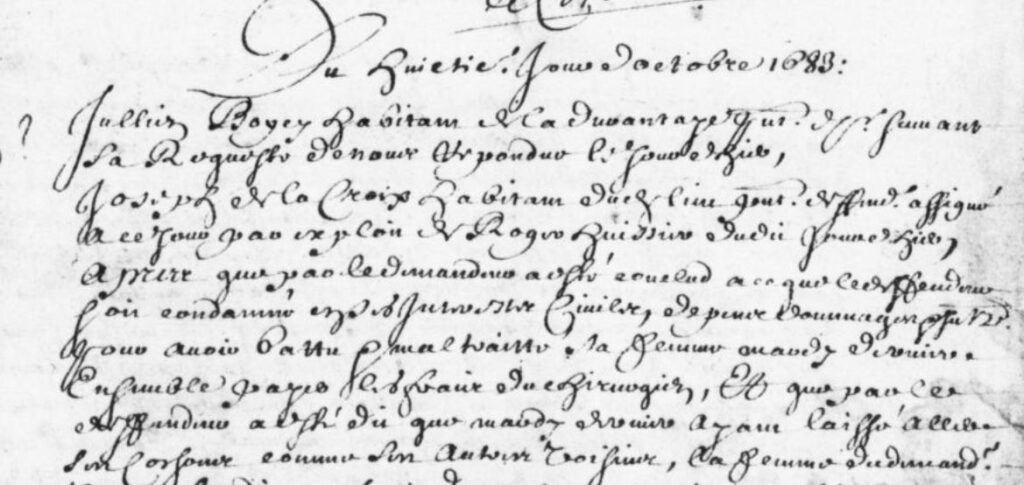
From the few sources at our disposal, Françoise Grossejambe does appear to have landed the first blow. But the mention of a surgeon and medical care suggests that she was the worst for wear, which was likely the determining factor in the ruling. The root she had taken to the head may have caused a serious injury—all the more so if Mrs. La Croix was intent on avenging the assault she had experienced months prior.
Feeling wronged, Joseph appealed to New France’s Conseil souverain, the court of appeal for the Prévôté. Julien was able to anticipate the hearing and make his case earlier than planned due to the threat of ice on the St. Lawrence. Joseph again shared his version of events. But it was in vain. Through Jacques de Meulles, the colony’s intendant, the Conseil upheld the prior verdict.
There are a few lessons in this. The brawl instigated by the pigs in the pea patch reminds us, as Robert Frost did, that good fences make good neighbors. It is also a reminder that La Croix, Boissy, and company were not ten feet tall. They were rough, they were proud, they were fallible. Largely, they were us.
Genealogical Epilogue
Julien Boissy and Françoise Grossejambe had descendants. By virtue of childhood mortality and the accident of birth, direct female descendants outnumbered male ones. With some male descendants moving to other jurisdictions, where Boissy was anglicized, the last name has become unusual in its original form. One of the couple’s most illustrious descendants was Gabriel Franchère (1786-1863), a fur trader and a founder of New York City’s Société Saint-Jean-Baptiste.
Of those who carried the name, Joseph de la Croix’s most famous descendant may be medievalist and philosopher Benoît Lacroix (1915-2016). But Joseph was not the only La Croix or Lacroix to settle in New France. François, from Normandie, married Anne Gasnier and they probably contributed more to Lacroix “stock” in North America than any other couple. Their descendants became particularly prevalent east of Quebec City, notably in the Charlevoix region, but some settled as far as Illinois and Louisiana. François was the ancestor of Edouard “King” Lacroix (1889-1963) who attained some renown in the Beauce region and in northern Maine.
There was also a Louis Lefebvre dit Lacroix, husband of Catherine Ferré, and female migrant ancestors named Lacroix unrelated to the men mentioned here. Suzanne Lacroix, for instance, was a fille du roi from the Paris area who would marry Jacques Savaria. In addition to Lefebvre, Lacroix is notably a “dit name” for Bourgault and Hubert.
Further Reading
For more on the Lacroix family:
- A French-Canadian House in 1815
- A French-Canadian Journey: Bellechasse to Sweetsburg
- A French-Canadian Journey: Saint-Césaire to St. Albans
- Farewell, Jerry
- Keeping Kinfolk in Franco-American Holyoke
[1] Since this story was less than tangential to my dissertation, I did not jot down the source at the time. I will be indebted to anyone who finds the article.
Pingback: Friday’s Family History Finds | Empty Branches on the Family Tree
This was fun. Problematic for them, yes, but the story just begs for a mini-series. Pigs in the pea garden…we now know who let the dogs out…great stuff.
I asked Duck Ai about the JFK quote. This is what it told me:
John F. Kennedy’s statement about the world not being “ten-foot tall” is not directly documented in a specific, widely available speech. However, the essence of his view on the limits of leadership and the challenges presidents face can be found in various speeches, especially in his Inaugural Address delivered on January 20, 1961.
In this address, he discussed human limitations and the responsibilities of leadership, famously stating:
“The world is very different now… For man holds in his mortal hands the power to abolish all forms of human poverty and all forms of human life.”
He emphasized the complexities and responsibilities tied to leadership, which resonates with the sentiment of the ten-foot tall comment.
If you’re interested, the complete transcript of his Inaugural Address is available on the John F. Kennedy Presidential Library.
Thanks Ann. The quotation I remember came out of a newspaper interview (at least I hope I remember correctly).