Michaud: it’s a common name. Statistics published several decades ago ranked it among the 50 most common surnames in Quebec—ahead of Desjardins, Parent, Charbonneau, and Lacroix. Just across the border, it outnumbered all other names in the early records of the Fort Kent, Maine, Catholic parish. Michauds are still present all across the Upper St. John Valley. They can trace their lines back to Pierre Michaud and Marie Ancelin, early settlers of Kamouraska along the lower St. Lawrence River.
Branches of the family found a home in the St. John Valley separately. Benjamin Michaud and his wife Marie Anne Bourgoin moved to the region in the early years of the nineteenth century. A distant cousin, Antoine Michaud, accompanied his parents and married Marie Louise Cyr in the 1840s—a small example of the gradual union of Acadian and French-Canadian settlers.
Yet another Michaud, Etienne, set foot in the Madawaska borderland region. But his journey proved far more complex.

Born in Kamouraska in the waning days of New France, Etienne lost his father at the age of 4. His mother married a Soucy shortly thereafter. A far more life-altering moment came several years later. Etienne likely spied the British ships that sailed up the St. Lawrence in the summer of 1759. Almost certainly, his family would have suffered from the campaign of intimidation launched by British troops days before the battle of the Plains of Abraham. Landing in Kamouraska, a detachment burned homes and barns while proceeding west, on the south short of the St. Lawrence, towards Quebec. A lean, long, and cold winter would follow.
By 1772, when Etienne married, his community had recovered—now with new mouths to feed. Etienne’s mother gave birth every few years with her last pregnancy coming at the age of 46. But by no means was Etienne neglected or left to fend for himself as he neared adulthood. Twelve days prior to his wedding, he and his bride-to-be, Théotiste Chassé, signed a contract at the home of the latter’s brother Sébastien. The marriage stipulations were fairly standard; they were following the French legal tradition known as the coutume de Paris, which persisted, informally, under the British regime. At the same time, Etienne’s mother and stepfather provided him with three and a half arpents of land, livestock, household items, horse-drawn vehicles, a plow, and the option to live in the parents’ home should they so wish. Though the donation would only become official a year later, when Etienne turned 21, he was given a steady start in life, that is, the means to support a family of his own.
Young hopes were soon dashed. Théotiste passed away a year later after giving birth to their first and only child. An inventory was undertaken in February 1774 to protect the four-month-old child’s claim to his mother’s succession. Beyond a house and a barn at Rivière-des-Caps, east of present-day Kamouraska, the family’s goods had included a horse, two cows, six sheep, a cariole, a variety of kitchen implements and agricultural tools, clothing belonging to the deceased, a box decorated with porcupine quills, and a silver crucifix.
Etienne remarried in Kamouraska the following summer. His second wife was Marie Josèphe Phocas dite Raymond, who bore them ten children. So far as we know, Etienne supported his growing family as a cultivateur, a landowning farmer. In 1797, he owned a plot of four arpents of frontage on the St. Lawrence and forty deep. This amplifies the challenge of understanding why he would move with unusual frequency, over long distances, in the next chapter of his life, while he was in his fifties.
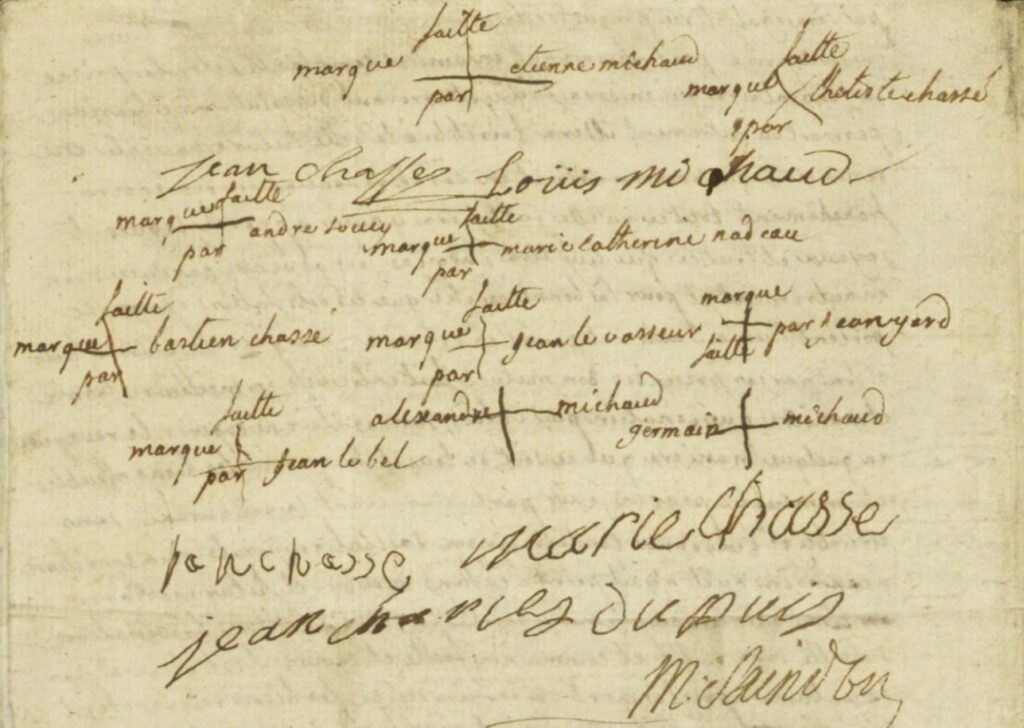
This occurred after Marie Josèphe’s premature death in 1796.[1] With his third wife, Madeleine Guéret dit Dumont, we find Etienne for several years in Rivière du Loup—but not the Rivière-du-Loup that lies east of Kamouraska. The family was in Saint-Antoine de la Rivière du Loup (present-day Louiseville), located west of Trois-Rivières, and Etienne worked as an agriculteur, a slightly more ambiguous term with regard to land ownership. Then, for several years, we find him as a day laborer in Saint-Denis-sur-Richelieu, in the District of Montreal, 200 miles from Saint-André de Kamouraska as the crow flies. By 1808, Etienne, Madeleine, and the younger children were again in Kamouraska County as cultivateurs.
Why did the Michauds make these peregrinations when they had their own land and seemed to be well-established in the parish of Saint-André? We know that some children, now nearing adulthood, settled permanently in those remote locations. It may well be that Etienne was helping them get their start in life—the kind that he had received more than a generation earlier. In 1799, Etienne and his wife Madeleine christened a daughter in Louiseville; the next year, son Pierre, aged 20, married in the same location. As the second of five sons (up to that point), Pierre was unlikely to inherit much and, at that time, there may have been few opportunities to acquire land in Kamouraska.[2] Etienne and other family members may have helped him establish himself in a different area—where, in fact, he stayed. So it was that the Michaud family found, through Pierre, a foothold in the Mauricie region.

A similar situation prevailed in and around Saint-Denis-sur-Richelieu, where at least two children built lives of their own. Henri became a merchant. Geneviève married in Saint-Antoine-sur-Richelieu in 1804 and named her first child after her father—and so the Michaud family found a foothold, through her, in the Montérégie region.
Etienne, Madeleine, and their younger children returned to Saint-André in or around 1807. It may be that the eldest son, from the first marriage, Etienne, Jr., was responsible for the family homestead in his parents’ absence. In early spring, 1808, Etienne, Jr., was free to explore new opportunities. At that time he was hired by Philippe Long to serve a courier between Quebec City and Grand Falls, New Brunswick. The one-year contract never came to term. This Etienne died at the age of 35 in January 1809, perhaps a victim of one of his errands.[3]
If Etienne, Jr., had been the family’s heir apparent, there were in fact many other heirs—with more to come. Children of the couple were baptized in Saint-Basile, in the Madawaska region, in the 1810s and early 1820s. Other families from Kamouraska were beginning to move to that region at the time; the Upper St. John Valley was becoming an outlet for the large families living along the lower St. Lawrence. There died another adult son of Etienne, Jean Baptiste, in the summer of 1814. This son was aged 28 and his death remains mysterious: his body was laid to rest in Saint-Basile about a month after his passing.
In 1822, nearing 70 years of age, Etienne seems to have retired—by which we mean that he relinquished whatever lands he may have owned and became a pensioner. He now had the opportunity to enjoy room and board with one of his oldest daughters, Théotiste, and her husband Jean Labbé. Other adult children, including Henri, from the Richelieu River, committed to help support Etienne in his later years. They signed a contract for this purpose, a contract that several times specified that the pension (of foodstuffs, clothing, and firewood) applied to Etienne seulement—Etienne only.
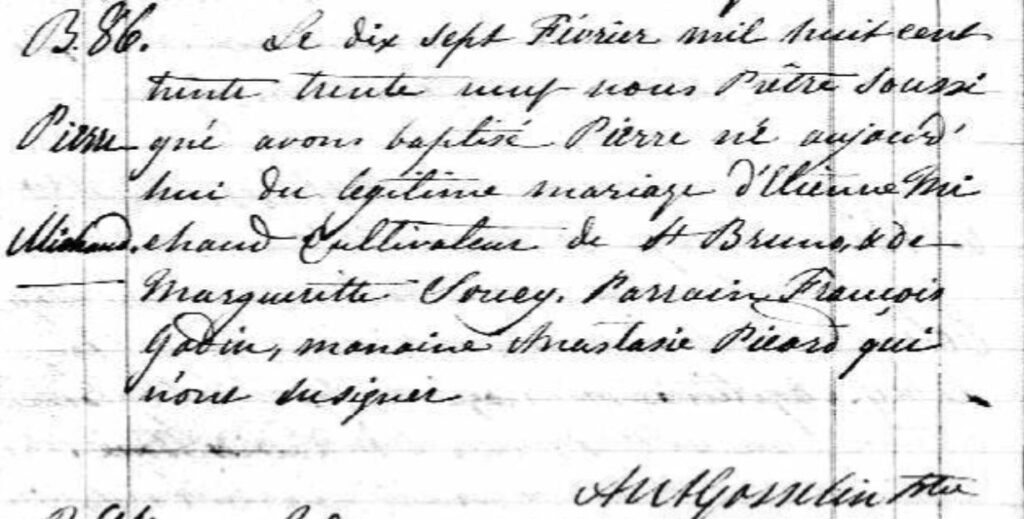
This matters, for Etienne had married for a fourth time in 1819. This wife, Marguerite Soucy, was more than 40 years his junior. With her, Etienne would continue to father children into his eighties. More than that, after 1822, we find Etienne working as a day laborer both in Saint-André and in Saint-Basile. The arrangement with his older children may have failed to stick—and no wonder, if the provisions did not extend to his young bride. In any event, Théotiste and her husband had children of their own and the house likely could not accommodate all of them—the last of whom came into the world in 1839. When Etienne died at the age of 88 and his body was laid to rest in Saint-André, the burial record gave his residence as Saint-Basile.
His passing occurred in January 1841 in the midst of events unfolding at a dizzying pace. His daughter Modeste married Edouard Lebel in Saint-Basile on January 11. Only two days later, she gave birth to a son, Hilaire. Etienne died on January 24 and Modeste passed away the next day, assuredly due to complications from childbirth. Young Hilaire Lebel survived and would marry Flavie Violette in Van Buren in 1865.
Marguerite Soucy, Etienne’s fourth and last wife, remained in the St. John Valley, where her surviving children were raised. They married into the Laferrière, Corneau, St. Amand, and Lévesque families. Marguerite, a widow now for nearly thirty years, was a domestic servant for Father P. H. Beaudet in Van Buren in 1870. She died in 1879, likely having outlived most of her husband’s children.
Etienne Michaud had 27 children by four women. They were prime witnesses to a high rate of infant mortality, occupational risks for men, and, for women, the looming threat of infection and hemorrhage in childbirth. Etienne experienced the invasion of 1759 first-hand and had to navigate the local civil war that erupted when the Bostonnais occupied the colony in 1776. In the Madawaska territory, he and his young wife were on the front lines of a border dispute that seemed to promise full-scale war. They knew the meaning of hard times.
Etienne and some of his family members saw nearly as much of Lower Canada as was possible to see in the early nineteenth century. Witnesses to history, they also witnessed a great deal of life across the colony. Fittingly, we find their descendants in Fort Kent, Maskinongé, Massachusetts, Kamouraska, Cowansville, and countless places between.
It is probably too much to hope to capture a historical figure’s personality from formulaic church records and a small number of legal transactions. But there is enough in Etienne’s life to have us hope for a time machine.
Further Reading
The story of Pierre Michaud and Marie Ancelin, the shared ancestors of all Michauds in North America, is available on The French-Canadian Genealogist.
Beyond the legal records that I was able to locate, I am indebted to the genealogists who developed Etienne’s profile on WikiTree; I have verified the profile’s information against available primary documents.
For more, see my blog post on life in early nineteenth-century Lower Canada and these three forgotten tales from the Upper St. John Valley.
[1] Again, the household was inventoried and provisions were made for the children (see here, here, and here). Debts were considerable; an alternative explanation for subsequent travels across the colony may lie in the need to meet financial obligations. Financial pressure is implied in legal disagreement over costs between Etienne and the children’s tutor, François Marquis. A sale of land to Quebec merchant John McLaughlin in 1797 brought the family little.
[2] However, in 1804, he received nearly £30 for land that he had acquired through the death of his mother, Etienne’s second wife.
[3] He had been entrusted with a letter in 1805, suggesting that this may not have been his first foray in the courier business.
Another separate Michaud line in the early days of the Madawaska… https://members.tripod.com/scott_michaud/Romaine-Michaud.html
My 4xGGF was Sébastien Chassé, Théotiste’s brother at whose home she and Etienne Michaud signed their marriage contract. After Théotiste died, age 22, so very young, on Nov. 28, 1773, Sébastien named his first girl, born in 1774, after his sister. I am descended from that Théotiste. She had a brief life, but her namesake lived to age 76 and had 19 children.
Interesting, thank you for sharing this, Susan!
I can only hope to someday know this much information about my French-Canadian ancestors! Thank you for writing such a detailed, informative article!
Pingback: This week's crème de la crème - July 19, 2025 - Genealogy à la carteGenealogy à la carte
Holy yikes! Fathering 27 children, and some of them into his 80s!? I think we can know something about this man’s personality!
And some of the kids — we’ll provide material support for dad, but dad only. And then he goes off and does day labor to support a 4th family.
This is powerful stuff, Patrick. This is the kind of story that, for me, fills in some of what interests me most about history: the intersection between the ordinary lives of our ancestors and the events that we read about in history books.
Tell us more!