An earlier version of this essay appeared in the spring/summer 2025 issue of Le Forum, the quarterly publication of the Franco-American Centre (University of Maine). Please cite appropriately, and please consider supporting the Franco-American Centre.
* * *
A man named Michaud graced the first page of the Boston Daily Globe on July 29, 1903. The Roman Catholic Diocese of Burlington, built in part on the strength of Vermont’s French-Canadian population, was celebrating its golden jubilee. In any ordinary edition of the Globe, readers would have readily noticed the portrait of Burlington’s Franco-Irish bishop, John Stephen Michaud, posing in his episcopal regalia.
This was no ordinary edition, nor any ordinary day. Screaming at readers next to Michaud’s image in big, bold font was the lead story: At Least 12 Persons Are Dead.
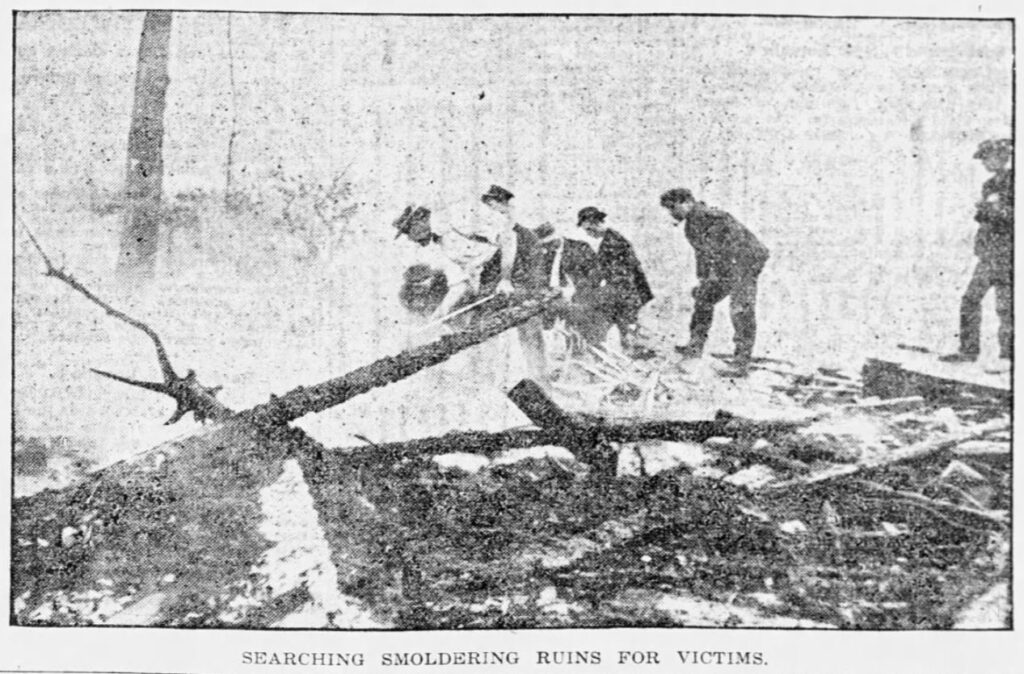
In Lowell, at nine o’clock on the morning of July 29, the storage facilities of the U.S. Cartridge Company, packed with dynamite and other explosives, erupted in a mighty, devastating blast. Shock waves rocked towns near and far. The immediate vicinity of the U.S. Cartridge facilities may well have been a war zone.

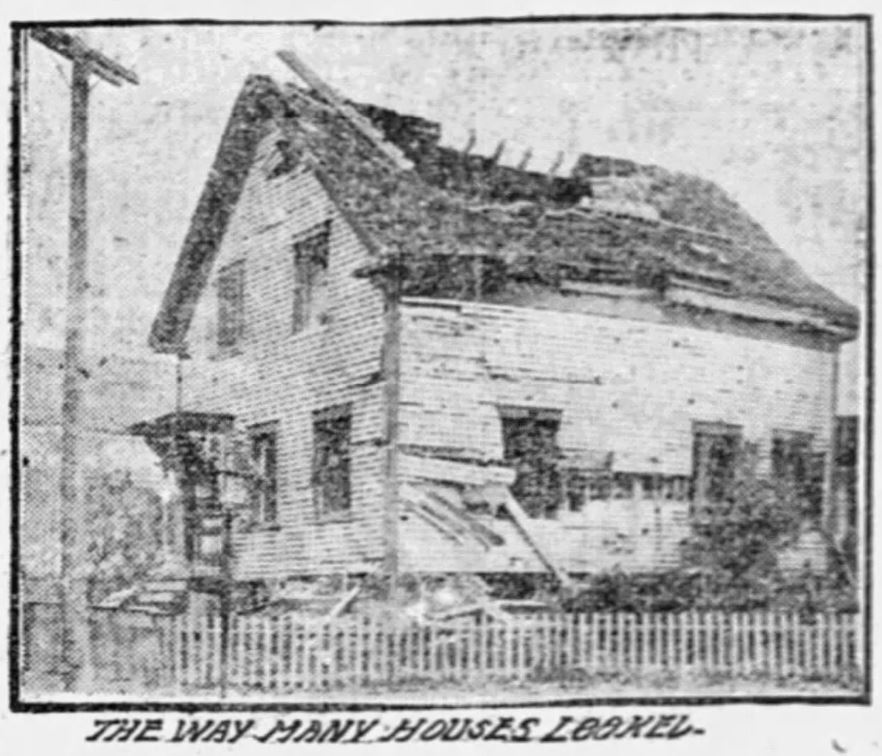
The dynamite and power magazines were located near the Concord River in Wigginville, just west of Tewksbury in what is today South Lowell. A dozen houses were instantly pulverized; thirty more remained standing but were now uninhabitable. A blaze was stamped out just as the full horror of the explosion came into focus. In fire crews’ footsteps came nearby residents who sought friends and family; then, curious throngs. The first to arrive on the scene witnessed people with deep gashes and other serious injuries caused by flying debris. Some people, unconscious, clung between life and death. Most were sent to St. John’s Hospital. The Globe offered a graphic description of the end that befell four boys who had been swimming in the Concord River at the time of the blast. Also among the dead were workmen who had been laying a new floor in the dynamite magazine. Remarkably, one survived. He stated that a glycerin leak was noticed during their work and efforts to neutralize it had caused the conflagration.
The victims were overwhelmingly working-class and Catholic. They also belonged to Lowell’s two largest minority groups. Irish names like Sullivan, Quinn, and Flynn stood out. In a single moment, Michael McDermott, an immigrant, and his wife Mary Theresa Galvin lost three children. The French Canadians of Wigginville were not spared.
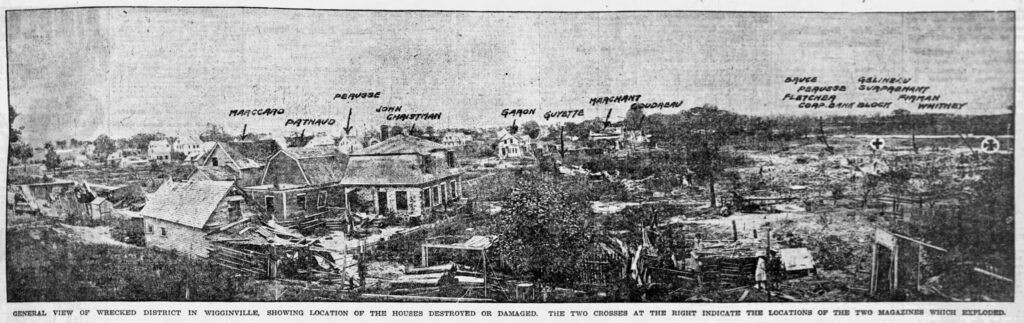
Several days after the explosion, the event was still front-page news. The Globe published a photograph of the neighborhood showing homes that were destroyed or damaged. It also identified their occupants. French names stood out: Patenaude, Pérusse, Garon, Goyette, Marchand, Gaudreau, Gélineau, Surprenant. With these little cottages near the river, immigrant families had taken a step towards home ownership and self-sufficiency; it was also a step away from the cramped tenements of Lowell’s Little Canada. Now it was all gone.
The lucky surviving workman was eighteen-year-old Alméda Bélanger. By being so near to the source of the blast, he likely avoided the volley of debris that tore through the neighborhood. Others were not so fortunate. For carpenter Zéphirin Pérusse, who had immigrated thirty-five years earlier, the explosion was doubly tragic. His daughter and youngest child Joséphine, aged 11, was fatally wounded; she died after four hours in hospital care. The child’s mother, Vitaline Lanteigne, appears to have died instantly. Zéphirin was taken in by an older daughter, Victoria, and her husband. Nearby lived families that felt the effects of the blast dearly and personally. Beyond those who were made homeless, three members of the Charles Hamel household were injured. Alba Pelletier suffered injuries to her head and an arm; Délina Gélineau was scalded because she was washing at the time of the explosion. Several individuals suffered a nervous shock.
While news of the tragedy reverberated in Quebec papers and in the victims’ home parishes, the local Franco-American publication, L’Etoile, launched a subscription. Relief funds amounting to more than $160 were distributed among 19 individuals. In light of their last names, they may all have been Canadian immigrants.
The number of injured, which varied from one account to the next, eventually stood between 70 and 100. The death toll rose quickly and stabilized. Twenty-two people died in the explosion or from resulting injuries. The last fatality, Clara Surprenant, was the ten-year-old daughter of Canadian immigrants Casimir Surprenant and Amanda Lagassé. She passed away at St. John’s Hospital on September 24, 1903, nearly two months after the explosion. She had suffered a skull fracture and never recovered. The following year, the whole family relocated to Manitoba. Their American experiment had come to an end in Wigginville.
Little structural change seems to have come of the explosion, but the owners of U.S. Cartridge implicitly recognized their responsibility. In an interesting twist, one of these owners was politician Butler Ames. Supporters had canvassed heavily among Franco-Americans during Ames’ bid for a congressional seat in 1902—and the same voters were said to have ensured his success. By February 1904, attorneys for the Ames family had settled some 170 claims for compensation out of court. Rumors later circulated of an average pay-out of $1,500. This may seem a huge figure by the standards of the day, but, in August 1903, Alméda Bélanger’s attorneys were already preparing a suit for $25,000. The value of the settlements was never officially disclosed. Butler Ames retired from politics in 1913 and was involved in various business interests that continued to enrich him. He died in 1954.
As far as we can tell, Bélanger married one Cora Smith in New Hampshire in 1906. He worked as a mill operative in Ashland and eventually relocated to Laconia, where he operated a small grocery store and became a Democratic town councilor. His tumultuous journey in life included five months that he spent as a fugitive—but that story must be left to another day. Bélanger passed away in 1956.
Sources
Reports from July and August issues of the Globe formed the basis of this article. Issues of the Lowell Sun are available on Archive.org, as is a report filed in 1904 by Tewksbury selectmen and titled Report of the Riverside Park Explosion. Ancestry.com databases, particularly census records and Massachusetts, U.S., Death Records, 1841-1915, helped supplement biographical data. Readers are welcome to contact the author for further information.
For more on Lowell, consider reading Part I and Part II of businessman Joseph Chalifoux’ unusual story.
Leave a Reply