Much has been made of the invisibility of Franco-Americans—invisibility in larger historical narratives, in popular media, and beyond. This was not an issue in the late nineteenth or early twentieth centuries. As a predominantly immigrant, working-class population, Franco-Americans were certainly underrepresented in certain spheres. On the other hand, they did not lack visibility as we commonly understand it. They drew significant attention, both positive and negative, by virtue of their numbers and their distinct culture. The press chronicled their role during labor strikes, their religious conflicts, their mobility, and, occasionally, their success stories. Franco-Americans of that era occupied public spaces, not least through impressive Saint-Jean-Baptiste Day rallies and parades. In the first third of the century, they rose into positions of public trust and found themselves represented in the performing arts. Nativists took note of their growing population and influence.
The quandary of invisibility, when we speak or write of Franco-Americans as a group, is therefore more recent. But that raises an equally important question. Who, exactly, belongs to this group? I raise the question not to have us come to an answer which, in any event, would be neither definitive nor satisfactory. Instead, I want to explore Franco-America as a historical category through two families that fell out of our narratives.
* * *
Mr. LaCross came from Huguenot ancestry, his family having left France many years ago and was then known as Lacroix.
– Daily News [Newport News], April 13, 1928
The above sentence embodies either the selective or the ephemeral nature of memory. It appeared in J. Frank LaCross’s obituary. LaCross died in Hampton, Virginia, in 1928. He had worked as an instructor at the nearby Hampton Institute. As he was a native of Maryland who spent most of his life in Virginia, we might be excused in taking the family at its word—that its immigrant ancestors were French Huguenots. Hampton was probably 350 miles from the nearest Little Canada and more than 550 miles from the Province of Quebec.
The true story of the LaCross clan lies in part in the recollections of Isaïe Pigeon, who, in the 1850s, left his Montreal home to explore and find work in the United States. He traveled to New York City and, from there, to Maryland. When the Civil War erupted, Pigeon joined a Confederate unit. He served for two years and was then imprisoned under suspicion of spying for the Union. When released, he traveled north to Indiana and, after gathering funds, he continued home to Lower Canada. An interview with Montreal’s La Presse in the early twentieth century, when Pigeon was in his sixties, made mention of the supposed Huguenots of Baltimore:
Mr. Pigeon keeps in his precious gallery [of photographs] a portrait of Miss Lacross (Lacroix), a Canadian who, 40 years ago, was nicknamed the Belle of Baltimore . . . She was the daughter of a Patriot of Chambly who, in 1837, was forced into exile. [Her father] settled in Baltimore where his graceful child was admired by the youth of the day.
– La Presse, March 3, 1904, transl.
Miss Lacroix, Emma, was, at the time of Pigeon’s interview, alive and well. In fact, she outlived her brother Frank (his obituary mentioned her, now Mrs. Emma Thropp, of New York) and she passed away in 1931. Her death certificate stated that she had been an actress. She had separated from her husband, Isaiah, some time in the 1870s.
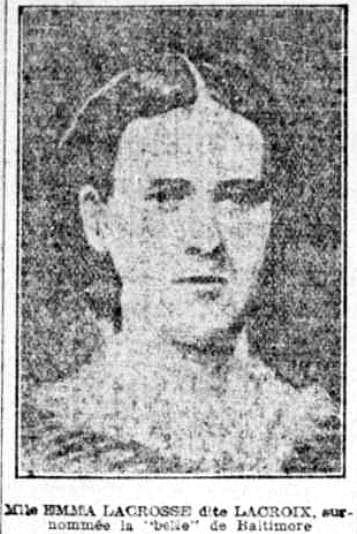
As for Emma’s and her brother Frank’s lineage, the young French-Canadian soldier who had lived in Maryland decades earlier had gotten it right—mostly. Their father was François Xavier Lacourcière, not Lacroix, though one can see how Lacourcière would have been shortened and anglicized to Lacross.
That anglicization is part of the story of Franco-Americanness, at least as far as this family was concerned. The census of 1870 listed as François Xavier’s wife an English-born woman named Ann. François may have made an effort to teach his children French. Maybe. But, in Maryland, with an English-speaking and likely monolingual mother, the children would have grown up in a world entirely disconnected from their father’s native land and culture.
In New England, Little Canadas tended to ease the transition to Americanness over the course of several generations—for the families that stayed for several generations. There was no transition for the Lacrosses; likely no spectrum involving various shades of French-Canadianness. Yet, ancestrally, Frank (that is, François, Jr.) and the Belle of Baltimore were very much of French-Canadian origin.
We don’t know how intentionally the story of Huguenot and metropolitan French origins was fabricated—or by whom, or in what circumstances. Did François Xavier, the immigrant, hide his roots? Did his children misunderstand or conceal them? There may, at the very least, have been wishful thinking. According to his 1928 obituary, Frank had served his local Presbyterian church as an elder. He had preached from the pulpit, overseen the Sunday school, and served the church in countless other ways. His faith was an integral part of his identity… into which a story of Huguenot refugees could be retrofitted more easily than a foreign world filled with saints and (as he saw it) superstition.
* * *
Another Frank.
François Ledoux entered the public annals of Canadian history with a passing mention of his name, fittingly, in the July 4, 1857 issue of Montreal’s La Minerve. He appeared in a list of French Canadians recently arrived in San Francisco. Though the gold rush was over, Americans from the East and immigrants were still arriving in large numbers. There were opportunities, perhaps more so as Californian society was becoming more settled and its economy diversified. Thus, Ledoux, aged 23, went on the adventure of a lifetime—but not alone. The list of French Canadians included some forty individuals who appear to have made the long oceangoing journey to San Francisco together. Nearly all came from the parishes stretching between the Richelieu and Yamaska rivers in southern Lower Canada: Sainte-Marie de Monnoir, Saint-Hilaire, Sainte-Brigide, Saint-Césaire, Farnham, etc.
We don’t know where, exactly, this group first settled in California, nor the extent to which they remained a group. It seems likely that most of the migrants would have gone to Amador Township, 35 miles east of Sacramento. In 1860, Amador was home to an impressive number of Canadians, many of them bearing French names: Gosselin, Boulet, Lebeau, Davignon, Dandurand, Lafontaine, Pâquet, Sicotte, Gamache, to name but a few.
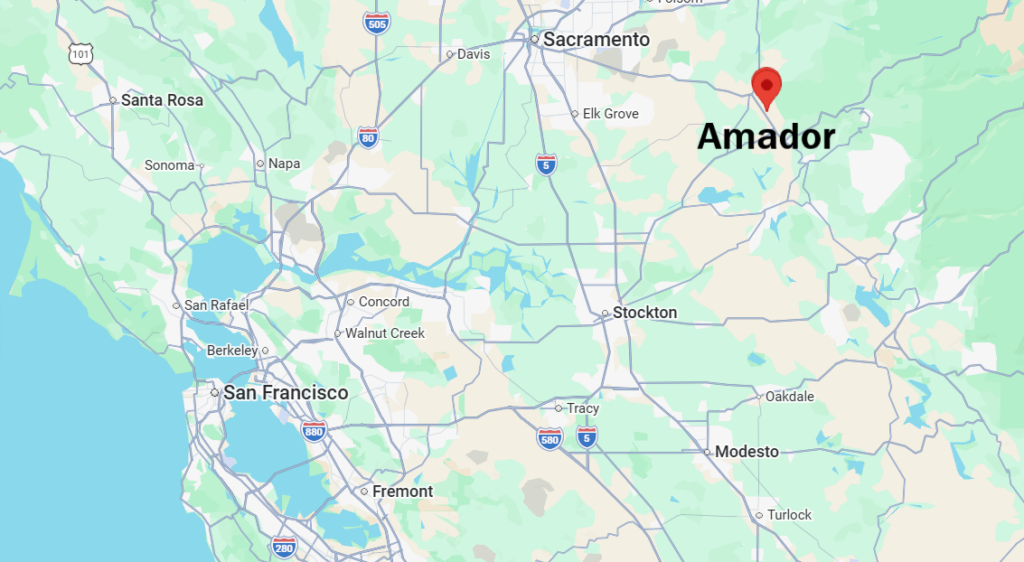
In 1870, when he reappears in historical records, François—now Frank—Ledoux was a resident of Amador. He had married Marie Martel, likely the daughter of Louis Martel, formerly of Farnham, who had also migrated in 1857. Frank worked as a farmer and the family earned extra income by taking in boarders, one of them being Canadian-born Peter Tatroe (Pierre Tétreault), a blacksmith.
Frank’s 1908 obituary tells of his story:
Francis Ledoux, for many years a resident of this county, having occupied a ranch above the Oneida mine for a long time, but latterly a resident of Sacramento, died quite suddenly at the home of Thomas Ryan at Martells, on Sunday afternoon. It has been customary for Mr Ledoux to go up to the mountain range of the Plasse brothers during the summer months for his health. He did so this year, and although 75 years of age he seemed in his usual good health and spirits. The latter part of last week he was seized with a stroke of paralysis and his friends hastened to bring him where medical attention was available. Mr and Mrs T. M. Ryan went to meet him in a buggy Sunday, and brought him from Antelope that afternoon. In the meantime, Mrs Ledoux was notified of his illness, and came up from Sacramento, arriving Saturday night. When Mr Ledoux reached the Ryan home, he seemed to have borne the trip well for his years, and took a seat in a chair. His wife entered the room to greet him, and just then he fell into unconsciousness and died in a few minutes. He was 75 years of age, and a native of St. Marie. The remains were buried in Sutter Creek Wednesday.
– Amador Ledger, September 4, 1908
Unfortunately, in the early twentieth century, if anyone knew the Ledoux name, Ol’ Frank’s ranch had little to do with it. His son Eugene, known as Jean, married an Emma Williams in August 1905. Any marital bliss that the couple may have enjoyed was short-lived. Emma was not content with traditional domestic life and, months into their marriage, the couple began to spend time apart. Jean was still living at his parents’ ranch when news came of the brutal murder of Albert N. McVicar in Stockton in March 1906. The suspected killer was quickly apprehended and she was none other than Mrs. Emma Ledoux. As it turns out, Emma had been married to McVicar—and technically still was when she wed Jean. She persuaded her estranged husband (McVicar) to make purchases on her behalf, after which she killed him and put his body in a trunk. She stood to inherit the money he had carefully put away. Initially sentenced to death, she received a commutation for life in prison after admitting her guilt in a second trial.
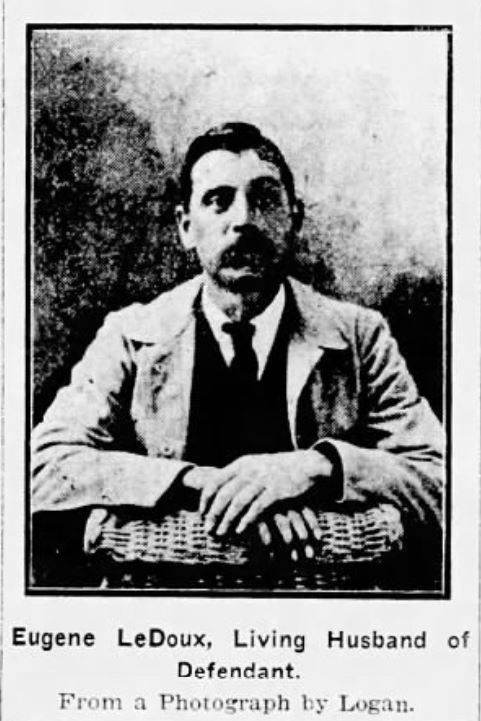
Then there was Jean, the young man, hardly out of his teens, who could not read or write and had poor hearing; the young man who fell perhaps too readily for Emma. For the remainder of his days, his name was tied inextricably to a murderess’s. But life went on. He remarried—his second wife was named Belle—and he worked for the postal service.
In 1920, Jean and his brother William were lodging with their married sister Angie in Sacramento. According to the census, all three declared that their father was a native of France. There may have been a misunderstanding involving the enumerator, since other census records for the family confirm their Canadian origins. This is therefore less a case of faulty family lore, or memory, than of documentation that can lead researchers astray. The bigger question nevertheless remains. What was Franco-American about Jean and his siblings? What piece of French Canada might Ol’ Frank have passed on to his American-born children?
* * *
Definitive or instructive answers are hard to come by—in these two cases and in many others. That is partly the point. Many of us have a much better sense of what Franco-American experiences and acculturation entailed in the communities of New England. Proximity to Quebec, the presence of distinct cultural institutions, and kinship networks help account for that. But the operative word may be communities. We know what happens in communities, and we know what happened to communities. Our historical narrative is built on a certain kind of community to which visibility came easily. Outside of these, we have a very different kind of Franco-American whose story is typically untold.
With the disappearance of Little Canadas and self-identifying Franco-Americans becoming ever more removed from the immigrant generation, that untold story has never been so relevant.
Thanks, Patrick for highlighting these stories that are outside of New England. These elements of americanized surnames, sometimes inaccurate family lore, and non French speaking spouses is something I have heard often with descendants here in Michigan.
Thank you for reading, David!
Pingback: This week's crème de la crème - February 28, 2026 - Genealogy à la carteGenealogy à la carte