The following is a slightly edited version of a manuscript drafted at the request of the Brome County Agricultural Society in 2018. Please cite appropriately.
* * *
Agricultural exhibitions or fairs stemmed from efforts to improve agricultural production in eighteenth-century Europe. The commercialization of agriculture, the consolidation of large rural estates, and the beginnings of the industrial revolution all pointed to a level of output and efficiency that had been inconceivable in a subsistence economy. The empirical pursuits of the Enlightenment led to new methods and knowledge (in chemistry and genetics, for instance) that were applied in cultivation, soil usage, and husbandry. This scientific turn laid the foundation of agronomy.[1]
In North America as in Europe, lower classes were reluctant to abandon entrenched customs and embrace agricultural innovation. Small landholders could easily sink into famine or bankruptcy if risk failed to pay off. But a series of poor harvests in Lower Canada (present-day Quebec) in the 1830s forced farmers to adapt and innovate. Rapid population growth in the St. Lawrence River valley put pressure on the land. Soils were increasingly depleted. The situation became critical as the wheat midge devastated a crop that was still central to the rural economy. Farmers transitioned from wheat to the cultivation of other crops and showed growing interest in cattle, but most still felt the shock in their pocketbook as well as in their plate. It is in this context that agricultural societies embodying a spirit of improvement emerged along the St. Lawrence. As one Catholic priest explained, “we learned from misery.”[2]
A Canadian agricultural society was established in 1789 and smaller regional associations appeared in its wake, but their combined membership—and, indeed, their impact on agricultural practice—was limited. Eventually, new societies formed in Montreal and Quebec City (1817) and at the county level in rural Lower Canada. The oldest agricultural fair in Quebec, the Missisquoi fair, soon to settle in Bedford, was born in the 1820s; the County of Huntingdon had its own association in the same period. William Evans, a pioneer of Canadian agronomy, began a series of studies on the subject in the 1830s. By 1839, Beauharnois County’s agricultural society was taking advantage of market days—a central, well-established aspect of rural life—to hold simultaneous produce and animal exhibits.[3]

In Quebec City, after an interlude of many years, fairs returned in 1846. Typically held on the Plains of Abraham, they appealed directly to an urban population. On such an occasion, a newspaper confidently argued that “the items exhibited attest to great progress in cultivation and husbandry among farmers of the Quebec City area.” Several years later, associations in Bellechasse and Dorchester (in the present-day region of Chaudière–Appalaches) announced their competitions. In light of their modest value, the prizes were evidently symbolic in nature. For instance, the farmer with “the best stallion of at least four years but under nine” would win £2.[4]
By the 1850s, agricultural fairs looked much as they do today. They encouraged agricultural improvements through cooperation and competition. They were at once public markets and exhibitions; increasingly, as they drew a wider public, a variety of shows and games accompanied the business of the fair. Initially, these events were held on a single day, but they soon became more extensive and elaborate. In Central Canada, they became an end-of-summer ritual. A large fair held in Kingston, in Upper Canada (present-day Ontario), in 1856 highlighted these trends. It attracted spectators far beyond the number of competitors. While dedicated to agricultural arts and techniques, the event appealed to varied tastes and interests. “There are shows and booths here of all sorts and descriptions,” one observer explained, “from the ‘greatest curiosity of the world’ to a ‘penny peep;’ and, as may naturally be supposed, there is a perfect Babel of tongues.” Still, the agricultural vocation of these fairs was not lost. Also in 1856, the regional press lauded the benefits—including emulation—of Shefford County’s fair. An article on the subject concluded simply, “Every landholder should be a member of this society.”[5]
Still, the challenges were many. One newspaper indicated in 1850 that county exhibitions were too small and expensive to achieve their lofty goals; larger, better-funded meetings might “excite emulation” more effectively. At the same time, a legislative report noted the advances and lingering weaknesses of Canadian agriculture. High membership costs and budgetary mismanagement deterred participation in local societies. Fairs tended to attract “our best farmers and capitalists,” but failed to include those who had the most to gain, farmers in a precarious financial position. Government subsidies, for their part, favoured well-endowed associations. At last, according to the same report, while rewarding the best animals and produce, organizers and exhibitors alike neglected agricultural problems. They should, accordingly, create new prize categories for seeding, for output, etc.[6]
The legislative committee reflected the government’s growing interest in agriculture. Tellingly, the committee stated that “the land is the most valuable resource of a people’s natural wealth; of all industries, the one devoted to cultivation is the most worthy of economists’ and legislators’ attention.” Some measures lay entirely in the hands of farmers, but the government could fund agricultural colleges, disseminate scientific studies, appoint provincial commissioners, and support such agricultural associations as already existed. The committee’s appointment was itself encouraging.[7]
Further, in 1850 and 1854, the assembly of the United Province of Canada supported competitions to select products that would represent the colony at the international exhibitions of London and Paris. Agricultural fairs could enhance a country’s image and inspire national honour. State support did not stop there. In 1853, the government of the province replaced the old Société d’agriculture du Bas-Canada with a proper Department of Agriculture. At last, in 1857, in the early days of the Brome County Agricultural Society, the assembly adopted a law to stimulate agriculture and industry, which would help local and regional associations coordinate their efforts and share the knowledge and know-how of their participants.[8]
After 1860, agricultural societies mirrored the evolution of Quebec agriculture as a whole. Among these changes were a new, more specialized mode of production including the rise of the dairy industry (average milk production per farm doubled from 1880 to 1910); the proliferation of new farm machinery; the establishment of the Union catholique des cultivateurs (forerunner of the Union des producteurs agricoles) in 1924; and the relative decline of family agriculture (Quebec agricultural labour declined by 43 per cent from 1951 to 1961). It is in fact due to the rural exodus that the mission of agricultural societies evolved in the 1960s and 1970s. As a result of urbanization, it became imperative “to ‘sell’ agriculture to consumers, to educate city dwellers on the effort, time, and sacrifices needed to build a herd and produce crops and vegetables.” Rather than educating farmers, the associations became more interested in raising public awareness of their concerns. At the same time, by promoting a rural lifestyle, it might be possible to retain more youths otherwise lured by towns and cities.[9]

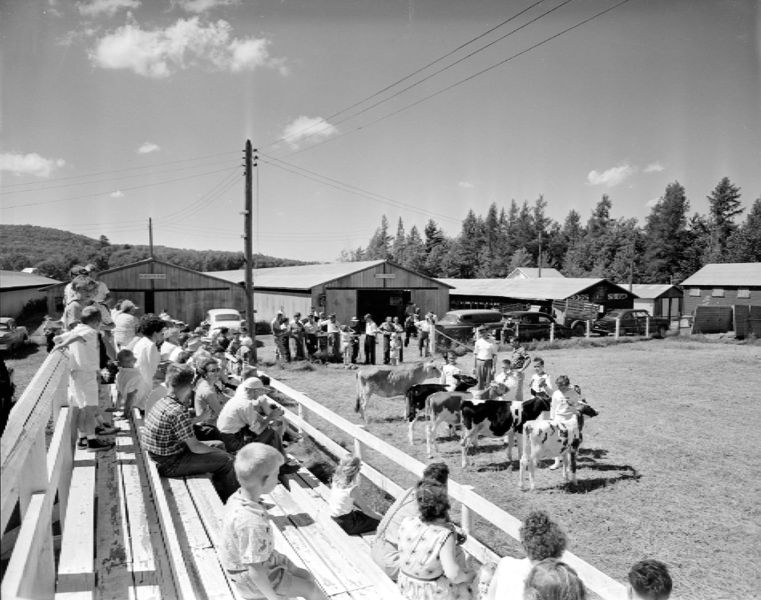
This renewed sense of purpose helps explain the rise of new agricultural fairs in the 1960s and 1970s. Existing fairs, for their part, felt pressure to diversify their activities. Races, wrestling, music and other shows, traditional arts and crafts, and exhibits on local history and heritage became mainstays. But more was needed, including cooperation across counties and regions. In 1955, delegates from nine agricultural societies created the Association des expositions agricoles du Québec (AEAQ). Beginning in the 1970s, their concerted efforts pressured the provincial and federal governments to loosen regulations and ensure their financial viability. Periods of budgetary restraint brought a certain urgency to the AEAQ’s mission. Nevertheless, at century’s end, Quebec fairs together drew 1.2 million visitors annually. The AEAQ now represents 28 fairs held across eleven of the province’s administrative regions.[10]
Local competition no longer promises immense strides in agricultural improvement. In recent decades, progress has rested on the products of large international firms (e.g. farm equipment and seeds), market forces, the demands of the agri-food industry, and the state of government regulation. The role of agricultural exhibitions has changed, but their new vocation is no less important. By educating visitors about farm life, these annual events help us understand the past and present of a sector that is too often invisible and underappreciated.
[1] A course taught by historian Frances Richardson traces agricultural modernization in Great Britain in this era. See “British Agricultural Revolution 1600-1870,” Open Educational Resources, Department for Continuing Education, University of Oxford, online, accessed June 18, 2018; on eighteenth- and nineteenth-century European agronomy, Paul Robin, Jean-Paul Aeschlimann, and Christian Feller, ed., Histoire et agronomie: Entre ruptures et durée (2007).
[2] Historians have debated the causes, manifestations, and extent of a so-called agricultural crisis for many decades. The most important studies include Fernand Ouellet and Jean Hamelin, “La crise agricole dans le Bas-Canada (1802-1837),” Etudes rurales 7 (1962), 36-57; Serge Courville, “La crise agricole du Bas-Canada: Eléments d’une réflexion géographique (première partie),” Cahiers de géographie du Québec 24 (1980), 193-223, and “La crise agricole du Bas-Canada: Eléments d’une réflexion géographique (deuxième partie),” Cahiers de géographie du Québec 24 (1980), 385-428; Allan Greer, Peasant, Lord, and Merchant: Rural Society in Three Quebec Parishes, 1740-1840 (1985); Christian Dessureault, “Crise ou modernisation: La société rurale maskoutaine durant le premier tiers du XIXe siècle,” Revue d’histoire de l’Amérique française 42 (1989), 359-387; Alain Laberge, “Crise, malaise et restructuration: l’agriculture bas-canadienne dans tous ses états,” Erudition, humanisme et savoir: Actes du colloque en l’honneur de Jean Hamelin, ed. Yves Roby and Nive Voisine (1996), 119-130; J. C. Taché et al., Rapport du Comité spécial sur l’état de l’agriculture du Bas-Canada (1850), 10. Translations by the present author.
[3] E. A. Heaman, The Inglorious Arts of Peace: Exhibitions in Canadian Society During the Nineteenth Century (1999), 34-35, 37-43; La Voix de l’Est, January 27, 2011; Ouellet and Jean Hamelin, “La crise agricole,” 47; P. J. O. Chauveau, “Biographie canadienne: William Evans, l’agronome,” Journal de l’Instruction publique, February 1857, 33-34; Jean-Claude Robert, “Evans, William,” Dictionary of Canadian Biography 8, online, accessed June 18, 2018; Le Canadien, August 30, 1839. Joseph-François Perrault also worked extensively in this area; see, on his case, Gilles Héon and Rénald Lessard, “Joseph-François Perrault et l’agriculture bas-canadienne,” Cap-aux-Diamants 46 (1996), 59.
[4] Le Canadien, October 2, 1846; Le Canadien, September 13, 1848.
[5] Montreal Herald, September 25, 1856; Montreal Herald, October 20, 1856. F. X. Valade’s depiction of the agricultural fair held at Point St. Charles in 1857 mirrored that of Kingston. See “Exposition des produits agricoles et industriels du Bas-Canada à Montréal,” Journal de l’Instruction publique, September 1857, 175-176.
[6] Le Journal de Québec, October 31, 1850; Taché et al., Rapport du Comité spécial, 15-19.
[7] Taché et al., Rapport du Comité spécial, 4, 14-15. Even amid growing government intervention, public figures argued that voters could be more demanding of elected officials and expect more of the province’s agricultural policies. See Le Canadien, September 15, 1857.
[8] Le Journal de Québec, August 10, 1850; Chauveau, “Biographie canadienne”; “Loi pour l’encouragement de l’Agriculture, des Arts et de l’Industrie,” Journal de l’Instruction publique, August 1857, 159-161.
[9] Jean-Pierre Wampach, “Deux siècles de croissance agricole au Québec, 1760-1985,” Recherches sociographiques 29 (1988), 184; Nathan Keyfitz, “L’exode rural dans la province de Québec, 1951-1961,” Recherches sociographiques 3 (1962), 307; Le Nouvelliste, August 29, 1967; Le Nouvelliste, January 20, 1971.
[10] Association des expositions agricoles du Québec, Album souvenir 50e anniversaire (1955-2005), online, accessed June 18, 2018.
Leave a Reply