Only several times in its venerable existence has this blog grazed the Franco-American communities of New Hampshire’s Seacoast region. We have learned about Exeter residents Pie Narcisse Legendre and Edward Daignault and about the mill workers of Somersworth. Recently, the blog referenced the “deserving poor” of a small mill town. There has been little else. Perhaps this is a reflection of the state of research on Franco-Americans who have lived in the shadow of Manchester and Nashua. Hardly do we hear of Dover, Rollinsford, and Rochester, New Hampshire, or of Berwick and South Berwick over the line in Maine.
Well, this former resident of Newmarket is finally making amends.
There is nothing instantly obvious in Newmarket that would point to a Franco-American presence—except, perhaps, for a mural on a side street that bears the names of its sponsors, names like Arquette, Beauchesne, Beaulieu, Cote, Dupuis, Fecteau, Labranche, Langlois, Lemieux, Lemire, and Trottier. Visible or not, we need not search very far in surviving census records to trace these families’ historic presence in Newmarket and its immediate area.
The 1870s were the critical years in the establishment of a French-Canadian presence in Newmarket. The town then had a population of just under 2,000 residents. When people spoke of immigrants, up to this point, inevitably they were referring to families that had come from the British Isles. There was a noticeable Irish population that was chiefly employed in local cotton mills. First powered by the Lamprey River, which empties in the Great Bay, the mills had already transformed Newmarket. The town had an industrial vocation that its immediate neighbors lacked.
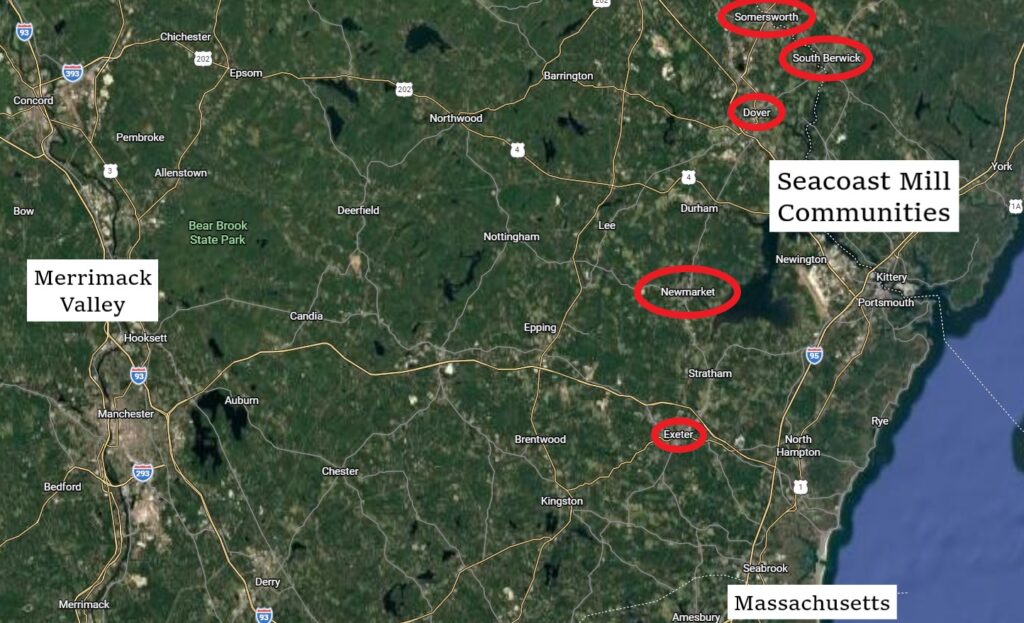
The census of 1870 provided places of birth but not ethnic origins. At that time, Newmarket had no more than a dozen Canadian-born residents and French Canadians were likely a minority among them. A decade later, the town had grown modestly to 2,368 residents. This increase owed entirely to Canadian immigration. Indeed, in 1880, there were 380 residents either born in Canada or with two Canadian-born parents. (This figure excludes people born in New Brunswick and Nova Scotia, who were still counted separately.) This is to say that 16 percent or roughly one-sixth of the local population now had a direct connection to Canada. Although nothing to compare with Manchester’s West Side, mill housing on Newmarket’s Nichols Avenue became known as a Little Canada.
Fittingly, a Catholic parish would come into existence in 1878. This being a small community that could not support two ethnic parishes, Irish and French Canadians would worship together. The ensuing decade was rich in developments for the Catholics of the Seacoast region. National parishes were established in Great Falls (now Somersworth) and Rochester.
In 1885, Plattsburgh’s National chronicled advances in cultural organization in the region. It seems that Newmarket now had a Société Saint-Jean-Baptiste. Farther north, Dover was home to many Canadian families who were served by the pastor of a predominantly Irish congregation; a Canadian as well as an Irish priest served the Catholics of Salmon Falls (Rollinsford). Great Falls had 240 families and Rochester, 150; each had a French pastor and a Société Saint-Jean-Baptiste. In the 1890s, a chapter of the Catholic Order of Foresters was founded in Newmarket.
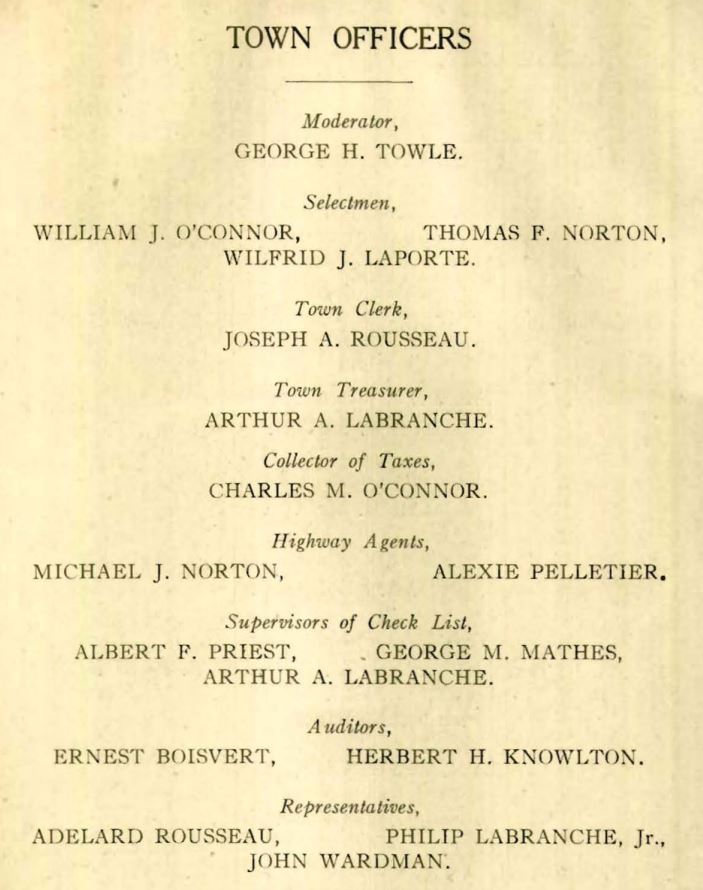
Franco-American life in town was richer than mill work and religious duties, important though these were. As in many other Franco centers in New England, baseball became a prized pastime. Well-placed residents also seized on opportunities to take part in civic life. Léon Camiré, a native of Saint-Norbert d’Arthabaska, Quebec, and a former mill operative, became the first Franco-American selectman. He later moved to Rhode Island. In 1923, Franco-American public officials in Newmarket included the town clerk, the treasurer, the commissioner of public works, and a selectman. By this time, French-heritage voters generally favored the Democratic Party.
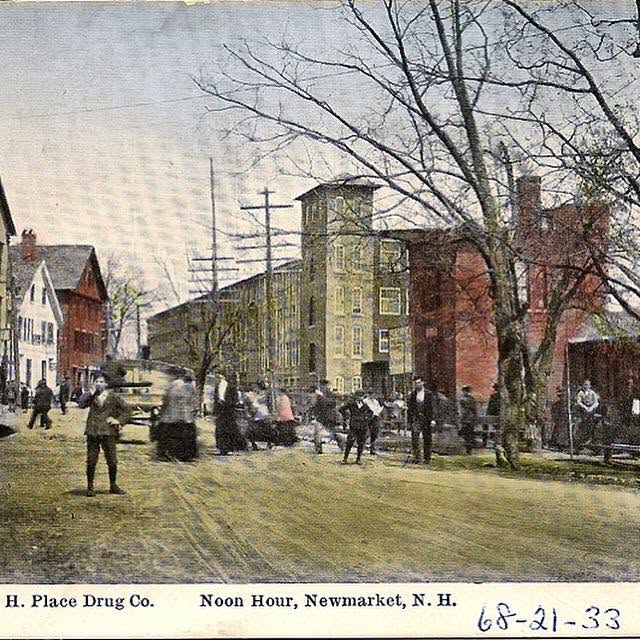
The town remained at the mercy of larger economic forces that sometimes set it back. In 1878, the Newmarket Manufacturing Company announced wage reductions ranging from 5 to 15 percent, enough to spark rumors of a looming strike. The depression of the 1890s was likely another blow to the community.
Hard times returned with the recession of the early 1920s, though, by this point, Newmarket mill workers had organized. In the spring of 1922, led by the United Textile Workers, employees walked off the job to protect their wages and working hours. Their strike stretched into the summer. After more than twenty weeks, the company settled.
Another strike paralyzed mill operations in 1926, as did a third on the eve of the Great Depression, in 1929. The last of these proved inauspicious. Strikers again sought to protect their wages. After a decade of declining profits in New England, textile manufacturers were no longer willing to negotiate. Approximately five weeks into the strike, workers in company housing received eviction notices. The American Federation of Labor sought to care for them and plans were made for a temporary tent city. The strike continued even as employees learned that the company was dismantling its production equipment. Local tensions only increased. In June, strikers Albert St. Hilaire and Fred Langlois were charged with assaulting deputy sheriffs. They were part of a group of 20 who had ambushed the agents. Their anger was ultimately fruitless. The strike of 1929 and the ensuing market crash signaled the end of the Newmarket Manufacturing Company.
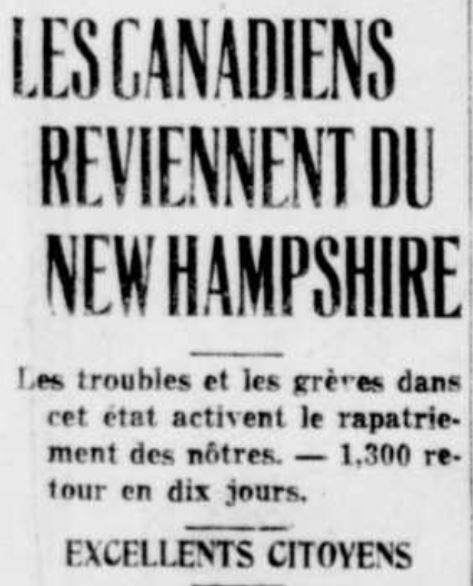
This was not the end of the town’s French-Canadian history, but it very nearly was. In September 1930, a Montreal newspaper reported on the large wave of French Canadians who were leaving New Hampshire’s mill towns and returning to Quebec. Newmarket had, allegedly, lost the near-entirety of its French-heritage population. This was not merely a product of the Depression. Early in the 1929 strike, 600 Canadians were said to have left town and repatriated. The number was undoubtedly inflated. It remains that the exodus preceded the Depression and, having hitched its wagon to textiles, Newmarket suffered mightily through the downturns of the 1920s. It lost one-fifth of its population from 1920 to 1930.
In the 1940s and 1950s, the town’s multicultural character persisted. Italians and Poles formed small but recognizable communities. French life also endured. On the eve of the Second World War, St. Mary’s Church had French pastors. The local newspaper advertised Joseph Brisson’s grocery store. It reported on the deaths of Franco-American residents. The rosters of local sports teams featured such names as St. Pierre, Mongeon, Labranche, Houle, and Dostie.
In 1950, Newmarket was still a manufacturing town, but smaller-scale operations had filled the vacuum created by the demise of the Newmarket Manufacturing Company. The Sam Smith Shoe Company had come to town in 1939 and created opportunities for women, including married women. Nearby were a rayon mill, a machine shop, and a company specializing in appliances. Henry Labranche and Lucien Pelletier became superintendents in these factories. Other men were managers in small businesses. Franco-Americans also worked as salesmen, mechanics, plumbers, barbers, and tradesmen at the nearby naval base.
Cultural adjustment mirrored economic adaptation. In 1950, a parochial school on Main Street was still providing primary education. Of the twelve educators, only one was a native of French Canada. At the same time, all but one had a French surname. This mirrored the larger landscape of the community. Canadian-born residents were nearly all aged 50 and up. A twenty-year-old waitress named Jeanine Auger, born in Fortierville (Centre-du-Québec), was an exception.
In the last third of the twentieth century, Newmarket experienced change that created a more familiar landscape. In the late 1960s, the Abington Shoe Company moved in. Its iconic product, the Timberland boot, momentarily revived local manufacturing. Factory operations moved to Tennessee in the mid-1980s. Since then, Newmarket has recovered notably through the presence of the University of New Hampshire in next-door Durham. UNH students, staff, faculty, and visitors are together a major driver of the town’s service-based economy. The repurposing of the old mill buildings to house small businesses and apartments was symbolic of this turn.
With people coming from all around the United States and abroad, Newmarket has diversified just as it did in the late nineteenth century. Franco-Americans are understandably less visible—and not so much the cohesive, self-identifying community they once formed. It remains nonetheless that they have played a significant role in the making of the Newmarket that we know today. In Query the Past’s next post, we will explore the origins of the town’s earliest French-Canadian families. Stay tuned.
Sources
The website of the New Market Historical Society is a treasure trove of local history collections. Beyond the links that appear above, the Society’s digitized newspapers, directories, and town reports were particularly helpful in understanding the town’s evolution. The federal census returns of 1870, 1880, and 1950, accessed on Ancestry.com, also helped trace the evolution of Newmarket’s immigrant communities and economic foundations. Wilfrid Paradis’s Upon This Granite (1998) provides information about the development of Catholic institutions in the Seacoast region. I address local politics briefly in “Tout nous serait possible”: Une histoire politique des Franco-Américains, 1874-1945 (2021).
Significant newspaper sources include the Boston Daily Globe, April 24, 1878; Le National [Plattsburgh], March 12, 1885; La Presse [Montreal], August 20, 1907; Lewiston Daily Sun, May 17, 1922; Evening Standard [New Bedford], August 3, 1922; Waterville Morning Sentinel, January 29, 1926; Le Canada [Montreal], March 6, 1929; The Labor World/Le Monde Ouvrier [Montreal], April 1, 1929; Le Canada, April 24, 1929; Rutland Daily Herald, June 22, 1929; Boston Daily Globe, September 18, 1929; L’Autorité nouvelle [Montreal], September 28, 1930; La Patrie [Montreal], September 12, 1954.
Further Reading: Those Other Franco-Americans
- Exeter
- Somersworth
- Berlin (Part I, Part II, and Part III)
- New York State
- Barre
- Cohoes (Part I and Part II)
- St. Albans (Part I and Part II)
- The Madawaska Region
- New Bedford (Part I and Part II)
- Tupper Lake
Pingback: Friday’s Family History Finds | Empty Branches on the Family Tree
Pingback: This week's crème de la crème - June 13, 2026 - Genealogy à la carteGenealogy à la carte
Wilfred Langlois, who was one of the strikers in 1929 was my Grandfather’s brother.