On November 9, I had the pleasure of addressing the annual meeting of the Greater Grand Isle Historical Society in Grand Isle, Maine. The notes below are a close approximation of my spoken remarks.
* * *
Thank you for the invitation. It is a pleasure to chat with you all and celebrate the history and heritage that speaks to us.
I won’t say too much about myself—partly because I want to keep this interesting—but I will offer some context. My professional training is in history. In the last decade, my research has revolved around French-Canadian migrations and minority francophone communities. The main characters in the historical world that I study are long past. When I was teaching, I would try to impress upon my students the legacies of these migrations and their relevance to the present. But that is a far cry from engaging in the work of cultural advocacy.
I was never given a form with a dotted line by which I would sign up to become a cultural activist or a cultural advocate. We all know there is no such form—for any of us. But that role is implied in my position at the Acadian Archives. My predecessors established the Archives as an institution that engages directly with the community. Archives are meaningless if they remain behind closed door or if they are accessed only when an academic researcher comes along. It is my view that archives reach their full potential when they bolster the life of the community—when they involve education and awareness, when they give meaning and are given meaning. Their significance to the present is why we hold on to past documents and artifacts in the first place.
I serve as a steward of incredible collections and I assist researchers. But, from the beginning, I have also been pondering and exploring the relationship between these archives and the culture of the St. John Valley as we know it today.
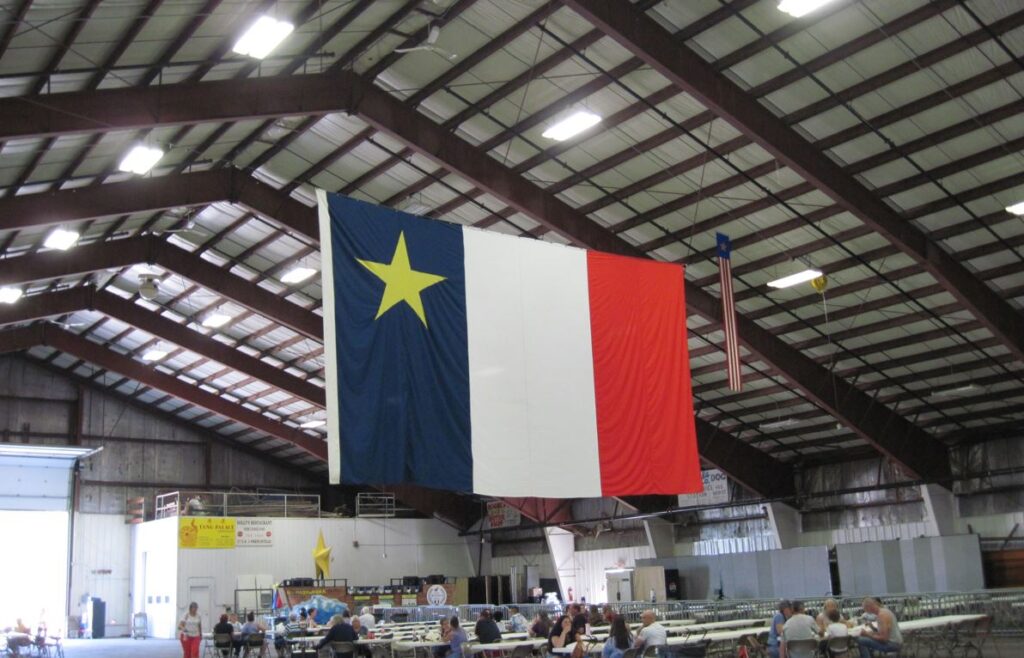
The history that I am tracing with you is, specifically, a history of the culture as something that is deliberately created and maintained. For more than a century, in the Valley and in Franco-American communities across New England and New York, culture was not something that placidly existed by sheer strength in numbers. Relative isolation and homogeneity helped, certainly. But it was actively nourished. From the early days of the Madawaska colony, missionaries and then resident priests nourished a commitment to French Canadians’ and Acadians’ historic faith. At the end of the nineteenth century, the arrival of religious orders provided the same in schools. The well-to-do might send their children downstate, to St. Francis College in Biddeford for instance. Larger Franco-American centers had French-language newspapers. The only such newspaper on the American side of the Valley appeared briefly in Van Buren in the early 1900s. But the interwar period would bring radio broadcasts from Canada; later, Valley residents would be able to access French television shows from the other side of the border. So, there was infrastructure, as there still is. Groups like the Société l’Assomption, the Foresters, and the Société Saint-Jean-Baptiste provided cultural leadership. Meanwhile, in the 1930s, Father Wilfrid Soucy, then in Sinclair, launched a cooperative movement that also had the effect of fostering common action and community. Community was something to be continually created and recreated through the efforts and through the labor of ordinary folks.
Something changed in the 1960s—and in came a heady mix of nostalgia, anxiety, and ambition. The language law of 1919 had been on the books for more than two generations. Southern Maine, Massachusetts, and Connecticut were still pulling families away from the Valley. The rapid pace of modernization and the influence of American media were cause for concern. Residents again became agents of their culture, but now in new ways. In a presentation before the Maine Acadian Culture Preservation Commission in the 1990s, Guy Dubay would trace some of these efforts. I draw some of the information that follows from his presentation.
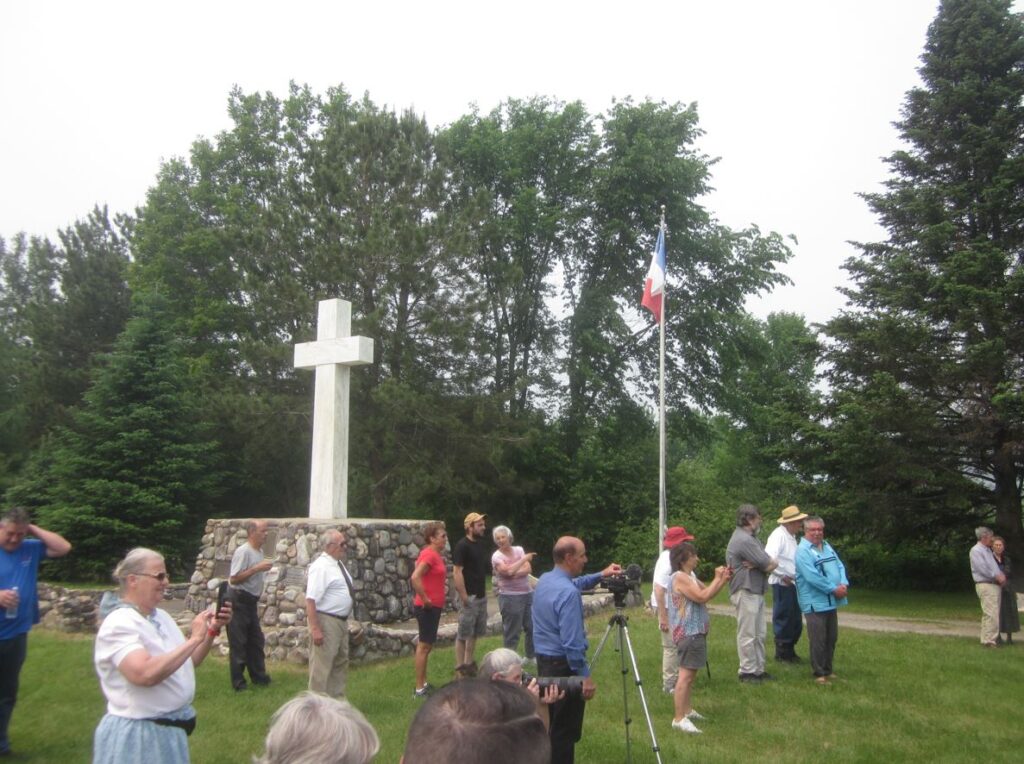
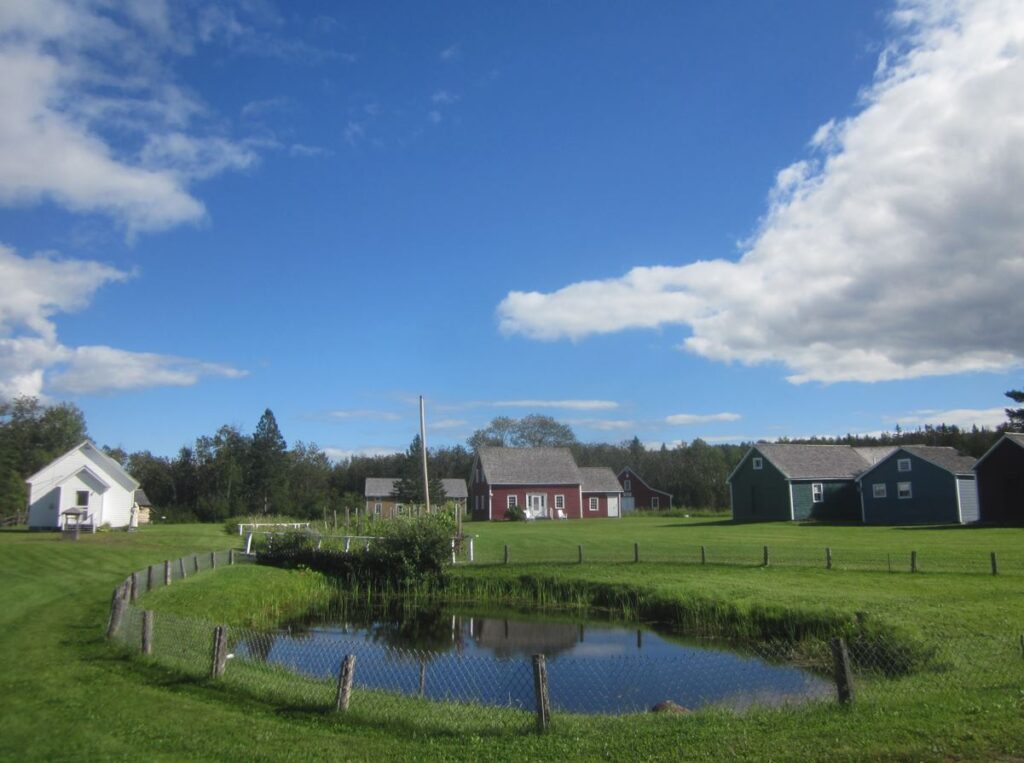
In 1962, we first have talk of creating a historical society in the Valley. In 1964, Quebec students visited Valley farms to research local techniques, providing academic visibility to the Valley—though Marcella Violette had pioneered the scholarly study of the region in the 1950s. Her work would continue to bear fruit in this period. Around 1966, a curriculum coordinator named Patrick Babin made a new push for a historical society and for the development of the St. David site. Julie Albert offered presentations. UMFK hired Roger Grindle, Lowell Daigle, and Roger Paradis, who would soon teach a course on Acadian culture. The Madawaska Historical Society was formed in 1968 and an Acadian village was touted for the site in St. David. In 1971, there was talk of a festival, though seven years elapsed before it happened. In 1973, Van Buren caught the bug and began the work of historical preservation. The town celebrated an Acadian Day on July 1, 1976; this was the year of the Village’s inauguration. The festival came soon after. As Dubay explained, with regard to these projects and to historical articles published in newspapers in that time, “sometimes some of these words, some of these articles remain in esoteric groups. But the festival helped us take the word and put it in the streets. So people all of a sudden when they started seeing our flags all over the place, for example, they said[,] what is that[?] And so we were in a position to answer it.”
By this time, Fort Kent had had its centennial celebration and reorganized its historical society. St. Agatha began to organize. Madawaska pioneered family reunions. We have a book published on Eagle Lake—and then we’re into the 1980s and 1990s… the Acadian Archives, the Maine Acadian Culture Survey, the Preservation Commission, le Club français, French-language immersion, the Heritage Council, and so on.
I am speeding through these dates and initiatives to highlight three things. First, it didn’t happen all at once. It started with hairbrained ideas, with proposals for things that had never been attempted in our region. Second, it took a lot of effort in every town, through thousands of volunteer hours, to create a bigger picture at the regional level. Third, it took courage and determination to create something new. Yes, this was preservation work, but the cultural activists were not trying to copy and paste the 1940s and 1950s. They were creating new spaces that met the needs of the present. Those are three lessons that I wish to insist upon today.
There is one recurring expression that I have heard in Massachusetts, in New Hampshire, in southern Maine, and here in our region: “The culture is dying.” I understand where this notion comes from. There are hardly any native French speakers under the age of 40 in our region. The cross-border life and relationship to French Canada that long set our region apart have been eroded. Young people have few opportunities, in or out of school, to learn about the folk life of the Valley. They are certainly less likely to take part in civic or cultural organizations. Some historical societies and other groups are struggling to retain or recruit volunteers. There is an understandable fear over what comes after us. Here we are again: nostalgia, anxiety, but also, I would hope, some ambition.
There are two things that bother me about the “our culture is dying” mantra. First, I cannot imagine a worse way of recruiting young people if they are constantly hearing that their culture is a thing of the past. We are signaling and advertising decline and doom. Why then bother getting involved? Those words are almost calculated to undermine any kind of passion or enthusiasm. That is my first objection: we have to think about how we brand or communicate the rich and unique French-heritage culture of the Valley.
And here is my second: If the culture disappears with us, the culture won’t know. It is not sentient; it does not have an existence outside of us. The culture is made up of people and it will exist as long as it has relevance to people—as long as it speaks to their identity, their lived reality, their hopes, their stories, and so on. I would add that it is continually changing. Your culture is not your great grandparents’ culture, whether we think of songs and media, material life, the way in which they understood themselves and the world around them, etc. Séraphin Poudrier and Andy Griffith would have meant nothing to them.
This is all to say that in declaring that the culture is dying, we are giving up on the opportunity to help young people make their heritage their own. If the culture is presented as an artifact handed down from past generations, only to be preserved, only to be kept intact, they will put it on a metaphorical shelf, where it will gather metaphorical dust. I think most of us want that culture to be kept relevant and to be used.
I don’t want to talk too much about failures, because the blame game resolves nothing. We could blame the school system, for instance, but we also happen to have dedicated teachers who go above and beyond and are frequently stretched thin. Administrators have to work with the limited budgets that local voters are willing to approve and with state mandates. It’s complicated. So are the solutions, but our time is better spent talking about solutions. Here, then, are five modest proposals:
1. Language is only one piece of the puzzle. I am excited and impressed with the French conversation group that has recently launched here. We have folks seeking out the language from Fort Fairfield to Fort Kent and we should continue to support these efforts. Personally, whatever accomplishments I can claim I owe particularly to fluency in two languages. But here is the flip side: if we make fluency in French a prerequisite for engagement with the culture, we will ultimately sacrifice both, especially in school districts where French is available only for a few years at the high school level. On the other hand, if we have exciting and engaging cultural offerings where everyone is welcome, we will provide young people with the inspiration and motivation to learn French. Bilingualism is valuable, but let’s not incur further losses because we have created an arbitrary litmus test for admission into the culture.
2. Let’s end the localism. The Valley is intensely local. I don’t mean only as a region, but at the town level too. There is hardly any collaboration between historical societies. Yet, every town has a historical society and they are all facing the exact same challenges with regard to volunteers, fundraising, maintenance, and attendance. We don’t have to share resources, at least just yet. We can begin by sharing information. Let’s learn from St. Agatha’s ability to retain committed volunteers and from Fort Kent’s efforts to raise money. These are just a few examples. Success stories should not be closely-guarded secrets. The whole region will benefit from historical societies that thrive. Ending the localism also means looking at what works and at what opportunities exist beyond our region. The Association of Maine Archives and Museum has all sorts of trainings and resources for small institutions across the state. The last two years, the Acadian Archives have tabled at PoutineFest in Portland, tapping into a new audience and then benefitting from PoutineFest funds for our programming. We can do the same in Edmundston or beyond. A robust virtual presence is also an essential that helps forge new connections.
3. Let’s take advantage of captive audiences. That means that we should go where people already are instead of simply waiting for them to visit us. We can do so anytime there is a large public event, perhaps by tabling, handing out membership cards, and having folks sign up for a mailing list. We can hold events at community centers, as the Club français has done with a game night at the Fort Kent Senior Center—or as we are doing today. We can work with schools to offer activities. I have found, from presentations at Fort Kent Elementary, that elementary-school kids absolutely love a show-and-tell in which we bring artifacts from our collections. This historical society could do the same in Van Buren and Madawaska. We might also think of the Maine Acadian Heritage Council’s work to bring Bon Débarras into local schools. Let’s keep planting those seeds.
4. Branding matters. This is partly about celebrating a culture that is alive and relevant, as I’ve mentioned. It is also about visibility. The Acadian flag and star; French signage; ployes, potatoes, and stew; the celebration of Acadian and French-Canadian roots—these are symbols, and symbols matter. Young people won’t feel invited into their own heritage if it is invisible. We need to occupy public spaces and make this rich culture a basic fact of life in the St. John Valley, and not just during a four-day festival. That will ensure that even if these young people leave the region, they will remain its lifelong advocates. Further, to reiterate, when it comes to communication, we need to reach the virtual spaces that these young folks occupy. A brick-and-mortar presence does not suffice. We need to know how to transform amazing physical collections into something that is more widely accessible.
5. We should do it for them, not for us. If you are a business owner and you want to remain in business, you evolve to meet your customers’ needs. It’s about them—and their satisfaction will be your success. I think we need to have a similar approach in the cultural efforts we make today. Heritage can provide young people with a sense of self, a sense of community, a better understanding of their history and of other groups; it can nourish empathy, forge the basis for civic engagement, and create meaning and bearings. What a precious gift! But a true gift takes into account the interests and needs of the recipient. We can’t impose our vision of what’s precious and immutable in our culture on them. There is a lot that we can do to aid in their journey—it remains their journey.
Those are my five big bullet points. But there is so much more that we can do that is more profitable than wringing our hands. We can support and attend cultural events, write to policymakers, share our concerns with principals and superintendents, communicate with local and state media, assert ourselves online, volunteer, express our identity in public settings, demand more of our institutions, and share resources. Not one of these items costs a dime. Now, money does matter—and for that, there are grants, there is information on best practices in fundraising, and there may be folks who want to think ahead and plan a gift or a bequest.
In essence, my pitch is this: nothing is inevitable when we have the right tools. And if Grand Isle has the right tools, and Madawaska has the right tools, and Frenchville has the right tools, and so forth, and if we can act together, we may be able to bury this business about “our culture is dying.”
Thirty years passed between Guy Dubay’s historical starting point and his presentation in Frenchville. Now, thirty years have passed since his presentation. This may be the time to reassess and carve a path for the future.
Okay, this has been very preachy. Truly, I don’t have magical solutions. We have to be intensely realistic, intensely willing to learn, and intensely open to change. I hope these suggestions can provide inspiration and guidance. Thank you.
* * *
Earlier thoughts on advocacy appeared as “Advocating for Franco-American Culture” in the winter 2024 issue of Le Forum. For more on cultural renewal in the Northeast, please see my blog post on the topic or my chapter in French All Around Us, Vol. 2.
Not preachy but inspiring!
I started a “tradition” with my sister’s grandchildren, my grand-nieces on Acadia Day this past summer: T-shirts and ployes.
The vegan two think ployes is a kind of manna.
For the t-shirts, I asked them to name their favorite animal. Two of them named a fox and a horse, for which I was able to use two of Patsy Cormier’s images.
The others had commercial images, because I couldn’t find Acadian artists who’d done monkeys, cats, or turtles. (They aren’t yet at the point of thinking the Acadian flag is a cool logo)
Little things…at least they now have an idea that there’s something in their own heritage to think about in the middle of August. (:
Very neat! Thank you for sharing this!