In appreciation of those who have followed and supported Query the Past, I am pleased to share another translated excerpt of “Tout nous serait possible”: Une histoire politique des Franco-Américains, 1874-1945, the first regional synthesis of Franco-Americans’ political involvement. The excerpt below takes us into the messy politics of the Great Depression.
* * *
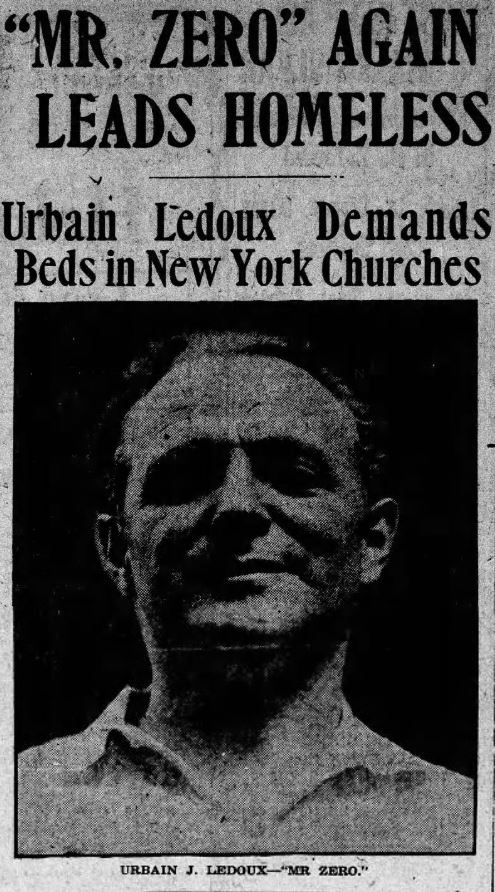
Prior to the economic crisis of the 1930s, few Franco-Americans ventured beyond the two major parties. Among the most notable exceptions was Amédée B. Lafrenière of Plainfield, Connecticut, a socialist labor candidate at his state’s constitutional convention in 1901 and a congressional candidate under the same banner a few years later. Urbain Ledoux, once the youngest agent in the U.S. consular service, abandoned his diplomatic career to devote himself to helping the less fortunate. In the First World War era, Ledoux organized soup kitchens and earned the nickname “Mr. Zero” because he was self-effacing in his efforts to support and give himself fully to the poor. Ironically, he became famous during the recession of the early 1920s. In Boston, he sought to organize a human auction. To force politicians to act to alleviate poverty and help the “slaves of unemployment,” he held an auction where the unemployed offered their services to anyone who promised fair compensation. A few weeks later, perhaps because throngs of unemployed men followed him and attracted media attention, he managed to meet with President Harding, Secretary of Commerce Herbert Hoover, and Colonel Arthur Woods, who had been appointed to coordinate national relief efforts. Ledoux wanted the profiteers of the Great War to repay the American people by contributing to this relief effort. Ultimately, his activities seem to have had little effect on the measures adopted at the federal and state levels.
During the Great Depression, the conservatism of Franco-American clerical and secular leaders in addition to working-class support for the Democratic Party in industrial cities lessened the temptation of radical politics. The unrest and misery experienced across the Northeast cohered in two movements during Franklin Roosevelt’s first term reflected: a wave of strikes that threatened to destabilize the Democratic coalition, and then the populist campaign of Father Charles Coughlin. The creation of a third party in New Hampshire also brought hope to people who felt politically abandoned, but in all cases, these alternatives were rejected at the ballot box.
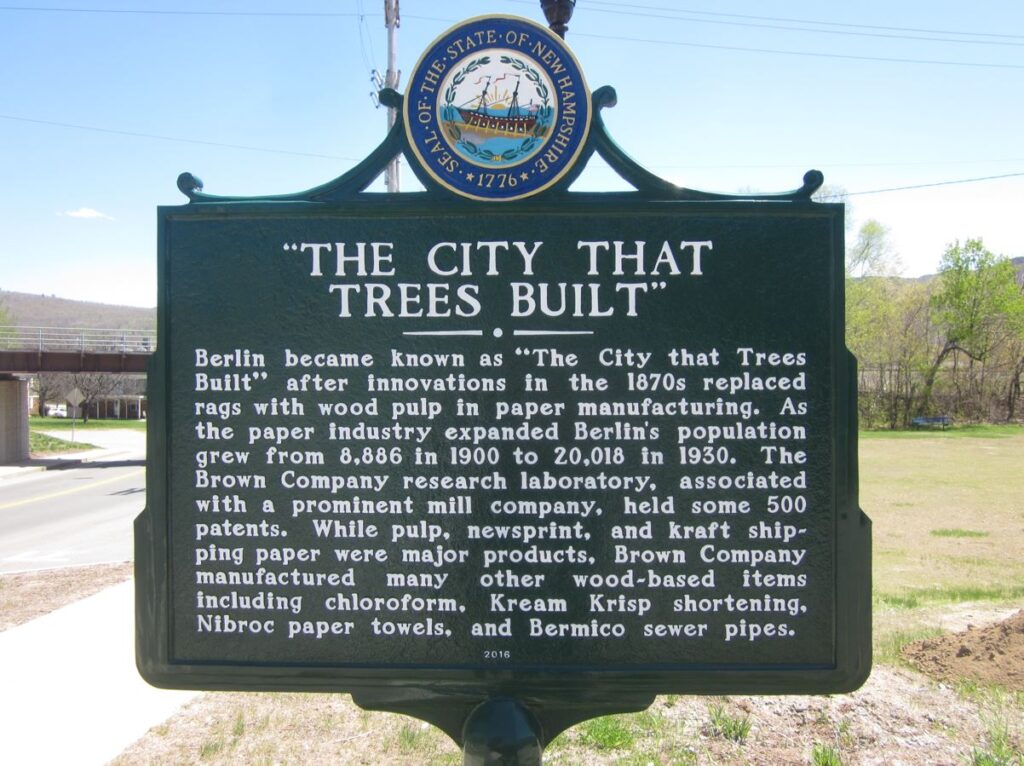
The brief political uprising in New Hampshire began in Berlin. While textile-producing cities were already facing economic challenges in the 1920s, Berlin—a logging and pulp and paper center—was booming. The French-Canadian workforce continued to grow and its numbers translated into local political influence. Merchant Élie or Eli King, formerly Roy, became mayor after the First World War. A Democrat, King would return to power later in the 1920s. Between his terms in office, Republican J.-A. Vaillancourt was elected and then re-elected by a large margin. A native of Yamachiche, Vaillancourt was an insurance agent and had been a manager of the Berlin Water Company. Unfortunately, while the Franco-American population of the area was well represented in politics, the integrity of its elected officials was not always equal to their popularity.
The Depression tested the Brown Company, which dominated the city’s economy. Layoffs multiplied, and the company could not meet all of its tax obligations. Suddenly, Berlin’s revenues were in free fall, making social assistance nearly impossible. But it was the actions of tax collector John Labrie that led to a tangible political reaction. Labrie deposited $75,000 of city funds into his own bank account for personal gain. This enormous sum was lost when, in December 1931, the Guaranty Trust Bank, whose clients included Labrie, failed. Shortly after his election in March 1932, Mayor Ovide J. Coulombe blamed the city’s financial difficulties on the unemployed who relied on public assistance. In addition to dropping all legal proceedings against Labrie, his administration reappointed him as tax collector. A group calling itself the Berlin Taxpayers Association was quickly established. It selected attorney Arthur Bergeron, a Dartmouth and Harvard graduate, to lead its efforts against the city and Labrie. In February 1934, the Superior Court ruled in favor of the citizens’ association. An agreement to recover $35,000 was signed, Labrie left office, and the State of New Hampshire began legal proceedings against him.
Until this time, the Democrats had been dominant in Berlin. The creation of the Berlin Taxpayers Association was not the only sign that the electorate would not settle into indifference. In the fall of 1933, taking advantage of the protection provided by the National Recovery Administration (established by Roosevelt), working men and women from the northern part of the state formed the Coos County Workers Club. By the end of the ensuing winter, this group had 4,000 members and a newspaper edited by Bergeron. In March, the club and its allies formally entered the political arena by creating the Labor Party, which pledged the clean and transparent management of municipal affairs, the end of patronage, and policies favorable to the less fortunate. The party’s victory in the Berlin mayoral race and the electorate’s disappointment with the National Recovery Administration, which seemed to prioritize corporate interests, encouraged its organizers to enter the Coos County races in the fall of 1934.
A convention in Laconia in 1936 launched a statewide Farmer-Labor Party. The United Textile Workers, which had 7,000 members in Manchester and even more elsewhere, were among the groups it represented. The new party issued a social-democratic platform, including a minimum wage commensurate with labor needs, a fairer tax system, and transparent government. Bergeron, who had been elected mayor of Berlin the year prior, became the party’s standard-bearer and gubernatorial candidate. He campaigned across the state, including southern industrial centers such as Dover and Newmarket.
The Farmer-Labor Party’s campaign encountered a series of obstacles in the summer and fall of 1936: some figures were revealed to be members of more radical groups; the United Textile Workers refrained from formally endorsing the party; and the economy gradually recovered thanks to the policies of the Roosevelt Administration. Moreover, the rumblings that had launched the protest movement in the north of the state did not find similarly favorable conditions farther south, where much more was needed to shake attachment to the old parties. The party garnered less than one percent of ballots cast in November. In the following years, disappointed, most of its leaders returned to other parties. Bergeron, for example, turned to the Republicans and it was under this banner that he held several county offices in the 1940s.
The National Recovery Administration’s “codes,” which established production standards that would limit competition and improve working conditions, also had the effect of sparking a protest movement. These codes protected the right to unionize, enabling the United Textile Workers to grow from 20,000 to 400,000 members within a year. Several corporations in the textile industry flouted the standards instituted by the federal government, however. Conditions were ripe for a fierce confrontation—which is what occurred in September 1934. Hundreds of thousands of workers in the Northeast and the South walked out to protest the unfair conditions to which the companies subjected them. According to Yves Roby, the Franco-American population—previously hesitant about the labor movement—was at the forefront of the strike and provided it with influential leaders.
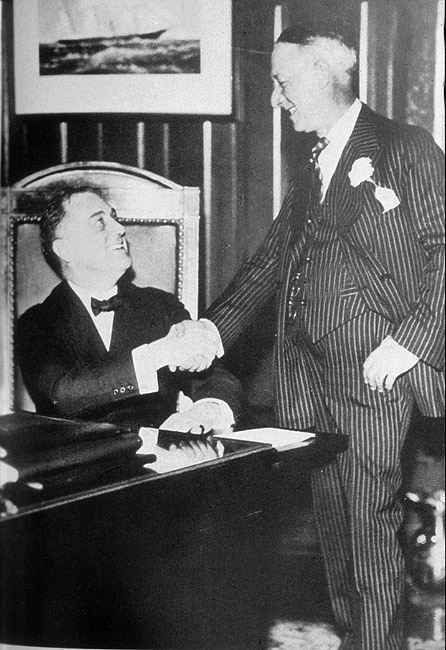
This work stoppage quickly turned violent in the Franco-American city of Woonsocket, where a confrontation between strikers and the National Guard left one person dead and several injured. In addition to Guardsmen, the employers benefitted from well-stocked warehouses and the price stabilization caused by the strike. As calm returned three weeks into the strike, both sides accepted the White House’s offer of mediation and the workers returned to the mills. Despite this disappointing outcome, Francos did not abandon their support for the Democratic Party at the federal level: they blamed the behavior of employers and state governments rather than Roosevelt’s policies. In Rhode Island, the working class was tempted by the formation of a third party, but expressed no interest in challenges to Roosevelt at the federal level.
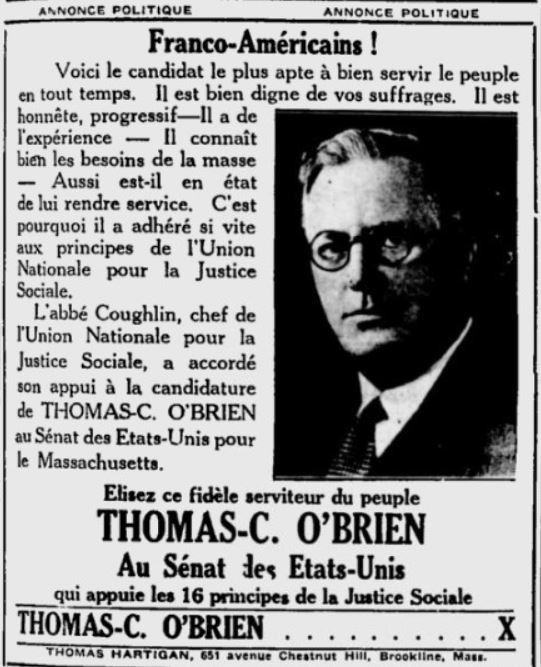
The Democrats finally averted one last political danger that had arisen in the years leading up to the 1936 election. Two figures initially sympathetic to Roosevelt and his platform turned against him and threatened to cost him reelection: Louisiana demagogue Huey Long and Royal Oak, Michigan, Catholic priest Charles Coughlin. Long’s assassination in 1935 prematurely ended the populist movement he had sought to build on a national scale. Coughlin, for his part, used his popular radio program to disseminate his political views. Like the president, he attacked corporate leaders and the financial interests that seemed to profit from the misery of the working class. His popularity and the policies he proposed may even have contributed to the social-democratic thrust of the Roosevelt Administration. However, Coughlin waged an even more insistent fight against communism. He turned away from the New Deal and the expansion of federal powers to call for a reform of the monetary and financial systems. In the national elections of 1936, the “radio priest” gave his support to the new third party, the Union Party, whose presidential candidate was William Lemke, a North Dakota congressman. A Catholic from Massachusetts named Thomas O’Brien became Lemke’s running mate.
Though Lemke headed the ticket, the party was more closely associated with the better-known Coughlin. Would the Franco-American electorate follow the Catholic prelate and the program he advocated? The Franco press paid attention to him during Roosevelt’s first term; the new political option he offered the American people could not be ignored. What’s more, Coughlin visited Northeastern cities three months before the 1936 election, including areas with large Franco-American populations such as New Bedford. Following his speech there, the Massachusetts Federation of Labor rushed to formally endorse the president, thus recognizing both the positive effects of the New Deal and the real challenge Coughlin posed to the implementation of Roosevelt’s program. In early September, the violent nature of some of the priest’s speeches earned him condemnation from the Osservatore Romano, the Vatican’s semi-official organ, which did little to enhance his image in the Catholic community.
On the eve of the election, Fall River’s L’Indépendant reported that the electorate’s interest in Coughlin had cooled in recent months. The ill-timed—sometimes incoherent—statements and partisan activities of a prelate who should be concerned with higher matters had repelled voters:
[He] has descended from the heights of objective discussion into the arena of subjective discussion; his principled movement has become a political protest; his social doctrine has become a springboard for the realization of a small group’s ambitions and an instrument of demolition and division, and millions of followers have drifted away . . . [T]he influence exerted by this priest is only a shadow of what it was.
Ultimately, Lemke won over 100,000 votes in Massachusetts, but his vote total in the four other Northeastern states where his name appeared on the ballot barely exceeded 50,000. Roosevelt won an overwhelming majority of the popular vote and triumphed in the Electoral College. The president’s personal popularity at the national level was also felt in Franco-American circles; in the Little Canadas, he enjoyed the support of the labor movement and such spokesmen as Harold Dubord and Henri Goguen. Finally, a visit to Quebec, where Roosevelt spoke in French, had perhaps a greater effect on the political opinions of Francos than Coughlin’s tour of the Northeastern centers, which occurred around the same time.
The president was less popular with the Franco-American elite than with the working class; a deeply conservative current continued to inform the thinking of a middle class that provided cultural leadership. Some French-language newspapers denounced the 1934 strike using arguments that had circulated for fifty years: they advocated for the right to work, and they feared violence, unrest, and the rise of radicalism. While Catholics and workers of different ethnic backgrounds were forging ties with one another, Franco-America’s socioeconomic classes were taking diverging paths.
Sources
“Tout nous serait possible” includes extensive bibliographical notes. Beyond the primary sources cited in the book, researchers may want to read James F. Findlay, “The Great Textile Strike of 1934: Illuminating Rhode Island History in the Thirties,” Rhode Island History (1983); Yves Roby, The Franco-Americans of New England: Dreams and Realities (2004); Linda Upham-Bornstein, “Citizens with a ‘Just Cause’: The New Hampshire Farmer-Labor Party in Depression-Era Berlin,” Historical New Hampshire (2008); Mark Richard, “‘Sunk into Poverty and Despair’: Franco-American Clergy Letters to FDR during the Great Depression,” Quebec Studies (2016); and Michael Guignard, “‘Mr. Zero’ of Maine: The Story of Urbain Ledoux,” Le Forum (2017).
Other English-language excerpts are available at the links below:
A brilliant understatement: the integrity of its elected officials was not always equal to their popularity.
This could be a movie.
I’d love to know more about Mr. Ledoux…he sounds like an amazing human being.