In May, the Acadian Archives in Fort Kent hosted ten visitors from Maine, New Hampshire, Massachusetts, and New York for a two-day cultural tour of the St. John Valley. Most of these visitors were in the Valley for the first time; they discovered the region’s physical and cultural landscape through its historic sites. The group’s average age was 35, an exceptional fact in the world of Franco-American events. Video footage of the tour will appear in French-Canadian Voyages, a YouTube series set to launch this year.
Since then, the Portland Sea Dogs have hosted an inaugural Franco-American Heritage Night, which drew folks from the St. John Valley, Lewiston–Auburn, the Portland area, and New Hampshire. In attendance were teachers, representatives of the Acadian Archives and the Alliance française, the founder of PoutineFest, members of the Franco-American Hall of Fame, an Acadian fiddler, a gubernatorial candidate—the list goes on. The pre-game ceremonies put le fait français du Maine front and center.
Also, this past month, Leominster, Massachusetts, played host to a well-attended French-Canadian festival with French and French-inspired music, Acadian poutine, and representation from cultural organizations. This is in addition to the turnout at the Samuel de Champlain History Center for Museum Day; Lowell’s Franco-American Week; a flag-raising ceremony in Boston; the annual French Heritage Day in Winooski, Vermont; and the reenactment of the Acadian Landing in Madawaska, Maine.
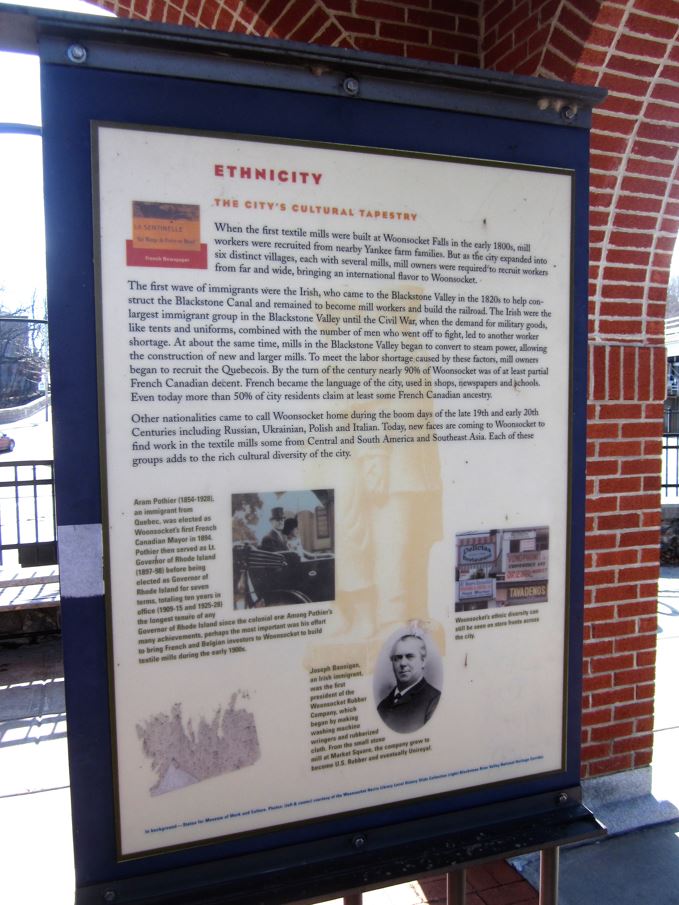
March and June are busy times of the year in New England’s Franco-American world, but there is much more to it, from the Rassemblement in Orono in April, a number of PoutineFests to choose from in the fall, the Vermont French-Canadian Genealogical Society’s annual conference, lecture series offered by the Museum of Work and Culture and the Acadian Archives, the year-round events of the USM Franco-American Collection, and a number of French-language conversation groups. Oh, and let’s not forget the podcasts, blogs, Facebook groups, publications, the daily work of historical and genealogical societies, and rich experiences offered by teachers in and out of the classroom that continually nourish the cultural conversation.
It’s a lot—and it’s not, as far as public expressions are concerned, how we would picture a declining or languishing culture. We may not need to envy the cultural landscape that existed three or four decades ago.
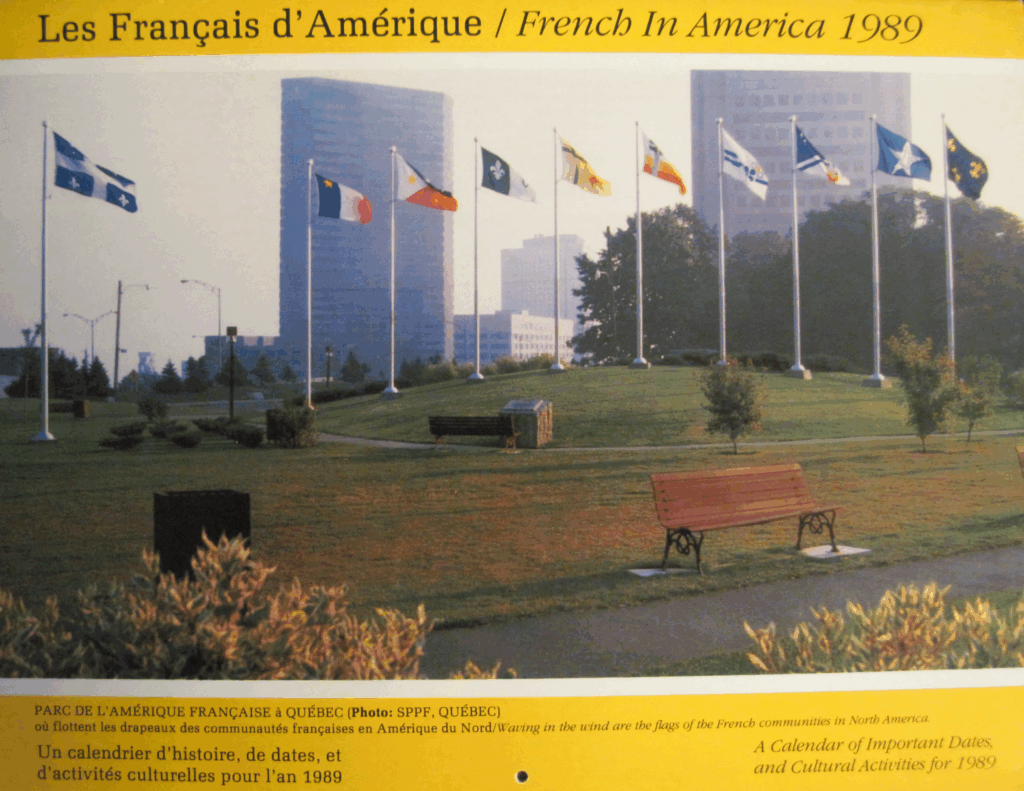
For many years, from 1985 until at least 2000, Virgil Benoit and Marie-Reine Mikesell planned and published annual calendars of Franco-American events titled Les Français d’Amérique. These came to fruition with the support of the Alliance franco-américaine du Midwest, CODOFIL, and the Société historique franco-américaine, which together helped ensure broad geographical coverage. With only a small sample of calendars readily at hand, we find:
- The annual conferences of the Institut français in Worcester, Massachusetts;
- An international conference of the French Colonial Historical Society in Providence, Rhode Island;
- Lowell’s Franco-American Week;
- An international conference on Jack Kerouac held in Lowell;
- The Madawaska Acadian Festival;
- La Kermesse in Biddeford, Maine;
- The Franco-American Jubilee held for some years in Woonsocket, Rhode Island;
- A variety of events held outside of New England, from California to Missouri and from Minnesota to Louisiana.
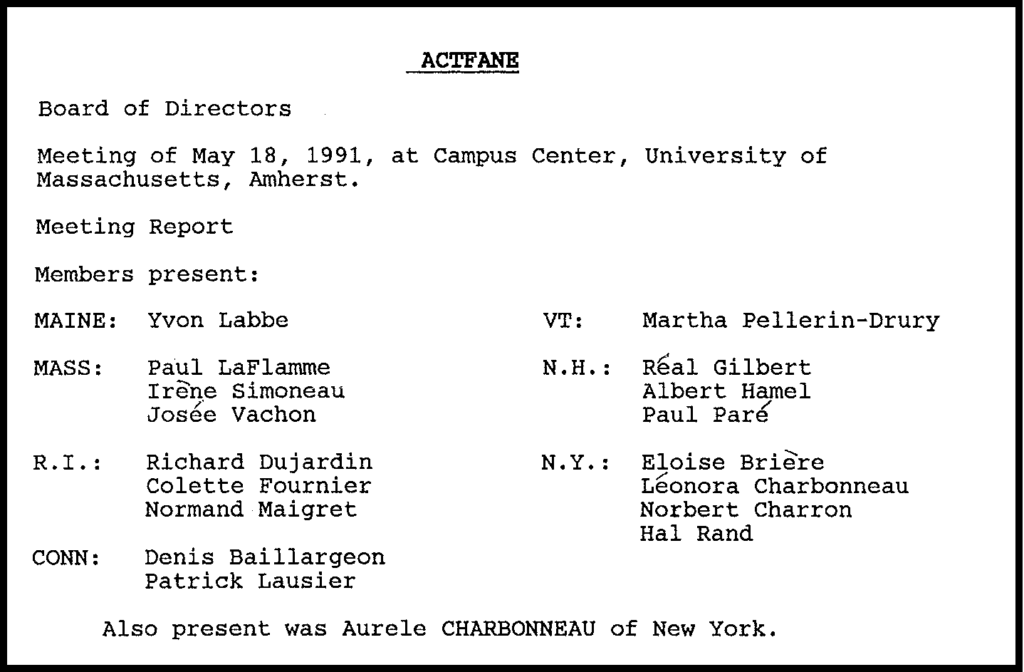
An inventory of cultural organizations published as Le répertoire de la vie française en Amérique in 1991 also gives the lay of the land. New England-based groups included the Association culturelle et historique du Mont-Carmel, the Association francophone de Fall River, the Comité de la Salle Louis-A.-Biron, the Comité de vie franco-américaine, the Fédération américaine francophone des aînés, the Fédération féminine franco-américaine, the Société historique franco-américaine, the Union Saint-Jean-Baptiste (USJB), multiple circles of the Alliance française, the Association canado-américaine (ACA), the Franco-American Centre in Orono, and the Institut français in addition to the many local genealogical and historical societies with a French-Canadian or Acadian focus.
Since then, the “Fédé” has voted itself out of existence, Catholic Family Life Insurance has absorbed the USJB, and the Franco-American Centre in Manchester has taken up the ACA’s cultural mandate. Other organizations have endured, many of them not captured by the répertoire; the Acadian Archives had been founded in 1990, for instance. New ones have emerged: the Vermont French-Canadian Genealogical Society began to organize in 1996; the Museum of Work and Culture opened in 1997; incorporation of the Maine Acadian Heritage Council took place the same year. In short, the cultural landscape may have changed, in the last generation, but perhaps not dramatically so.
We should acknowledge the significant distinction between tangible, public expressions of culture and the daily, lived experience of that culture. There is a gap between attending a few events over the course of a year and living in a rich, bubbling culture that carries forth the language of the ancestors. But: the latter requires the former. A culture requires spaces for community, opportunities to nourish and feel nourished, a network that creates solidarity, and visibility that enables people to feel welcome and feel encouraged to identify with this culture. All of this exists in some areas and in some measure in New England.
In the 1960s, some leading Franco-Americans were quoted as saying, essentially, c’est fini, the culture is dead.[1] There has been enough in the last forty or fifty years to shut down the defeatists of that time—and perhaps enough to shut down the defeatists of today. We can easily imagine folks reminiscing, fifteen years from now, about that cool podcast, that cool event in Burlington, that cool concert in Bath, those book talks, the kind folks we wouldn’t have known without this or that cultural gathering, and so forth. There is a richness to the present culture, though one that requires significant time, money, and energy to maintain—and therefore one not to be taken for granted.
To simplify cartoonishly, in any minority group, there are different levels of engagement with the culture. There are creators and organizers, who open spaces, inspire, connect, and nourish a conversation. There are consumers, who take interest in their roots, attend events, become members of various organizations, and often through their money make activities possible. There are, finally, individuals who are indifferent to or ignorant of a culture where they might find a home.
The Franco-American world has its fair share of all three groups—and this conceptualization may help us approach the ecosystem and keep breathing life into it. We need to thank creators and organizers, encourage them in tangible ways, and work with them to inspire the upcoming generation. We need to realize that an active culture requires resources. Those resources should serve to create spaces that speak to people’s present-day concerns, such that they might find a home and either stay connected or reconnect. Such spaces will in turn enable folks in the third group to encounter Franco-American life and see value in broadening their cultural horizons, no matter whether they themselves are Francos. Already we have seen this approach work—and typically it has worked because organizers have focused on successes rather than on trying to fix the things that keep failing.
Judging by the successes of the last ten years, harsh as this may seem, minority cultures that are at times embattled don’t need naysayers (it can’t be done), unconverted nostalgics (it was better then), inquisitors (they don’t even speak French), grumblers (I didn’t grow up with poutine), or gatekeepers (they are wrong). Minority cultures need a thoughtful approach that broadens the first two of the three groups and shrinks the last. They also need hope. There is a lot in the present to inspire hope. Let’s turn that hope into action and silence the defeatists of 2040.
[1] The world they had known was changing quickly and the culture was evolving. The demise of a heavy, official, static survivance opened space for new expressions.
Leave a Reply